

Introduction
Risk management is one of the most important aspects of successful forex trading. Even the most accurate trading strategy can fail if traders do not manage risk properly. One of the most effective tools for controlling risk is the Average True Range (ATR). An ATR forex strategy helps traders measure market volatility and make better decisions regarding stop loss placement, position sizing, and trade management.
Unlike indicators that focus on price direction, ATR measures how much a currency pair typically moves during a specific period. This makes it an excellent tool for adapting trading decisions to changing market conditions. During periods of high volatility, ATR values rise, while during calm market conditions, ATR values fall. By understanding these changes, traders can avoid placing stops too close to market noise and can size their positions more accurately.
In today’s forex market, where economic data releases, central bank decisions, and geopolitical events can create sudden price swings, using ATR as part of a comprehensive risk management framework is more valuable than ever. This guide explains how an ATR forex strategy works and how traders can use volatility indicators, stop loss placement techniques, position sizing methods, and technical analysis to improve trading performance and protect capital.
Understanding ATR Forex Strategy
The Average True Range was developed by J. Welles Wilder Jr. and remains one of the most widely used volatility indicators in financial markets.ATR calculates the average range between high and low prices over a specified number of periods, commonly 14 periods. It takes into account:
- Current high minus current low
- Current high minus previous close
- Current low minus previous close
The largest of these values becomes the True Range, and ATR is the average of these ranges over time.
Why ATR Matters in Forex Trading
Currency markets experience constant fluctuations. Some days EUR/USD may move only 40 pips, while on other days it may move more than 150 pips.
Without considering volatility, traders often:
- Set stop losses too tight
- Risk too much capital
- Exit profitable trades prematurely
- Experience unnecessary losses
An ATR forex strategy solves these problems by adjusting risk parameters according to actual market conditions.
A trader placing a stop loss only 20 pips away may be stopped out by normal market fluctuations rather than an actual change in trend.ATR helps create realistic expectations about price movement and market behavior.
Volatility Indicators in ATR Forex Strategy
Volatility is one of the most important factors in forex trading because it determines how much a currency pair is likely to move within a given period. In an ATR forex strategy, volatility indicators play a crucial role by helping traders measure market activity and adjust their risk management approach accordingly. Rather than predicting market direction, these indicators focus on the intensity of price movements, allowing traders to make more informed decisions regarding trade entries, stop-loss levels, and profit targets.
Among all volatility indicators, the Average True Range (ATR) is considered one of the most effective because it directly measures the average price movement of a currency pair over a selected timeframe. When ATR values increase, it signals that market volatility is rising and larger price swings are occurring. Conversely, when ATR values decrease, the market is experiencing lower volatility and more stable price action. This information helps traders avoid using fixed stop-loss distances that may not match current market conditions.
The greatest advantage of using volatility indicators within an ATR forex strategy is adaptability. Forex markets constantly change due to shifts in economic conditions, interest rate expectations, and investor sentiment. By monitoring volatility through ATR, traders can align their trading decisions with current market behavior rather than relying on fixed rules. This dynamic approach helps improve consistency, reduce unnecessary losses, and create a more disciplined framework for managing risk in both trending and ranging markets.
Stop Loss Placement in ATR Forex Strategy
Stop loss placement is one of the most critical elements of successful forex risk management. A well-placed stop loss protects trading capital from excessive losses while giving a trade enough room to develop naturally. In an ATR forex strategy, stop loss placement is based on market volatility rather than arbitrary pip distances, making it a more effective and adaptive risk management technique.
ATR stop loss placement is especially useful during periods of high market volatility. Events such as central bank announcements, inflation reports, employment data releases, and geopolitical developments can cause sharp price swings. During these periods, ATR values typically increase, signaling traders to widen their stop losses. Conversely, when market conditions are calm and ATR values decline, traders can tighten their stops to improve risk-to-reward ratios.
One of the biggest benefits of ATR-based stop loss placement is consistency. Instead of relying on emotions or guesswork, traders use objective market data to determine risk levels. This not only improves trade management but also helps maintain discipline over the long term. By adapting stop losses to changing market conditions, an ATR forex strategy allows traders to protect capital more effectively while maximizing the potential for profitable trades.
Position Sizing in ATR Forex Strategy
Position sizing is a fundamental component of forex risk management because it determines how much capital is exposed on each trade. Even the most accurate trading setup can result in significant losses if the position size is too large. In an ATR forex strategy, position sizing is closely linked to market volatility, allowing traders to maintain consistent risk regardless of changing market conditions. The Average True Range (ATR) helps traders measure the typical price movement of a currency pair. Since volatility can vary significantly from one trading session to another, using a fixed lot size may expose traders to unnecessary risk during highly volatile periods. ATR-based position sizing solves this issue by adjusting trade size according to the current level of market volatility.
The basic principle is simple: when ATR values are high, indicating greater market volatility, traders reduce their position size to limit risk. When ATR values are low, indicating calmer market conditions, traders can increase their position size while maintaining the same percentage risk on their trading account. This ensures that no single trade has a disproportionate impact on overall account performance.
ATR-based position sizing offers several important advantages. First, it promotes capital preservation by preventing excessive exposure during volatile market periods. Second, it helps traders avoid emotional decision-making because position sizes are determined by objective market data rather than personal judgment. Third, it improves long-term consistency by ensuring that every trade follows the same risk management principles.
Ultimately, successful forex trading is not only about finding profitable opportunities but also about controlling risk. An ATR forex strategy provides a practical framework for position sizing by adapting trade exposure to current volatility levels. By using ATR to calculate position sizes, traders can protect their capital, manage risk more effectively, and build a more disciplined and sustainable trading methodology.
Technical Analysis in ATR Forex Strategy
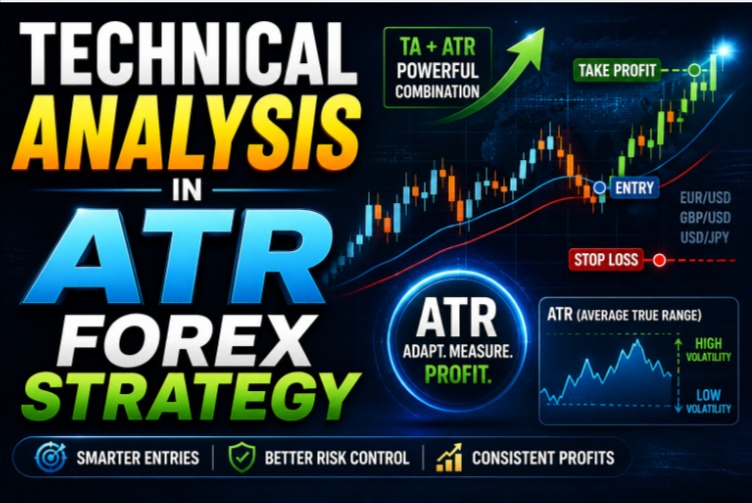
Technical analysis plays a crucial role in the success of an ATR forex strategy because it helps traders identify market direction, potential entry points, and profit targets. While the Average True Range (ATR) is a powerful volatility indicator, it does not indicate whether a currency pair is likely to move upward or downward. Therefore, combining ATR with technical analysis allows traders to create a more complete trading and risk management framework.
Support and resistance levels are another important aspect of technical analysis that complement an ATR forex strategy. Support represents a price area where buying interest tends to emerge, while resistance is a zone where selling pressure often increases. Traders can use ATR to enhance these levels by ensuring stop losses are placed beyond normal market volatility. This reduces the likelihood of being stopped out by temporary price movements around key support or resistance zones.
Ultimately, technical analysis provides the directional framework for trading decisions, while ATR supplies the volatility-based risk management component. Together, they create a comprehensive approach that helps traders identify high-quality opportunities, manage risk effectively, and adapt to changing market conditions. By integrating technical analysis with an ATR forex strategy, traders can make more informed decisions and improve their chances of achieving consistent long-term success in the forex market.
Conclusion
An ATR forex strategy is one of the most effective approaches for managing risk in today’s dynamic currency markets. Rather than relying on fixed stop losses or arbitrary position sizes, ATR allows traders to adapt to changing market volatility in a systematic and objective way.
When combined with technical analysis tools such as support and resistance levels, moving averages, breakout strategies, and price action patterns, ATR becomes even more powerful. It helps traders align risk management with actual market behavior rather than guesswork. Whether trading major currency pairs during quiet sessions or navigating high-impact economic events, ATR provides a reliable framework for preserving capital and improving long-term consistency.Ultimately, successful forex trading is not just about finding profitable entries. It is about managing risk effectively. Traders who incorporate ATR into their daily trading plans can better handle volatility, protect their accounts, and build a disciplined approach that supports sustainable growth over time.