Introduction
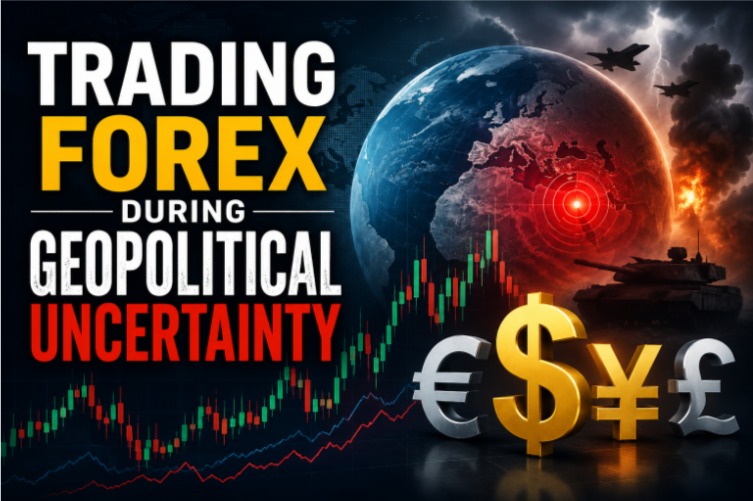
The foreign exchange market is highly sensitive to global political developments. Wars, international conflicts, trade disputes, sanctions, elections, diplomatic tensions, and unexpected political events can significantly influence currency values. Traders who understand how geopolitical events affect currencies can identify opportunities while protecting themselves from excessive risk. This concept is known as geopolitical uncertainty forex trading, where market participants analyze political developments and their potential impact on economic stability and investor confidence.
In recent years, geopolitical uncertainty has become a major driver of forex markets. Conflicts in Eastern Europe, tensions in the Middle East, shifting trade relationships between major economies, and changing monetary policies have all contributed to increased market volatility. During such periods, traders must adapt their strategies, focus on risk management, and monitor global news closely. Understanding the relationship between geopolitical events and currency movements is essential for making informed trading decisions in today’s interconnected financial markets.
Understanding Geopolitical Uncertainty in Forex Markets
Geopolitical uncertainty refers to situations where political events create unpredictability in financial markets. These events may include military conflicts, political instability, economic sanctions, elections, trade wars, or diplomatic disputes. Such developments can alter investor expectations regarding economic growth, inflation, interest rates, and international trade.Forex markets react quickly because currencies represent the economic strength and stability of nations. When uncertainty rises, investors often move funds away from risky assets and into safer investments. This shift creates significant currency fluctuations, offering both opportunities and challenges for forex traders.
Modern forex traders must recognize that geopolitical events are no longer regional issues. Due to globalization, events occurring in one part of the world can impact currencies across multiple continents. Therefore, staying informed about international developments has become a critical component of successful forex trading.
Market Volatility During Geopolitical Uncertainty Forex Trading
How Market Volatility Impacts Currency Prices
Market volatility is one of the most noticeable effects of geopolitical uncertainty. When unexpected political events occur, traders rapidly adjust their positions, causing sharp movements in currency pairs. Increased volatility often leads to larger price swings, wider spreads, and unpredictable market behavior.
For example, when military conflicts escalate or major sanctions are announced, investors may reassess economic growth forecasts. This reassessment creates sudden buying and selling pressure across various currencies. Volatility can increase dramatically within minutes, particularly when news headlines emerge unexpectedly.
High volatility presents opportunities for traders seeking short-term profits. Large price movements can create favorable trading setups and increased profit potential. However, volatility also increases risk because stop-loss orders may be triggered more frequently, and price gaps can occur during major news events.
Volatility Trading Techniques
Experienced traders often adjust their strategies during volatile periods. They may reduce position sizes, widen stop-loss levels, or focus on shorter-term trading opportunities. Technical indicators such as Average True Range (ATR) can help measure current market volatility and assist in determining appropriate risk parameters. Another effective approach involves waiting for confirmation before entering trades. Rather than reacting immediately to breaking news, traders can allow markets to establish a clear direction before committing capital. This helps reduce the likelihood of being caught in sudden reversals.
Recent geopolitical developments have demonstrated how quickly forex markets can react to uncertainty. Energy supply concerns, regional conflicts, trade negotiations, and election-related developments have all contributed to heightened volatility across major currency pairs. Traders who successfully navigate these conditions typically combine technical analysis with a thorough understanding of current geopolitical events.
Safe Haven Currencies and Their Role in Geopolitical
Uncertainty Forex Trading

During periods of geopolitical uncertainty, investors often seek assets that are perceived as stable and reliable. These are known as safe haven currencies. Safe haven currencies tend to attract capital during times of crisis because investors believe they will retain value better than riskier alternatives.
The most recognized safe haven currencies include:
- US Dollar (USD)
- Japanese Yen (JPY)
- Swiss Franc (CHF)
These currencies are generally supported by strong economies, stable political systems, deep financial markets, and high levels of investor confidence.
Although safe haven currencies can offer opportunities, they are not immune to volatility. Rapid shifts in geopolitical developments can quickly reverse market sentiment. Traders must remain flexible and avoid assuming that safe haven trends will continue indefinitely.
Why Safe Haven Currencies Gain Strength
When uncertainty rises, investors prioritize capital preservation over higher returns. As a result, funds often flow into safe haven currencies. This increased demand can cause these currencies to appreciate against more risk-sensitive currencies. The US Dollar frequently benefits because of its status as the world’s primary reserve currency. Global investors often view US Treasury markets as a secure destination during times of crisis.
The Japanese Yen tends to strengthen because Japan maintains significant foreign assets and is viewed as a financially stable nation. Similarly, the Swiss Franc benefits from Switzerland’s long-standing reputation for political neutrality and financial stability.
Risk Sentiment and Its Influence on Geopolitical Uncertainty Forex Markets
Risk sentiment plays a crucial role in determining currency movements during periods of geopolitical uncertainty. In the forex market, risk sentiment refers to the overall willingness of investors to take on or avoid risk based on current economic and political conditions. When geopolitical events such as military conflicts, trade disputes, economic sanctions, or political instability occur, investor confidence can change rapidly, causing significant shifts in currency demand. Understanding how risk sentiment influences the market is essential for traders involved in geopolitical uncertainty forex trading
Risk-On and Risk-Off Currency Behavior
Certain currencies are particularly sensitive to changes in risk sentiment.
Risk-On Currencies
Currencies that often perform well during positive sentiment include:
- Australian Dollar (AUD)
- New Zealand Dollar (NZD)
- Canadian Dollar (CAD)
These currencies are closely linked to global economic growth and commodity demand.
Risk-Off Currencies
Currencies that typically benefit during periods of uncertainty include:
- US Dollar (USD)
- Japanese Yen (JPY)
- Swiss Franc (CHF)
As investors seek safety, demand for these currencies generally increases.
One of the most important skills in forex trading is recognizing shifts in sentiment. Markets can move rapidly from risk-on to risk-off conditions following geopolitical developments. Traders who identify these transitions early often gain a significant advantage in positioning their trades.
Monitoring Market Sentiment
Successful geopolitical uncertainty forex traders regularly monitor indicators that reflect investor sentiment. These may include: Equity market performance
- Government bond yields
- Commodity prices
- Volatility indexes
- Central bank communications
Combining these indicators with geopolitical analysis can help traders anticipate potential currency movements before they become fully priced into the market.
Sentiment Shifts Create Opportunities
One of the most important skills in forex trading is recognizing shifts in sentiment. Markets can move rapidly from risk-on to risk-off conditions following geopolitical developments. Traders who identify these transitions early often gain a significant advantage in positioning their trades.
Forex Strategy for Trading During Geopolitical Uncertainty
Developing an effective forex strategy during periods of geopolitical uncertainty requires traders to combine market awareness, risk management, and disciplined execution. Political events such as wars, trade disputes, sanctions, elections, and diplomatic tensions can trigger sudden currency fluctuations, making traditional trading approaches less reliable. A successful geopolitical uncertainty forex strategy focuses on protecting capital while taking advantage of opportunities created by increased market volatility.
Focus on News and Fundamental Analysis
The foundation of any geopolitical forex strategy is staying informed about global developments. Unlike normal market conditions where economic data may be the primary driver of currency movements, geopolitical events can quickly become the dominant market influence. Traders should closely monitor government announcements, international negotiations, military developments, trade policies, and central bank responses.
Understanding the potential economic consequences of these events helps traders anticipate currency movements before they occur. For example, escalating tensions between major economies may weaken trade-dependent currencies while strengthening safe-haven currencies. By combining real-time news monitoring with economic analysis, traders can make more informed decisions during uncertain market conditions.
Conclusion
Trading during periods of geopolitical uncertainty forex conditions requires a deeper understanding of how political events influence global financial markets. Whether the uncertainty stems from military conflicts, trade disputes, elections, sanctions, or diplomatic tensions, the impact on currency values can be substantial. Traders who recognize these relationships are better equipped to identify opportunities while managing risk effectively.
Market volatility often increases significantly during geopolitical events, creating both profit potential and additional challenges. At the same time, safe haven currencies such as the US Dollar, Japanese Yen, and Swiss Franc frequently attract investor demand as capital seeks security. Understanding shifts in risk sentiment allows traders to anticipate changes between risk-on and risk-off market environments, providing valuable insight into potential currency movements.
A successful forex strategy during geopolitical uncertainty combines fundamental analysis, technical analysis, disciplined risk management, and continuous monitoring of global developments. As geopolitical risks continue to shape financial markets, traders who remain informed, adaptable, and disciplined will be better positioned to navigate uncertainty and capitalize on emerging opportunities while protecting their trading capital.