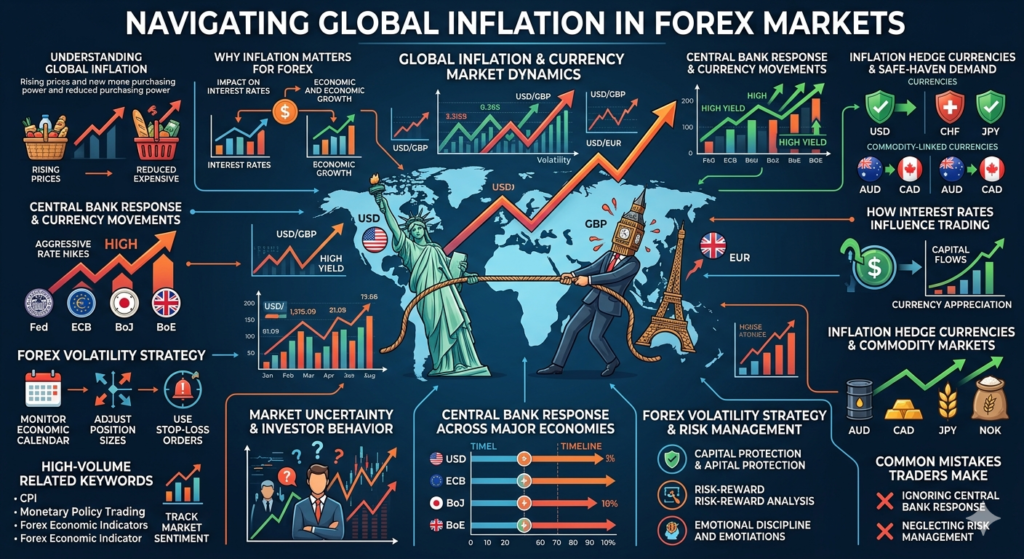

Inflation has become one of the most influential forces shaping modern financial markets. Rising consumer prices affect everything from household spending and business investment to central bank policies and global economic growth. For forex traders, periods of high inflation often create significant volatility and some of the most profitable trading opportunities in the currency market.
Understanding global inflation forex dynamics is essential for traders seeking to capitalize on inflation-driven market movements. A successful strategy requires identifying inflation hedge currencies, analyzing central bank response patterns, adapting to changing market conditions through a forex volatility strategy, and understanding how market uncertainty influences investor behavior.
This comprehensive guide explains how inflation impacts forex markets, which currencies tend to benefit during inflationary periods, and how traders can navigate the challenges and opportunities created by rising global prices.
Understanding Global Inflation and Currency Markets
Inflation occurs when the general price level of goods and services increases over time, reducing the purchasing power of money.
Periods of elevated inflation often affect interest rates, economic growth, government spending, and investor sentiment.
The relationship between inflation and exchange rates forms the foundation of successful global inflation forex trading.
When inflation rises rapidly, financial markets begin adjusting expectations regarding future monetary policy.
These changes frequently trigger significant currency movements.
Understanding the broader global inflation forex environment helps traders anticipate market trends and identify high-probability opportunities.
Because inflation affects nearly every economy, its impact on forex markets is often widespread and long-lasting.
Why Inflation Matters for Forex Traders
Inflation directly influences the value of currencies.
When inflation rises faster than expected, investors often reassess economic prospects and future interest rate expectations.
These adjustments create opportunities within global inflation forex markets.
High inflation can weaken a currency if investors lose confidence in economic stability.
However, inflation can also strengthen a currency when central banks respond aggressively with higher interest rates.
This complex relationship makes inflation one of the most important factors in market uncertainty and currency valuation.
Successful traders closely monitor inflation trends to anticipate future market developments.
Global Inflation Forex and Economic Growth
Inflation affects economic growth in multiple ways.
Moderate inflation can support economic activity by encouraging spending and investment.
However, excessive inflation often reduces consumer purchasing power and increases business costs.
These developments influence global inflation forex trends because economic performance remains a major driver of currency demand.
Traders who understand the relationship between inflation and growth can better evaluate currency opportunities.
Strong economic growth combined with controlled inflation often supports currency strength.
Conversely, inflation without growth may increase market uncertainty and weaken investor confidence.
Inflation Hedge Currencies and Safe-Haven Demand
Certain currencies are often viewed as inflation hedge currencies during periods of rising prices.
Investors frequently seek currencies associated with strong economic fundamentals, stable monetary policy, and attractive interest rates.
The U.S. Dollar, Swiss Franc, and in some cases commodity-linked currencies may function as inflation hedge currencies depending on market conditions.
Understanding which currencies attract capital during inflationary periods is essential for successful forex trading.
Many traders focus on inflation hedge currencies because they often outperform weaker alternatives when inflation concerns dominate financial markets.
Monitoring capital flows can provide valuable insight into changing investor preferences.
Central Bank Response and Currency Movements
Among all factors influencing forex markets during inflationary periods, central bank response is often the most important.
Central banks use monetary policy tools such as interest rates and balance sheet adjustments to manage inflation.
A strong central bank response can significantly influence exchange rates.
When policymakers raise interest rates to combat inflation, foreign investors may be attracted by higher returns.
This increased demand can strengthen a currency.
Conversely, a weak or delayed central bank response may reduce confidence and contribute to currency weakness.
Understanding policy expectations is a critical component of successful global inflation forex analysis.
How Interest Rates Influence Inflation Trading
Interest rates are closely linked to inflation and currency valuation.
A decisive central bank response often involves increasing rates to slow economic activity and control price growth.
Higher rates can attract international capital and support currency appreciation.
Many professional traders focus on interest rate expectations when developing forex volatility strategy frameworks.
Markets frequently react not only to current rates but also to future policy guidance.
Understanding these dynamics helps traders anticipate market reactions and improve decision-making.
Interest rate trends remain one of the most powerful drivers of long-term currency movements.
Forex Volatility Strategy During Inflation Surges
Periods of rising inflation often create significant market fluctuations.
A successful forex volatility strategy helps traders manage risk while taking advantage of increased price movement.
Inflation reports, central bank meetings, and economic forecasts frequently trigger sharp currency moves.
Effective forex volatility strategy planning includes:
Monitoring economic calendars.
Adjusting position sizes.
Using stop-loss orders.
Following interest rate expectations.
Tracking market sentiment.
These practices help traders navigate inflation-driven volatility more effectively.
Flexibility and discipline remain essential components of a successful forex volatility strategy.
Market Uncertainty and Investor Behavior
Inflation often increases market uncertainty because it creates uncertainty regarding economic growth, monetary policy, and financial stability.
Investors may struggle to predict how policymakers will respond to changing conditions.
This uncertainty frequently contributes to larger market swings and increased trading activity.
Understanding market uncertainty is essential because investor sentiment often influences currency prices as much as economic data.
Periods of heightened uncertainty can create opportunities for prepared traders.
Monitoring sentiment indicators alongside economic reports improves market awareness and trade selection.
Inflation Hedge Currencies and Commodity Markets
Commodity-exporting countries often benefit during inflationary periods because rising resource prices contribute to stronger export revenues.
As a result, some commodity-linked currencies may act as inflation hedge currencies.
Currencies such as the Australian Dollar, Canadian Dollar, and Norwegian Krone often attract attention when commodity prices rise.
Understanding the relationship between inflation and commodities improves global inflation forex analysis.
Many traders monitor commodity markets to identify potential opportunities in inflation-sensitive currencies.
These relationships can provide valuable insight into broader market trends.
Central Bank Response Across Major Economies
Different central banks often react differently to inflation.
Some prioritize aggressive rate hikes, while others adopt a more cautious approach.
Comparing central bank response patterns across countries helps traders identify relative currency strength.
For example, if one central bank raises rates aggressively while another remains accommodative, the corresponding currency pair may experience significant movement.
Successful global inflation forex traders closely monitor policy differences between major economies.
Understanding relative policy expectations improves trade selection and forecasting accuracy.
Forex Volatility Strategy and Risk Management
Risk management becomes especially important during inflationary periods.
Even the best forex volatility strategy can fail if traders ignore position sizing and capital preservation.
Inflation-driven market conditions often create unexpected price movements.
Professional traders prioritize:
Capital protection.
Risk-reward analysis.
Position management.
Market monitoring.
Emotional discipline.
These principles improve consistency and reduce the likelihood of large losses.
Strong risk management supports long-term success regardless of market conditions.
High-Volume Related Keywords for Inflation Forex Trading
In addition to the primary keywords, traders frequently search for:
Inflation trading strategy.
Interest rate forex trading.
CPI forex analysis.
Currency inflation impact.
Forex economic indicators.
Monetary policy trading.
Safe haven currencies.
Inflation and interest rates.
Forex market trends.
Global economic outlook.
These related keywords complement global inflation forex, inflation hedge currencies, central bank response, forex volatility strategy, and market uncertainty while helping traders develop a broader understanding of inflation-driven currency movements.
Common Mistakes Traders Make During Inflation Surges
Many traders focus exclusively on inflation data while ignoring the broader central bank response.
Others underestimate the role of market uncertainty in driving currency movements.
Some traders neglect risk management despite increased volatility.
Failing to identify effective inflation hedge currencies can also limit trading opportunities.
Successful traders combine economic analysis, policy expectations, and disciplined execution.
A comprehensive approach often produces more consistent results.
Conclusion
Global inflation remains one of the most powerful forces affecting forex markets. Understanding global inflation forex dynamics, identifying inflation hedge currencies, analyzing central bank response patterns, implementing an effective forex volatility strategy, and adapting to periods of market uncertainty can help traders navigate challenging market environments.
As inflation continues to influence economies worldwide, traders who understand these relationships will be better positioned to identify opportunities, manage risk, and capitalize on evolving market conditions.
Frequently Asked Questions
What is global inflation forex trading?
Global inflation forex trading involves analyzing how inflation trends influence currency values and forex market behavior.
What are inflation hedge currencies?
Inflation hedge currencies are currencies that may attract investor demand during periods of rising inflation due to economic strength or favorable monetary policies.
Why is central bank response important for forex traders?
A central bank response often determines interest rate direction, which significantly influences currency values and investor sentiment.
What is a forex volatility strategy?
A forex volatility strategy is a trading approach designed to manage risk and capitalize on increased price movement during volatile market conditions.
How does market uncertainty affect currencies?
Market uncertainty influences investor behavior, capital flows, and risk sentiment, often creating significant currency volatility.
Which economic reports are most important during inflation surges?
Inflation reports, interest rate decisions, employment data, and central bank statements are among the most important indicators for global inflation forex traders.
How can traders manage risk during inflation-driven volatility?
Traders can improve results by implementing a disciplined forex volatility strategy, monitoring central bank response developments, controlling position size, and maintaining strong risk management practices.