 The U.S. dollar is the world’s most traded currency and serves as the backbone of the global financial system. Because of its dominant role in international trade, central bank reserves, and global investment flows, periods of high dollar volatility can create significant opportunities and risks for forex traders. Understanding how to navigate these conditions is essential for long-term success in currency markets.
A successful approach to USD volatility forex trading requires understanding market drivers, conducting effective dollar index analysis, implementing strong forex risk management, identifying opportunities in volatile currency pairs, and adapting to changing conditions through disciplined macro trading strategies.
This comprehensive guide explores the causes of USD volatility, its impact on forex markets, and the best trading approaches for navigating rapidly changing market environments.
Understanding USD Volatility in Forex Markets
The U.S. dollar influences nearly every major currency pair and plays a central role in global finance.
Periods of heightened USD volatility forex activity often occur when economic conditions change rapidly, central banks adjust policy, or geopolitical events create uncertainty.
Because the dollar is involved in most global transactions, shifts in its value can have widespread consequences across financial markets.
Successful USD volatility forex trading begins with understanding the factors that drive dollar movements.
Interest rates, inflation, employment data, economic growth, and investor sentiment all contribute to changes in dollar demand.
Recognizing these influences helps traders anticipate market opportunities and manage risk more effectively.
Why USD Volatility Matters
The dollar’s global importance means that even small changes in value can influence numerous asset classes.
Periods of increased USD volatility forex activity often affect stocks, commodities, bonds, and emerging market currencies.
For forex traders, higher volatility can create larger price movements and more trading opportunities.
However, greater volatility also increases risk.
This is why effective forex risk management becomes particularly important when trading during periods of significant dollar movement.
Understanding how volatility influences different currency pairs is essential for long-term trading success.
Dollar Index Analysis and Market Direction
One of the most important tools for understanding dollar strength is dollar index analysis.
The U.S. Dollar Index (DXY) measures the value of the dollar against a basket of major currencies.
Effective dollar index analysis helps traders evaluate overall dollar sentiment rather than focusing solely on individual currency pairs.
Many professional traders use dollar index analysis to identify broader market trends and confirm trade ideas.
When the Dollar Index rises, it often indicates broad-based dollar strength.
When the index declines, it may suggest weakening demand for the U.S. currency.
Incorporating dollar index analysis into trading decisions can improve market awareness and forecasting accuracy.
Key Drivers of USD Volatility Forex Markets
Several factors contribute to periods of elevated USD volatility forex activity.
Federal Reserve decisions remain among the most important influences.
Interest rate changes often affect global capital flows and investor sentiment.
Economic indicators such as employment reports, inflation data, GDP growth, and consumer spending can also create significant market reactions.
Geopolitical developments frequently increase USD volatility forex conditions as investors reassess risk.
Understanding these drivers helps traders prepare for market-moving events.
Successful traders monitor economic calendars closely and adjust strategies accordingly.
Volatile Currency Pairs During Dollar Movements
Certain currency pairs are particularly sensitive to changes in dollar strength.
These volatile currency pairs often provide the greatest opportunities during periods of heightened market activity.
Examples include:
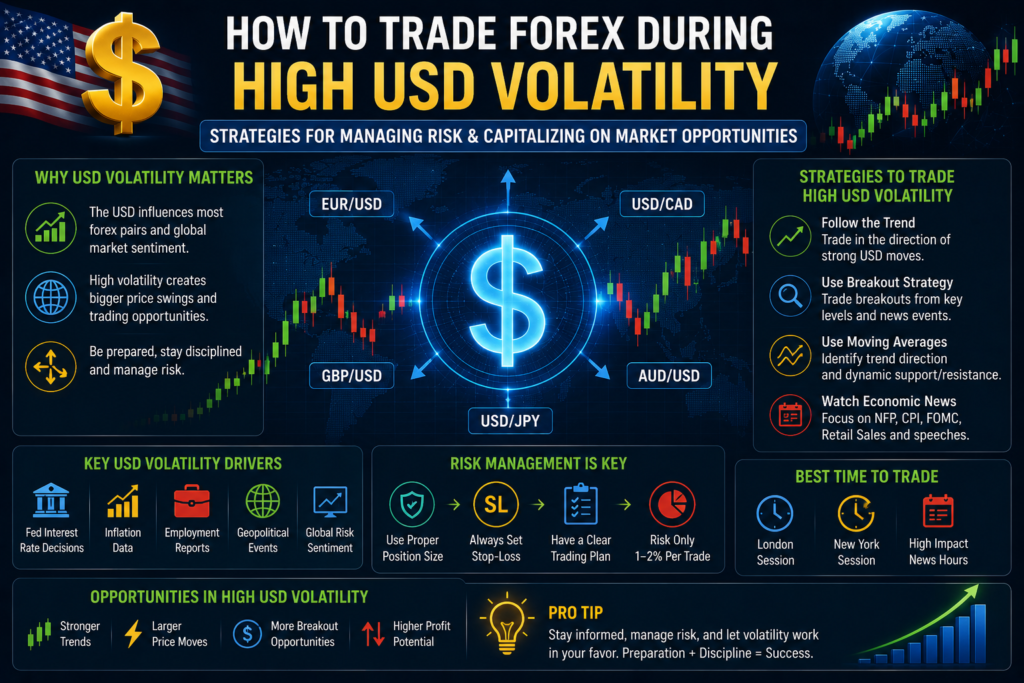
EUR/USD
GBP/USD
USD/JPY
AUD/USD
USD/CAD
These volatile currency pairs frequently experience large price swings when significant economic news is released.
Traders who understand the behavior of volatile currency pairs can better identify opportunities while managing risk.
Monitoring volatility levels helps determine which markets are most suitable for current conditions.
Macro Trading and USD Volatility
One of the most effective approaches during periods of significant dollar movement is macro trading.
Macro trading focuses on broad economic trends, central bank policy, inflation dynamics, and geopolitical developments.
Rather than concentrating solely on technical indicators, macro trading emphasizes understanding the larger forces driving market behavior.
Periods of elevated USD volatility forex often create ideal conditions for macro trading strategies.
Traders who understand economic relationships can identify trends before they become widely recognized.
This approach is particularly useful when major policy changes influence market expectations.
Forex Risk Management During High Volatility
Strong forex risk management is essential when trading volatile markets.
Increased volatility can generate larger profits, but it can also produce significant losses if positions are not managed carefully.
Effective forex risk management includes:
Position sizing.
Stop-loss placement.
Leverage control.
Portfolio diversification.
Emotional discipline.
Even experienced traders prioritize forex risk management during periods of extreme market movement.
Protecting capital is often more important than maximizing short-term gains.
A disciplined risk management approach improves long-term consistency.
Dollar Index Analysis and Market Sentiment
Investor sentiment plays a major role in dollar index analysis.
Periods of global uncertainty often increase demand for the U.S. dollar as investors seek safety.
This behavior can strengthen the Dollar Index and influence numerous currency pairs.
Understanding sentiment trends enhances the effectiveness of dollar index analysis.
Many traders combine technical analysis with sentiment indicators to improve forecasting accuracy.
Market psychology often influences currency movements just as much as economic fundamentals.
Trading Volatile Currency Pairs Effectively

Successful trading of volatile currency pairs requires preparation and flexibility.
High volatility creates opportunities but also increases the likelihood of unexpected price swings.
Traders should monitor key support and resistance levels, economic releases, and central bank communications.
Understanding the unique characteristics of volatile currency pairs helps traders adapt strategies to changing conditions.
Combining technical analysis with macro trading principles often produces stronger trading decisions.
Preparation remains one of the most important elements of successful forex trading.
Macro Trading and Federal Reserve Policy
Federal Reserve decisions frequently drive major currency market trends.
Changes in interest rate expectations can significantly influence USD volatility forex conditions.
A strong macro trading framework includes monitoring Federal Reserve statements, economic projections, and inflation data.
Understanding policy expectations helps traders anticipate market reactions.
Many professional traders rely on macro trading because central bank decisions often shape long-term currency trends.
Combining economic analysis with technical tools improves overall market understanding.
Forex Risk Management and Position Sizing
Position sizing is a critical component of forex risk management.
During periods of elevated USD volatility forex, traders often reduce position sizes to account for larger price movements.
This approach helps protect capital while maintaining exposure to potential opportunities.
Strong forex risk management also involves avoiding excessive leverage.
Many trading losses occur because traders underestimate market volatility.
A disciplined approach to risk helps ensure long-term survival in the forex market.
High-Volume Related Keywords for USD Volatility Trading
In addition to the primary keywords, traders frequently search for:
Dollar strength trading.
DXY analysis.
Federal Reserve forex strategy.
USD trend analysis.
Currency market volatility.
Forex economic calendar.
Interest rate trading.
Risk management forex.
Global macro trading.
Major currency pairs.
These related keywords complement USD volatility forex, dollar index analysis, forex risk management, volatile currency pairs, and macro trading while helping traders gain a broader understanding of dollar-driven market opportunities.
Common Mistakes Traders Make During High USD Volatility
One common mistake is ignoring forex risk management during major market events.
Another error is focusing on individual currency pairs without conducting broader dollar index analysis.
Some traders attempt to trade every market movement instead of concentrating on the most attractive volatile currency pairs.
Others overlook the importance of macro trading and fail to recognize larger economic trends.
Successful traders remain disciplined and adapt to changing market conditions.
Understanding volatility is often more important than predicting every price move.
Conclusion
Periods of high dollar volatility create some of the most dynamic opportunities in the forex market. By understanding USD volatility forex dynamics, conducting detailed dollar index analysis, implementing strong forex risk management, focusing on key volatile currency pairs, and applying effective macro trading principles, traders can navigate these conditions with greater confidence.
The U.S. dollar will continue to play a central role in global financial markets. Traders who understand how volatility affects currency prices can improve decision-making, manage risk more effectively, and capitalize on opportunities created by changing economic conditions.
Frequently Asked Questions
What is USD volatility forex trading?
USD volatility forex trading involves analyzing and trading currency pairs affected by significant fluctuations in the value of the U.S. dollar.
What is dollar index analysis?
Dollar index analysis involves studying the U.S. Dollar Index (DXY) to evaluate overall dollar strength or weakness against major currencies.
Why is forex risk management important during volatility?
Forex risk management helps traders protect capital and control losses during periods of increased market movement.
What are volatile currency pairs?
Volatile currency pairs are pairs that experience larger-than-average price movements, particularly during major economic events.
What is macro trading?
Macro trading focuses on broad economic trends, central bank policies, inflation, and geopolitical developments that influence financial markets.
Which currency pairs are most affected by USD volatility?
EUR/USD, GBP/USD, USD/JPY, AUD/USD, and USD/CAD are among the most popular volatile currency pairs influenced by dollar movements.
How can traders prepare for high USD volatility?
Traders can improve results by conducting dollar index analysis, following economic calendars, practicing strong forex risk management, and applying disciplined macro trading strategies.