 Volatile forex markets can create both exceptional opportunities and significant risks for traders. Rapid price movements, sharp reversals, and unpredictable market sentiment often make it difficult to identify trends and execute trades with confidence. During these challenging conditions, moving averages remain one of the most reliable tools for analyzing market direction and improving trading decisions.
A successful approach to moving averages forex trading involves understanding trend identification, implementing a proven trend following strategy, utilizing key forex indicators, applying effective technical analysis strategy principles, and adapting to dynamic conditions through disciplined volatility trading techniques.
This comprehensive guide explores how moving averages work, why they remain popular among professional traders, and how they can be used effectively in volatile forex markets.
Understanding Moving Averages in Forex Trading
Moving averages are among the most widely used tools in moving averages forex analysis.
A moving average calculates the average price of a currency pair over a specific period. By smoothing price fluctuations, moving averages help traders identify broader market trends and reduce the impact of short-term noise.
The popularity of moving averages forex trading comes from their simplicity and effectiveness.
Whether markets are trending strongly or experiencing temporary consolidation, moving averages provide valuable insights into price direction.
Many traders incorporate moving averages forex tools into their daily analysis because they help simplify complex market data and improve decision-making.
Understanding the role of moving averages is the foundation of a successful technical analysis strategy.
Why Moving Averages Matter in Volatile Markets
Volatile markets often create confusion for traders.
Large price swings can make it difficult to determine whether a market is genuinely trending or simply reacting to temporary news events.
This is where moving averages forex tools become particularly valuable.
By smoothing price action, moving averages help traders maintain focus on the broader trend rather than reacting emotionally to every market fluctuation.
Many professional traders rely on moving averages as part of a comprehensive volatility trading approach.
The ability to identify trend direction accurately is one of the key advantages of using moving averages during periods of elevated market activity.
Types of Moving Averages
Several types of moving averages are commonly used in forex trading.
The Simple Moving Average (SMA) calculates the average price over a specified period.
The Exponential Moving Average (EMA) places greater emphasis on recent price data.
Both indicators play important roles in moving averages forex analysis.
Many traders use multiple moving averages simultaneously as part of a broader trend following strategy.
Shorter-term moving averages respond quickly to market changes, while longer-term averages help identify major trends.
Choosing the right moving average depends on trading style, time horizon, and market conditions.
Building a Trend Following Strategy
One of the most common uses of moving averages is creating a reliable trend following strategy.
A trend following strategy focuses on identifying established market trends and entering trades in the direction of those trends.
Moving averages help traders determine whether buyers or sellers currently control the market.
When price remains above a moving average, traders may interpret this as bullish momentum.
When price remains below a moving average, bearish conditions may be present.
Many successful traders use moving average crossovers as part of a structured trend following strategy designed to capture sustained market movements.
Moving Averages Forex and Trend Identification
Trend identification is one of the primary benefits of moving averages forex analysis.
Volatile markets often produce confusing price action, making trend recognition difficult.
Moving averages simplify this process by filtering out short-term fluctuations.
Traders frequently use 50-period, 100-period, and 200-period moving averages to evaluate overall market direction.
Combining multiple timeframes can further improve the effectiveness of moving averages forex techniques.
Understanding trend direction helps traders avoid unnecessary countertrend positions and improves trade selection.
Forex Indicators That Work Well With Moving Averages
Although moving averages are powerful on their own, many traders combine them with additional forex indicators.
Popular forex indicators include:
Relative Strength Index (RSI)
Moving Average Convergence Divergence (MACD)
Stochastic Oscillator
Average True Range (ATR)
Bollinger Bands
These forex indicators provide additional confirmation and help traders evaluate momentum, volatility, and market strength.
Combining moving averages with complementary forex indicators often improves accuracy and reduces false signals.
Professional traders frequently use multiple indicators to create more robust trading systems.
Technical Analysis Strategy Using Moving Averages
A comprehensive technical analysis strategy often incorporates moving averages as a central component.
Moving averages can help identify:
Trend direction
Potential entry points
Support levels
Resistance levels
Momentum shifts
Trend reversals
These insights enhance the effectiveness of a broader technical analysis strategy.
Many traders combine price action analysis with moving averages to improve decision-making.
A disciplined technical analysis strategy provides structure during volatile market conditions and helps traders remain objective.
Volatility Trading With Moving Averages
Periods of increased market activity create unique opportunities for volatility trading.
Moving averages help traders navigate these conditions by identifying the dominant trend.
A successful volatility trading approach focuses on participating in major market movements while managing risk effectively.
During volatile periods, shorter-term moving averages may react more quickly to price changes.
However, they may also generate more false signals.
Many professional traders combine short-term and long-term averages to improve their volatility trading performance.
Balancing responsiveness and reliability is essential.
Moving Average Crossovers in Forex Trading
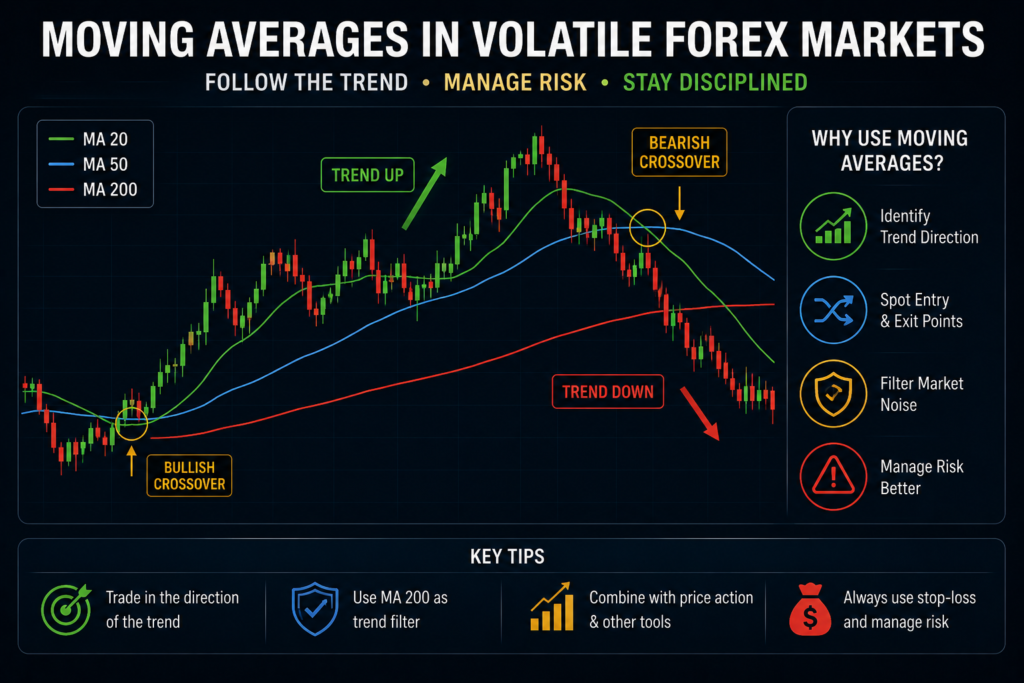
Moving average crossovers remain one of the most popular techniques in moving averages forex trading.
A crossover occurs when a shorter-term moving average crosses above or below a longer-term moving average.
These signals often indicate changes in market momentum.
Many traders use crossover systems as part of a trend following strategy.
While no signal is perfect, moving average crossovers can provide valuable confirmation during volatile market conditions.
Combining crossover analysis with other forex indicators often improves reliability.
Risk Management During Volatility Trading
Risk management is essential when implementing any volatility trading strategy.
Volatile markets can generate substantial profits, but they can also produce significant losses.
Even the best technical analysis strategy cannot eliminate risk completely.
Effective risk management includes:
Position sizing.
Stop-loss orders.
Leverage control.
Trade planning.
Emotional discipline.
Many traders use moving averages to help define stop-loss placement and manage open positions.
Proper risk management remains a critical component of long-term trading success.
Using Multiple Timeframes for Better Analysis

Professional traders often combine multiple timeframes when applying moving averages forex techniques.
Higher timeframes help identify major trends, while lower timeframes provide precise entry opportunities.
This approach strengthens a trend following strategy by ensuring alignment with broader market conditions.
Multi-timeframe analysis also enhances the effectiveness of other forex indicators.
Combining different perspectives often reduces false signals and improves overall trade quality.
Common Mistakes When Using Moving Averages
Many traders misuse moving averages by relying on them as standalone indicators.
While moving averages forex tools are valuable, they should be integrated into a complete technical analysis strategy.
Another mistake is using too many moving averages simultaneously.
Excessive complexity can create confusion and reduce decision-making efficiency.
Some traders also ignore broader market conditions during volatility trading.
Successful traders understand that moving averages are tools, not guarantees.
Combining moving averages with risk management and market context produces better results.
High-Volume Related Keywords for Moving Average Trading
In addition to the primary keywords, traders frequently search for related topics such as:
EMA crossover strategy.
Simple moving average forex.
Forex trend indicators.
Moving average trading system.
Price action trading.
Trend confirmation strategy.
Forex chart analysis.
Momentum trading forex.
Technical forex signals.
Swing trading strategy.
These related keywords complement moving averages forex, trend following strategy, forex indicators, technical analysis strategy, and volatility trading while helping traders develop a broader understanding of market analysis techniques.
Advantages of Moving Averages in Forex Trading
The continued popularity of moving averages forex analysis stems from several important advantages.
Moving averages simplify trend identification.
They work well with numerous forex indicators.
They support both short-term and long-term trading approaches.
They provide structure for a disciplined technical analysis strategy.
They help traders adapt to changing market conditions during volatility trading periods.
These benefits explain why moving averages remain among the most widely used tools in the forex market.
Conclusion
Moving averages are powerful tools that help traders navigate volatile forex markets with greater confidence. By understanding moving averages forex techniques, developing a structured trend following strategy, utilizing complementary forex indicators, implementing a disciplined technical analysis strategy, and applying effective volatility trading principles, traders can improve their ability to identify trends and manage risk.
While no indicator guarantees success, moving averages provide a reliable framework for analyzing market direction and making informed trading decisions. Traders who combine moving averages with strong risk management and continuous learning can gain a significant advantage in today’s dynamic forex market.
Frequently Asked Questions
What are moving averages in forex trading?
Moving averages forex indicators calculate average price levels over specific periods to help traders identify market trends and reduce noise.
What is a trend following strategy?
A trend following strategy involves identifying established market trends and entering trades in the direction of those trends.
Which forex indicators work best with moving averages?
Popular forex indicators used alongside moving averages include RSI, MACD, Stochastic Oscillator, ATR, and Bollinger Bands.
What is a technical analysis strategy?
A technical analysis strategy uses chart patterns, indicators, and price action to identify trading opportunities.
Why are moving averages useful during volatility trading?
Moving averages help traders identify the dominant trend and avoid reacting emotionally to short-term price fluctuations during volatility trading conditions.
What is a moving average crossover?
A moving average crossover occurs when one moving average crosses another, often signaling a change in market momentum.
Can moving averages be used in all market conditions?
Yes. Moving averages forex tools can be applied in trending, ranging, and volatile markets, although they tend to perform best when clear trends are present.