 Banking sector crises are among the most disruptive events in global financial markets. When banks face liquidity shortages, solvency concerns, or sudden collapses, investor confidence can deteriorate rapidly. These events often trigger sharp market reactions, increased volatility, and significant shifts in currency valuations. For forex traders, understanding how to navigate these conditions can create opportunities while helping protect capital from unexpected market swings.
A successful approach to banking sector forex trading requires understanding the dynamics of financial crisis trading, monitoring demand for USD safe haven assets, recognizing opportunities in market fear trading, and adapting to increased forex volatility.
This guide explores how banking crises affect currency markets, how professional traders react during periods of financial stress, and which strategies can help traders manage risk while identifying profitable opportunities.
Understanding Banking Sector Crises and Forex Markets
A banking sector crisis occurs when financial institutions face significant challenges that threaten confidence in the banking system. These challenges may include liquidity shortages, excessive loan losses, poor risk management, or broader economic weakness.
For traders focused on banking sector forex, these events often create major market disruptions. Banking problems can spread quickly across financial systems, affecting currencies, stocks, bonds, and commodities.
During a banking crisis, investors often reassess risk exposure and move capital into safer assets. These shifts frequently create opportunities in financial crisis trading because currency markets react rapidly to changes in investor sentiment.
Understanding how banking instability influences exchange rates is a key component of successful banking sector forex strategies.
Why Banking Crises Create Forex Volatility
One of the most immediate effects of banking sector instability is increased forex volatility.
When concerns about financial stability emerge, traders and institutional investors often reposition portfolios quickly. This behavior can generate large price swings across major currency pairs.
Periods of elevated forex volatility often occur because market participants struggle to assess the potential economic impact of banking failures.
For traders engaged in market fear trading, volatility can create both risks and opportunities.
A strong understanding of banking sector forex dynamics allows traders to navigate these unpredictable market conditions more effectively.
Because volatility tends to increase significantly during financial crises, risk management becomes especially important.
Financial Crisis Trading and Investor Behavior
Investor psychology plays a central role in financial crisis trading.
When financial institutions experience stress, fear often spreads across markets. Investors become more focused on capital preservation and less willing to take risks.
This environment creates ideal conditions for financial crisis trading because currency markets frequently respond before broader economic consequences become visible.
During periods of uncertainty, traders monitor banking news, government interventions, and central bank actions to anticipate market reactions.
Successful financial crisis trading requires understanding how investor sentiment influences capital flows and currency demand.
Traders who remain objective and disciplined often perform better than those who react emotionally to headlines.
USD Safe Haven Demand During Banking Crises
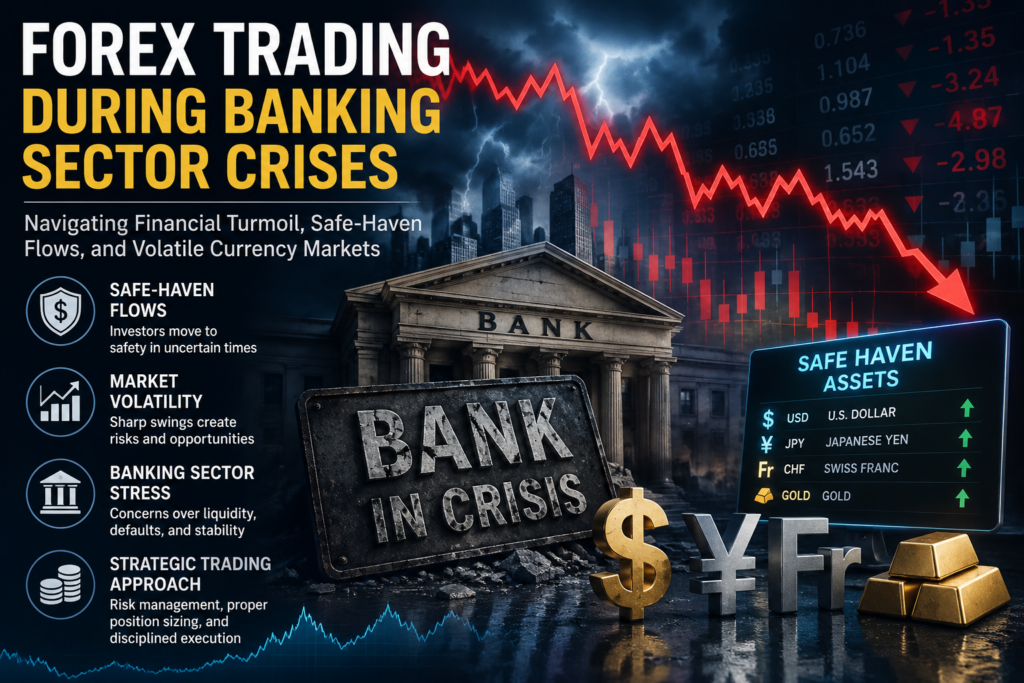
One of the most important trends during financial instability is increased demand for USD safe haven assets.
The U.S. dollar is widely regarded as one of the world’s primary reserve currencies. During periods of financial stress, investors frequently seek safety in dollar-denominated assets.
As banking concerns intensify, USD safe haven demand often rises sharply.
This demand can strengthen the dollar against many global currencies, particularly those associated with higher risk.
Understanding the role of USD safe haven flows is essential for traders analyzing market reactions during banking crises.
Monitoring capital movements into U.S. Treasury securities and other defensive assets can provide valuable insights into broader market sentiment.
Market Fear Trading During Financial Stress
Periods of banking instability often create powerful market fear trading opportunities.
Fear-driven market behavior frequently causes rapid price movements that differ from normal market conditions.
Successful market fear trading requires understanding how investors react when uncertainty increases.
As fear spreads, traders often sell risk-sensitive assets and move toward safer alternatives.
This behavior can create strong trends across forex markets.
Professional traders engaged in market fear trading focus on identifying shifts in sentiment before they become obvious to the broader market.
Recognizing early signs of panic can provide a significant competitive advantage.
Forex Volatility and Safe-Haven Currency Pairs
Certain currency pairs tend to experience increased activity during banking crises.
Pairs involving the U.S. dollar, Swiss franc, and Japanese yen often attract significant attention because these currencies are viewed as relatively safe.
Periods of heightened forex volatility frequently create strong movements in:
USD/JPY
USD/CHF
EUR/USD
GBP/USD
EUR/CHF
These pairs often reflect changing USD safe haven demand and broader risk sentiment.
Traders involved in banking sector forex strategies closely monitor these markets for signs of emerging trends.
How Central Banks Respond to Banking Crises
Central banks play a critical role in stabilizing financial systems during periods of banking stress.
Emergency lending programs, liquidity injections, and policy adjustments can significantly influence currency markets.
For traders focused on financial crisis trading, central bank actions often provide important clues about future market direction.
Announcements regarding liquidity support can reduce panic and stabilize markets.
However, unexpected policy measures may also increase forex volatility in the short term.
Monitoring central bank communications is therefore an essential component of any banking sector forex strategy.
The Relationship Between Banking Crises and Currency Strength
Banking crises do not affect all currencies equally.
Countries with stronger financial systems often experience increased demand for their currencies during global uncertainty.
This dynamic frequently supports USD safe haven flows while weakening currencies associated with greater economic risk.
Understanding these relationships can improve market fear trading decisions.
Professional traders often compare economic fundamentals, banking stability, and policy responses when evaluating currency opportunities.
These factors help explain why some currencies strengthen while others weaken during financial crises.
Risk Management During Banking Sector Forex Trading
Risk management is one of the most important aspects of successful banking sector forex trading.
Periods of elevated forex volatility can create substantial profit opportunities, but they also increase the likelihood of large losses.
Effective risk management strategies include:
Reducing leverage.
Using stop-loss orders.
Monitoring economic news.
Diversifying exposure.
Maintaining disciplined position sizing.
A strong risk management framework helps traders survive unpredictable market conditions.
Even experienced professionals prioritize capital preservation during periods of intense financial crisis trading activity.
Market Fear Trading and Economic Indicators

Economic indicators often become more important during banking crises.
Traders engaged in market fear trading closely monitor:
Employment reports.
Inflation data.
GDP growth.
Consumer confidence.
Banking sector health indicators.
These data points help traders assess whether financial stress is likely to spread into the broader economy.
Combining economic analysis with banking sector forex strategies can improve trading decisions.
Understanding both market psychology and economic fundamentals provides a more complete picture of market conditions.
Historical Lessons From Banking Crises
History offers valuable lessons for traders interested in financial crisis trading.
Major events such as the 2008 Global Financial Crisis demonstrated how rapidly investor sentiment can shift.
During these periods, USD safe haven demand increased significantly as investors sought stability.
At the same time, forex volatility reached exceptionally high levels.
Studying historical market reactions can help traders prepare for future banking sector disruptions.
While every crisis is unique, many behavioral patterns remain consistent over time.
Common Mistakes Traders Make During Banking Crises
One common mistake is ignoring risk management during periods of heightened forex volatility.
Another error is chasing market moves without understanding the broader context of financial crisis trading.
Some traders underestimate the importance of USD safe haven demand and fail to recognize changing investor sentiment.
Others react emotionally rather than following a structured market fear trading plan.
Successful traders remain disciplined, objective, and focused on long-term consistency.
Avoiding emotional decision-making is particularly important during banking sector crises.
Conclusion
Banking sector crises create some of the most challenging yet potentially rewarding conditions in the forex market. By understanding the principles of banking sector forex trading, analyzing opportunities in financial crisis trading, monitoring USD safe haven demand, recognizing patterns in market fear trading, and adapting to increased forex volatility, traders can navigate financial turmoil more effectively.
Success during banking crises depends on preparation, discipline, and strong risk management. Traders who understand how financial instability influences currency markets are often better positioned to protect capital while identifying high-quality trading opportunities.
Frequently Asked Questions
What is banking sector forex trading?
Banking sector forex trading involves analyzing how banking industry developments and financial stability concerns affect currency markets.
What is financial crisis trading?
Financial crisis trading focuses on identifying opportunities created by market disruptions, investor fear, and economic uncertainty during financial crises.
Why is the USD considered a safe haven?
The USD safe haven status comes from the U.S. dollar’s role as the world’s primary reserve currency and its widespread use in global finance.
What is market fear trading?
Market fear trading involves capitalizing on price movements created by investor anxiety, risk aversion, and uncertainty.
Why does forex volatility increase during banking crises?
Forex volatility rises because investors rapidly adjust portfolios and reassess risk exposure when financial stability concerns emerge.
Which currency pairs perform well during banking crises?
Currency pairs involving the U.S. dollar, Swiss franc, and Japanese yen often attract increased attention due to USD safe haven demand and defensive market positioning.
How can traders manage risk during banking sector crises?
Traders can improve risk management by reducing leverage, using stop-loss orders, monitoring forex volatility, and following a disciplined banking sector forex trading plan.