
You are not alone since you have taken trades that looked good and did not work. This is the reason why trade filtering techniques are important. Rather than plunging into each and every signal, intelligent traders make use of systematic filters to enhance the quality of setups and filter out weak setups. Put simply, trade filtering techniques enable you to look only at high-probability trades and leave the market noise that evaporates accounts behind.
Quick summary
| Layer | Description |
| Trend | Price above 50 EMA |
| Volume | 20% above recent average |
| Volatility | ATR within defined range |
| RSI | Not overbought/oversold |
| Time filter | Avoid low-liquidity hours |
What are Trade Filtering Methods?
Let’s be honest, trade filtering methods are guidelines that are used to prevent unprofitable trades and concentrate on good trades. You do not take all the signals and instead apply conditions such as trend, volume, or news checks to gain entry.
The goal? Enhance the quality of setup trading and prevent random entries.
Why Filtering Matters
- The success or failure of unfiltered trade:
- You overtrade
- You take low-quality setups
- The quality of your setup trading goes out of line.
Example: If your raw strategy wins 45% of the time, adding structured trade filtering methods can increase the win rate to 55–60% while reducing drawdown.
Having powerful trade filtering techniques:
- You become selective
- You minimize unjustifiable losses.
- You improve consistency
That is why direct improvement of a better filtering setup quality is trading in the setting.
Real-World Perspective: Why Filters Improve Trading
The majority of traders are the people who lose due to a lack of proper trade filtering techniques. They make unverified random arrangements.
The professionals do the reverse.
That is because there are structured trade filtering techniques that are used by professionals to verify the trend, volume, and risk before entering. It is the way they enhance the quality of the trading setup.
Simple:
Improved trade filtering measures = setup quality trading.
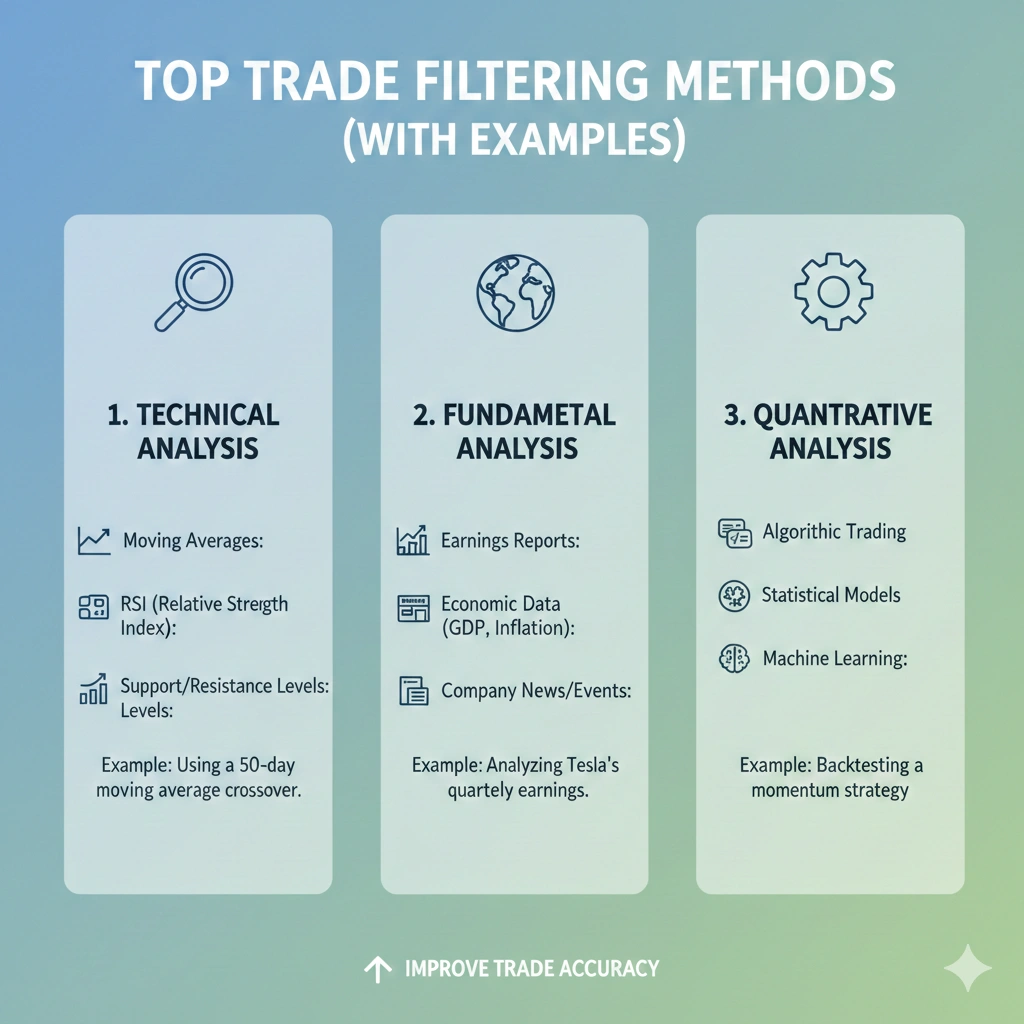
Top Trade Filtering Methods (With Examples)
- Technical indicator filters.
These are popular yet effective trade filtering techniques.
- Moving Average Crossovers
Only take long trades when a faster MA crosses above a slower MA.
- RSI (Relative Strength Index)
Never buy when the market is overbought, and never sell when the market is oversold.
- Bollinger Bands
Determine volatility expansions and breakout strength.
Use at least two indicators to enhance the quality of the trading setup.
-
Market Structure Filters
These focus on price context.
- Trade with the trend
- Support and resistance: respect.
- Confirm real breakouts
This immediately enhances the quality of trading setups.
-
Volume-Based Filters
Volume confirms strength.
- Only above-average volume was traded.
- Do not have low liquidity sessions.
The trade filtering techniques are volume-based, which minimizes the bogus moves.
-
Volatility & Statistical Filters.
- ATR range checks
- Prior entry volatility confirmation.
These trade filtering techniques will make the move a reality.
-
News & Sentiment Filters
- Do not release big economic news.
- Be cautious around central bank events.
The smart trade filtering technique cushions the quality of setups against spikes.
How to Combine Filters for Better Trade Signals
To trade with a greater quality of setups, trade filtering methods on multiple layers are recommended – do not use single signals.
Example Filter
| Layer | Description |
| Volume | Above average volume |
| RSI | Not overbought/oversold |
| Trend | Price above 50 EMA |
| Volatility | ATR within range |
With every level, your trade filtering techniques are enhanced.
In case one of the conditions is not good, skip the trade.
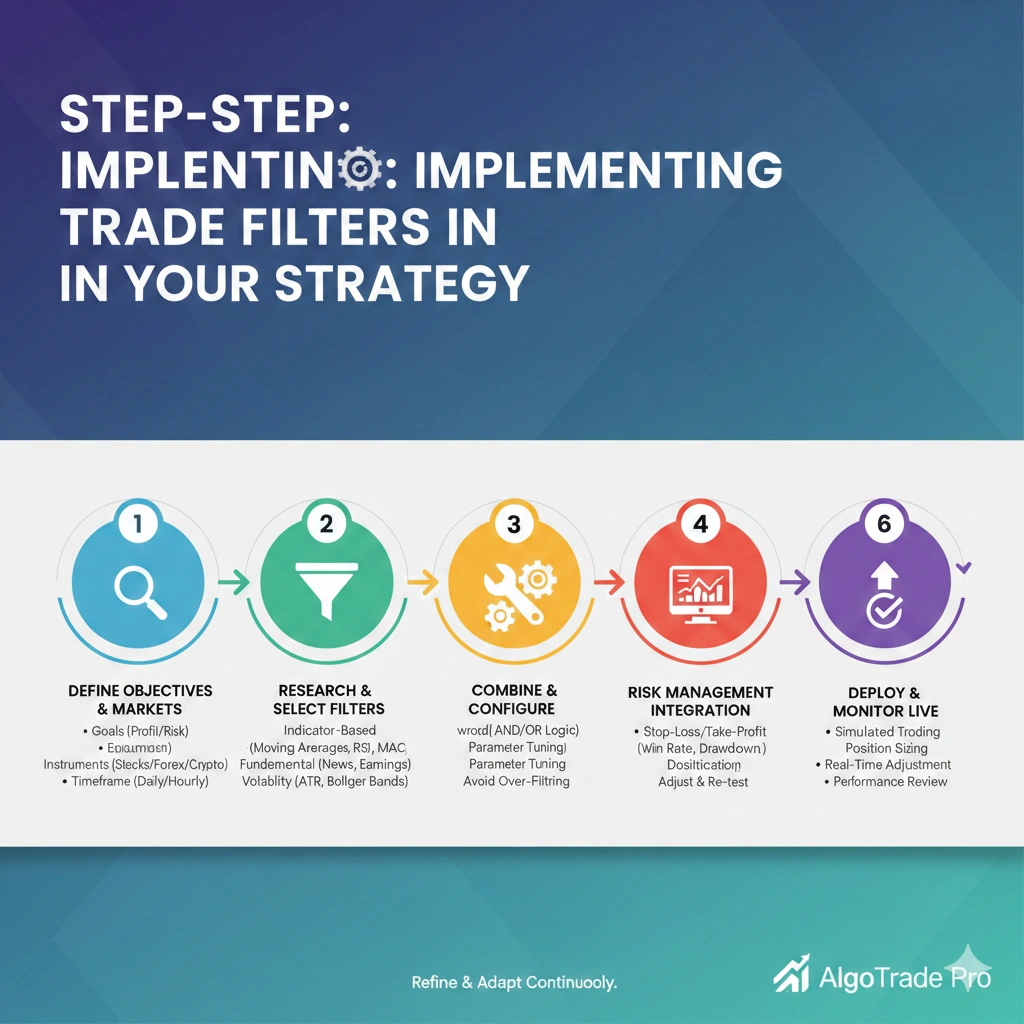
Step-by-Step: Implementing Trade Filters In Your Strategy
The trading setup can be improved by the use of trade filtering in steps.
Step 1 -Define Your Trading Universe.
Pick markets: Forex, Stocks, Crypto and Commodities.
Step 2 — Identify Your Core Edge
Trend-follow, breakout, or mean-reversion, do what your strategy dictates.
Step 3 — Choose Filter Layers
Combine the technical, volume, market structure, and volatility filters.
Step 4 — Backtest & Forward Test
Test filters on historical data and in a test account.
Step 5 — Review Metrics
Measures track win rate, returns, drawdown, and risk-adjusted performance.
Enhanced trade filtering techniques = enhanced the quality of the trading set ups.
Metrics & KPIs to Evaluate Filtering Effectiveness
In order to be able to really enhance the quality of setup trading, your trade filtering techniques should have quantifiable outcomes. Here’s what to track:
Must-Track Metrics
- Signal Accuracy (%) – Displays the number of profitable trades out of the filtered trades.
- Win/Loss Ratio – Ensures that your filters give more winners than losers.
- Risk to Reward (R: R) – Hold 1:2 or more to realize profitable gains.
- Maximum Drawdown- Tracks the greatest decline in your account so as to control the risk.
- Expectancy – Mean performance on filters; positive values indicate real edge.
Expectancy Formula:
Expectancy = (Win Rate × Avg Win) – (Loss Rate × Avg Loss)
Common Challenges Traders Face With Filters
Even the best trade filters that are best have pitfalls. It is their identification that enhances quality trading in setups.
Key Challenges
Mixed Messages – There are too many filters.
Fix: Minimize and concentrate on high-impact filters.
Over-Filtering – Oversensitive with missing trades.
Fix: Backtest and balance accuracy vs. opportunity.
Ignoring Market Context – volatility or trend is overlooked.
Fix: Trend + volatility checks should always be present.
Minor adjustments in trade filtering procedures = superior setup quality trading.

Example: Combining Filters for a Breakout Trade
Step-by-Step Filter Example
- Trend – Price above 20 & 50 SMA
- Volume Spike – Increased by at least 30 percent.
- Volatility – ATR will ensure that there is enough movement.
- No Overbought Conditions – RSI is less than 70.
- Timing- Do not enter around earnings or important news.
- Everything was good to go ahead and accept the trade.
- If anything goes wrong, then skip the setup.
We shall simplify it and make it practical. With trade filtering techniques, it is possible to transform an average breakout into a high-probability trade.
FAQs
Q.1 What tools can help with trade filtering methods?
Insightful Trade, TradingView, MetaTrader, NinjaTrader, and TradeStation are all charting platforms that include built-in indicators, alert systems, scanning systems, and strategy testers. These assist in real-time filter implementation and visualization.
Q.2 How many filters should I use?
No ideal figure applies, but the majority of successful traders apply 3-5 complementary filters. A few of them can be noisy, and many of them can be over-optimizers.
Q.3 Are filters only technical?
No. Filters may be technical, basic, volatility-related, and even sentiment-based or news-oriented. The combinations of categories are frequently combined in a balanced approach.
Q.4 Can trade filtering methods guarantee profits?
Not even the most effective filters can ensure profits, but good filters will minimize the risk and increase the chances of success.
Q.5 Are filters useful for all markets?
Yes, regardless of what you are trading, stocks, crypto, forex, or commodities, filters will allow you to recognize better opportunities.
Example Filter Score System:
- Trend aligned = 1 point
- Volume confirmed = 1 point
- RSI valid = 1 point
- Volatility confirmed = 1 point
Take trade only if score ≥ 3.
Conclusion
Anyone serious in the trade needs to use filtering methods. They ensure that quality trading is made more uniform, minimize errors, and enhance discipline. With careful overlaying of filters, risk management will be easier, and only trades with a high probability of success should be considered. It is a time-tested solution to improve performance and improve long-term outcomes; whether in the beginning or later in practice, organized trade filtering procedures are beneficial. To get a more in-depth glance, visit InsightfulTrade to get strategy and real-world filter arrangements.
Author: Arihant Jain
Trading Experience: 5+ Years
Arihant Jain is a financial markets analyst and trading educator with expertise in Forex, indices, crypto, and risk-managed trading systems. His insights are based on real trading experience, data-driven analysis, and transparent market understanding. All content is reviewed for accuracy and aligns with Google’s EEAT guidelines.
Risk Disclaimer:
Trading involves substantial risk. All information is for educational purposes only and should not be taken as financial advice. Always do your own research.
Last Updated: 19 February 2026