
The week kicked off with a cautious vibe as the Indian Rupee Defensive February 16 2026 narrative gained traction among traders and analysts. The rupee is sitting near the 90.70 mark against the US dollar. Most traders are waiting and watching the market, keeping a sharp eye on upcoming trade numbers, capital flows, and global dollar strength.
The Indian Rupee Defensive February 16 2026 isn’t just a price level; it shows the current situation, the economic uncertainty, external risks, and the central bank’s reports that could shape the situation.
In this blog, we break down what is driving the rupee’s defensive stance, what trade data risks mean for the currency, and how traders can navigate the volatility.
Why the Indian Rupee Is Defensive Right Now
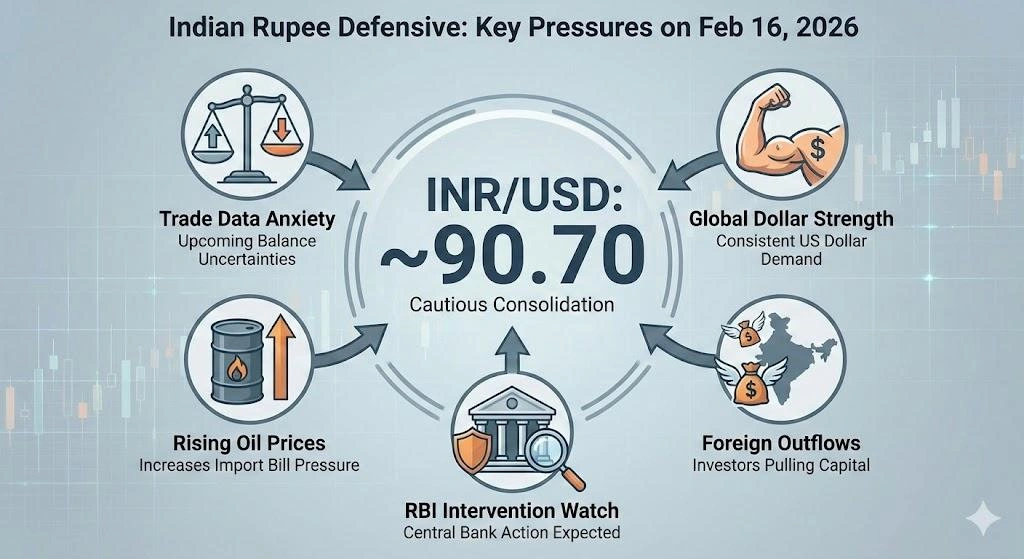
The Indian Rupee Defensive February 16 2026 is the result of local and global pressures hitting all at the same time.
Key factors include:
- Worries about upcoming trade balance data
- A consistently strong US Dollar on the Global stage
- Higher oil prices are increasing the India’s import bills
- Foreign investors are continuously pulling their money out of the market
- The expectation that central bank might intervene
Right now the currency is stuck between a limited price range, waiting for a clear reason to move in one direction or the other. In this situation everyone’s eye is on RBI, as most traders expect them to act if the rupee drops too far past the psychological levels.
Trade Data Risks: The Biggest Catalyst
The reason why the Indian rupee is so defensive today is the upcoming trade data. Which is very important because they show the exact demand of the US dollar today.
How Trade Data Affects the Rupee
- Higher Imports = More Dollar Demand
If imports increase, then companies will need more dollars to pay off the bills, which naturally weakens the rupee. - Export Slowdown Risks
The uncertain nature of global demand leads to a decrease in exports, which causes a deficiency in foreign currency. - Oil Price Sensitivity
As the oil prices are rising, India is facing currency pressure, being a massive oil importer.
If, according to the data, the trade gap widens, then this defensive mood could quickly turn into real downward pressure for the rupee.
Global Factors Driving Rupee Caution
Currency markets don’t live in a bubble. The rupee’s defensive arrangement follows what is happening on the global stage.
US Dollar Strength
If the US increases the interest rate, it will attract more cash into dollar-based assets, making it much harder for emerging market currencies like rupees to compete.
Risk-Off Sentiment
The current global tensions and economic worries make investors choose safe-haven currencies, which decreases the demand for emerging market assets.
Bond Yield Movements
Climbing global bond yields often trigger a safety button where the capital leaves developing economies and moves to safer sides, straining currency stability.
The worldwide market trends make the Indian Rupee Defensive February 16 2026 theme the current focus of forex market discussions.

Technical Perspective: Key Levels to Watch
If we look from the trader’s point of view, Indian Rupee Defensive February 16 2026 highlights some key levels to watch.
Important levels include:
- 90.50 – The first support zone
- 90.70 – Current consolidation area
- 91.00 – Psychological resistance level
- 89.80–90.00 – Strong support band
If the rupee moves above 91, it means that the rupee is heading toward a stronger depreciation trend. Still, many traders believe that RBI will step in to prevent any sudden out-of-control move.
RBI Intervention Expectations
How the central bank acts plays a huge role in what people expect from the currency.
The Indian Rupee Defensive February 16 2026, shows that traders expect that RBI will stop wild swings rather than just defending a fixed price.
Typical intervention signals include:
- Quick unexpected reversals during the day
- A sudden surge in dollars from state-owned banks
- Market volatility slow down after a big move
This market action often creates short-term trading opportunities.
Forex Trading Strategies in a Defensive Rupee Market
The Indian Rupee Defensive February 16 2026 environment is particularly suitable for tactical trading strategies rather than aggressive directional bets.
1. Range Trading Strategy
When a currency is moving within a range:
- Buy near support zones
- Sell near resistance levels
- Use tight stop losses
This works great till any real breakout occurs.
2. Breakout Strategy
Be prepared for fast price jumps during any big event.
Key steps include:
- Watch for volume rise
- Track major news triggers
- Wait for a clear signal
Any news report or trade data can easily trigger these kinds of moves.
3. News-Based Trading
Big economic news often drives big price jumps in USD-INR.
Key events you should watch:
- Trade data reports
- Inflation report
- Interest rate policy
- Global economic indicators
The Indian Rupee Defensive February 16 2026 phase may end quickly if surprises emerge.
4. Dollar Index Correlation
Watching the US Dollar Index (DXY) helps anticipate rupee direction.
A stronger dollar usually pressures emerging market currencies.

Market Sentiment and Institutional Positioning
One more big reason for why the rupee is being defensive today is that institutions are being cautious. Big investors often reduce their positions before major data drops to avoid risk.
This results in:
- Low liquidity
- Tighter trading ranges
- Sudden price jumps after data
Individual traders should watch out for these patterns to avoid getting trapped by false breakouts.
Oil Prices: The Hidden Currency Driver
Energy prices are a huge external factor that can impact the rupee’s value.
Rising oil prices:
- Increase India’s import bill
- Raise inflation risks
- Increase dollar demand
If oil stays expensive, the Indian Rupee Defensive February 16 2026 could move toward further weakness.
Medium-Term Outlook for the Rupee
The market can jump for a small while, but the rupee has strong long term backing:
- Solid economic growth
- A bigger manufacturing base
- A booming digital sector
- Steady government policies
Basically the weakening rupee is just for a little while until the micro and macro conditions get stable, not a sign that the currency is fundamentally broken.
Risk Management for Traders
When the local currency is weak compared to the global exchange currency, it demands disciplined, strict risk management.
Pro traders focus on:
- Control your trade size
- Skip huge leverages
- Spick to stop losses
- Try to see the bigger picture
- Watch for any sudden risk
When the market is uncertain, protecting your capital is the most important task.
What to Watch Next
To stay prepared for the upcoming market trends, you should keep an eye on:
- Trade deficit numbers
- Foreign money flows
- Oil price direction
- US interest rates
- RBI policy hints
- Dollar strength
These reports can help you predict the markets’ and currencies’ next move.

Conclusion
As we all can see, the Indian rupee is currently sitting near 90.70 this Feb 16 2026, this is due to the current global conditions, like trade data, a strong dollar, rising oil prices, and cash flows. While some fresh data might cause short-term volatility, the long-term estimation still depends on the fundamental and central bank moves. For traders there is both risk and reward; it just depends on how you plan your next move. Connect with Insightful Trade; they help you make plans and stay disciplined during such periods to maintain longevity in the market.
FAQs
1. Why is the Indian rupee defensive on February 16, 2026?
The rupee is currently consolidating because of unclear trade data, a strong dollar, and worries about where the money is flowing.
2. What level is important for USD-INR right now?
The 90.70 price is the key zone to watch, with 91 acting as a major resistance level.
3. Can trade data weaken the rupee further?
Yes, if the trade gap grows, demand for the dollar spikes, putting pressure on the rupee.
4. What is the best strategy in a defensive currency market?
The best way to trade during the defensive market is trading within the range, preparing for breakouts, and strong risk management.
Author: Kumkum Chandak
Experience: 3+ Years in Trading Research & Market Content Strategy
Kumkum Chandak is a trading content strategist and market research writer who specializes in simplifying technical analysis, trading tools, and strategy-driven educational content. Her work is optimized for EEAT, accuracy, and user intent, ensuring every article delivers practical insights for traders of all levels
Risk Disclaimer:
All content is strictly educational and not financial advice. Trading involves substantial risk. Always perform your own analysis or consult a professional advisor.
Last Updated: 16 February 2026