
Quick Summary
Trade size is a really important factor of trading; it has a huge impact on your trade performance. Most traders forget this, as they’re so focused on indicators and chart patterns that they ignore how position size liquidity actually dictates their final fill prices. If your order is too large for the current market, you’ll get hit by slippage or incomplete fills. In this blog, you’ll learn why size matters and how to match your order with the real market conditions.
Key Insights at a Glance
| Factor | What Happens | Why It Matters |
| Large Trade Size | Consumes multiple price levels | Increases slippage |
| Low Liquidity | Thin order book | Higher execution uncertainty |
| Volatility | Liquidity withdrawal | Amplified price impact |
| Market Orders | Immediate execution | Higher trade size impact |
| Limit Orders | Controlled pricing | Risk of incomplete fills |
| Documentation | Execution variance occurs | Compliance importance |
Why Trade Size Impact on Execution Is Often Ignored
Most of the traders are focused on:
- Entry signals
- Chart patterns
- Stop-loss placement
But it rarely comes to their mind that their trade size can also affect their actual performance. Even a winning strategy can struggle if you ignore how much cash flow is available in the market.
For example:
- According to a trial you’ll get perfect fills every time
- But live trading you might notice your average entry price are worse
- This might be because your position was too large for the current market depth
Understanding this impact turns position sizing from a mathematical formula to a smart market decision.
Understanding Position Size Liquidity
Position size liquidity simply means how easily the market can accept your trade without the heavy price jumps.
High liquidity:
- Big orders get easily filled without moving the market much
- The gap between buy and sell prices remain tight
Low liquidity:
- Even a normal trade can push price at a new level
- Slippage gets bad and partial fills become more common
The impact of your trade size really spikes when there isn’t much cash flow in the market to back it up.

The Mechanics Behind Execution and Market Depth
To see the trade size impact on execution, just look at how the order book works.
At any given moment, the market shows:
- Bid prices with available quantity
- Ask prices with available quantity
If your order size is bigger than what’s available at the best price, the rest has to fill at the next level up.
Example:
Index trading at 10,000
Available sell orders:
- 50 contracts at 10,000
- 40 contracts at 10,005
- 60 contracts at 10,010
If you buy 150 contracts:
- 50 fill at 10,000
- 40 fill at 10,005
- 60 fill at 10,010
Your final average price will end up higher because of the different price levels your trades were executed at.
Volatility and Position Size Liquidity
Volatility has a huge impact on market cash flow.
During high volatility:
- Price providers reduce exposure
- Number of orders decreases
- Spreads widen
This makes your trade size impact on execution much harder. That even a normally active market can experience temporary liquidity shortages.

Slippage as a Direct Result of Trade Size Impact on Execution
When your executed order gets filled at a price different from the one you wanted, it is called slippage.
Large trade size:
- Increases market impact
- Pushes price levels
- Shifts your final average fill
This is especially noticeable in:
- Thin markets
- After-hours sessions
- News events
This is just how the market functions.
Market Orders vs Limit Orders and Trade Size
The type of order can also change the trade size impact on execution.
Market Orders
- Accepted by market immediately
- Strong price impact
- Higher slippage for large size
Limit Orders
- Price control
- Risk of incomplete fills
- Reduced immediate impact
Traders trading big capital often use limit orders to keep their cost low.
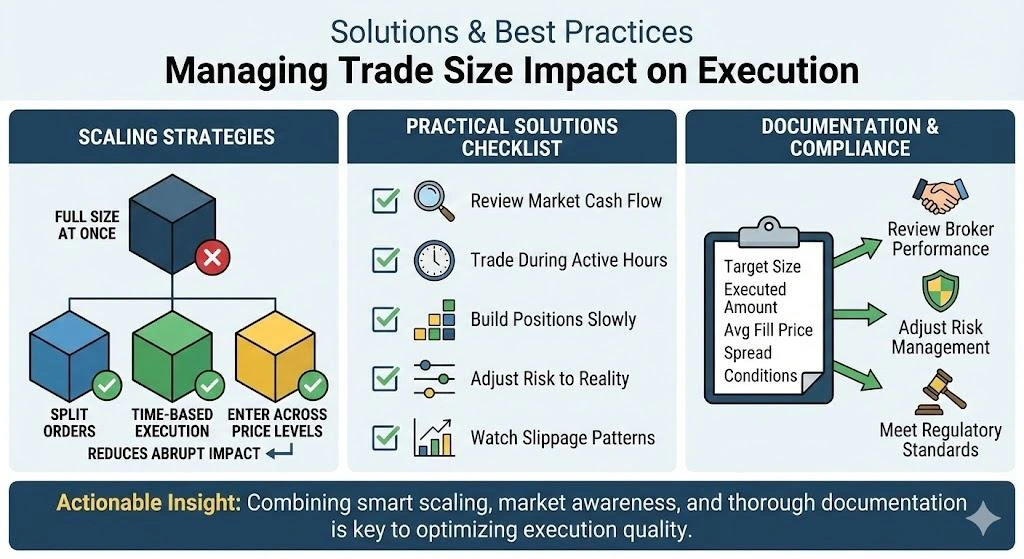
Scaling Strategies to Reduce Execution Impact
Rather than placing a complete big order at once, traders may:
- Divide orders into smaller parts
- Use time-based execution
- Enter different price each time intentionally
This doesn’t cause sudden price jumps and matches with the market’s capacity.
Asset Class Differences in Liquidity
The impact of trade size depends on what you’re trading.
High Liquidity Instruments
- Major currency pairs
- Large-cap indices
- Highly traded stocks
Lower Liquidity Instruments
- Small-cap stocks
- Exotic forex pairs
- After-hours markets
In short, the impact of position size liquidity is measured differently for every single asset.
Compliance and Documentation
The documents that a trader should keep are
- Their targeted position size
- The amount actually executed
- The final average fill price
- Spread at entry
- Market conditions
These documents will help:
- Review the broker’s performance
- Help in adjust the risk management
- Meet regulatory standards
It will help in sharpening your analysis.
Managing Trade Size Impact on Execution
Practical solutions include:
- Review the market cash flow before placing your trades.
- Trade when most traders are active.
- Build your positions slowly and avoid placing them all at once.
- Adjust your risks based on realistic expectations.
- Watch the slippage patterns because they will show your actual filling.
Psychological Considerations
Large position sizing often follows:
- Winning streaks
- A boost in confidence
- The urge to grow faster
However, going big without checking the market depth also increases the risk. Increasing your position with discipline can improve your long-term stability.
Tools for Monitoring Execution Quality
Tools traders can use:
- Live view of market depth
- Slippage tracking
- Reports on how fast your trade hit the market
- Trade history analytics
- Volatility alerts
These tools help you see how your trades will hit the market and let you adjust your strategies.
Conclusion
To wrap it up, the size of your trade has a massive impact on your performance because it’s directly connected to market depth and liquidity. Large orders consume more available cash flow, which causes worse slippage and moves the price against you, especially when the market is calm. By matching the size of your trade to the market and using the right order type, you can avoid the unnecessary friction. For further insights on how trades are executed, you should connect with InsightfulTrade. They can help you execute your trade smoothly and manage your risk efficiently.
FAQs:
1. What is the trade size impact on execution?
It shows how big orders change fill prices when there isn’t enough market cash flow.
2. Why does position size liquidity matter?
Because if there is low liquidity, it could lead to worse prices and messy fills.
3. Can smaller trade sizes eliminate execution risk?
They can lower the damage, but they won’t stop the market’s natural swings.
4. How should Indian traders manage execution documentation?
For every trader it’s important to keep track of their trades and record the order size, type, and timestamps to avoid any sort of dispute with the broker or regulators.
Author: Kumkum Chandak
Experience: 3+ Years in Trading Research & Market Content Strategy
Kumkum Chandak is a trading content strategist and market research writer who specializes in simplifying technical analysis and strategy-driven educational content. Her work is optimized for EEAT, accuracy, and user intent, ensuring every article delivers practical insights for traders of all levels.
Risk Disclaimer:
All content is strictly educational and not financial advice. Trading involves substantial risk. Always perform your own analysis or consult a professional advisor.
Last Updated: 14 February 2026