
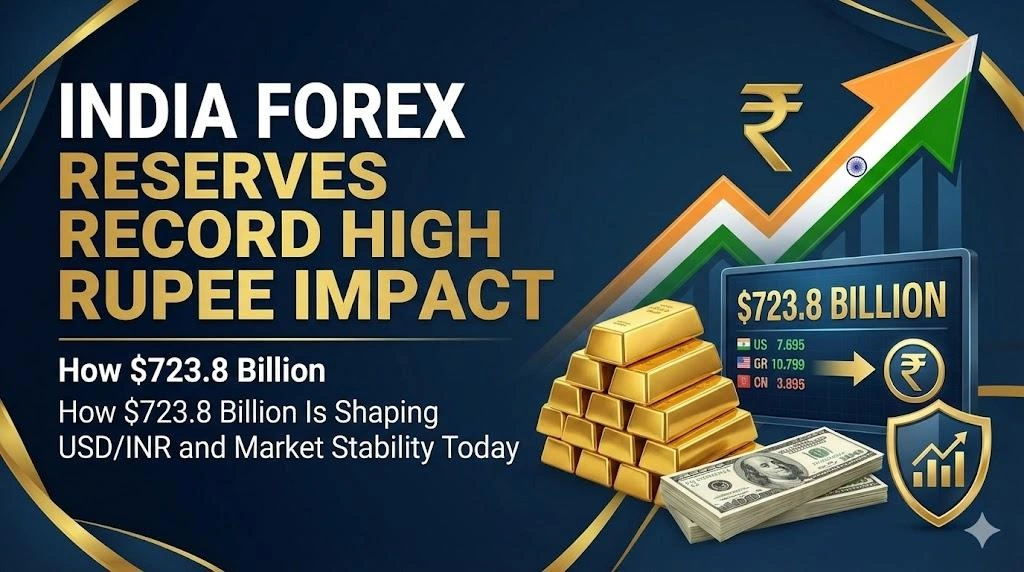
India’s foreign exchange has just hit a massive financial milestone, with its forex reserve reaching a historic $723.8 billion. This has influenced people wondering about how it will impact the rupee, inflation, and day-to-day trading.
Especially for traders, exporters, and even the policy makers, it’s a major signal. It shows that money is flowing in and that RBI has a strong grip over the global shocks. But what does this actually change for the rupee’s value? And how should you interpret this record high in your own trading today?
Let’s break it down in a structured, practical way.
Quick Summary
| Indicator | Latest Data | Why It Matters |
| Forex Reserves | $723.8 Billion (Record High) | Strong external buffer |
| RBI Position | High intervention capacity | Rupee volatility control |
| USD/INR Trend | Stabilizing bias | Reduced speculative pressure |
| Trade & Imports | Cushion against oil/gold imports | External stability |
| Market Sentiment | Positive macro signal | Confidence boost |

What Are Forex Reserves, and Why Do They Matter?
Forex reserves are made up of:
- Foreign currency assets (primarily USD holdings)
- Gold reserves
- SDRs (Special Drawing Rights)
- Reserve position with the IMF
And when we talk about the impact of such big reserves, we’re looking at how this large reserve protects:
- Currency stability
- Investor confidence
- Trade balance management
- Monetary flexibility
The more reserves we have, the better India can cover its big bills, like oil imports, debt repayments, and trade confidently without the rupee going into panic-driven moves.
Why Did India’s Forex Reserves Reach $723.8 Billion?
To understand the reason behind how India forex reserves record high rupee impact, we first have to look at what’s driving the rise.
1. Strong Capital Inflows
It boosts the confidence of overseas investors to come back into Indian stocks and bonds, bringing a steady stream of dollars with them.
2. RBI Dollar Purchases
When the rupee gets strong too fast, the RBI buys dollars to keep things steady, which naturally adds to the reserves.
3. Gold Valuation Gains
As the gold prices are rising globally, the value of India’s existing gold reserve also gets a natural boost.
4. Stable External Position
A manageable trade gap and steady exports are keeping India’s global financial position looking very healthy and strong.
These are the factors that make the strong foundation for the rupee’s record-high stability in today’s market.

India Forex Reserves Record High Rupee Impact: What Happens Next?
1. Stronger Rupee Defense Mechanism
This record gives the RBI support to:
- Sell dollars if the Rupee drops to fast
- Shutdown speculative attacks on currency
- Smooth out wild or erratic market swings
This prevents moves driven by panic, and the impact is also psychological for traders to stay in calmer knowing the RBI has a massive reserve ready.
2. Reduced Currency Risk Premium
Global investors look at two things:
- Can a country protect its currency?
- Does it have enough cash for imports?
With a reserve of $723 billion, India can easily cover its imports. This lowers the risk and provides a natural support for rupee.
3. Stability During Oil Price Spikes
India imports about 80–85% of its crude oil, and all the payments are made in USD.
High reserves mean:
- Sudden Spikes in oil prices won’t crash the Rupee immediately
- RBI can comfortably manage the extra demand for dollars even if crude prices surge.
The India forex reserves record high rupee impact is especially relevant when oil volatility rises.
4. Support for Bond Markets
Stronger reserves:
- Increase global confidence in India’s macro fundamentals.
- Reduce fears of external sector instability.
- Support lower bond risk premiums.
This indirectly strengthens the rupee outlook.
What Traders Should Watch Now
Even though the rising reserve is a positive sign for the rupee, it’s important not to oversimplify things.
Forex reserves do not mean:
- The rupee will only strengthen
- Volatility disappears
- External risks vanish
Instead, traders keep their eye on:
Dollar Index (DXY)
If the dollar is surging globally, the rupee can still feel the heat despite high reserves.
Crude Oil Prices
And as India imports so much oil, a price spike can force importers to scramble for dollars.
FPI Flows
If the foreign investors pull money out of the stock market, it can temporarily outweigh the strength of the reserve.
RBI Intervention Pattern
Is the central bank aggressively defending a specific price, or are they letting the rupee drift lower at its own pace?
Short-Term vs Long-Term Rupee Impact
Short-Term
- You can expect daily swings
- Importers’ need for dollars can still push USD/INR higher.
- Global panic can briefly drown out the security of those reserves.
Long-Term
- Stronger stability.
- Low probability of currency crash
- India’s global financial reputation looks much stronger.
The impact of these record highs is much more about a solid foundation than a quick speculative trade.

What This Means for Different Market Participants
For Forex Traders
- You can expect a smoother, more controlled ride
- RBI presence is likely near key psychological levels.
- Reduced tail-risk scenarios.
For Equity Investors
- A steady rupee shields company profits from rising import costs.
- It also gives foreign investors more confidence to keep their money in India.
For Importers
- Less need of panic hedging.
- Better forward premium visibility.
For Exporters
- The risk of an overly expensive rupee remains well managed
- The RBI will continue to prevent the currency from getting too strong for your global sales.
Is a Stronger Rupee Guaranteed?
No, it’s not like that. It’s just a reality check; high reserves provide stability, but they don’t guarantee any direction. The rupee’s value still depends on:
- Global interest rates
- US Federal Reserve moves
- Geopolitical risk
- Trade deficit trends
- Local inflation
Reserves are a solid safety tool, not a one-way ticket for currency.
The Bigger Macro Picture
With $723.8 billion in the banks, India is now the top global reserve holder. Which is a sign of:
- The economy is much more resilient
- India is better prepared for global crises
- We are less vulnerable to external shocks
This news brings confidence for long-term traders and investors of India’s economic fundamentals.
Could RBI Use Reserves Aggressively?
The RBI usually:
- Use reserves against wild market swings.
- Let the market move naturally in a safe range
- Avoid defending one specific point too rigidly.
So, those record results mean the rupee moves more steadily and naturally rather than staying fixed or being forced to order direction.
Strategic Insight for Traders
If you’re trading USD/INR today:
Focus On:
- Demand for dollars from importers
- RBI activity in the market
- Overall Global US dollars strength
- Fluctuation in crude oil prices
Avoid:
- Assuming the rupee only move in one direction
- Overlooking major Global economic news
- Over-leveraging on reserve headlines.
Conclusion: India forex reserves record high rupee impact
To summarize, India’s forex reserve reaching a massive $723.8 billion is a very big deal for the economy. This record will impact the rupee’s value but also bring more stability and fewer nasty surprises. Especially for traders, it means smoother volatility, less risk of sudden currency crashes, and a much stronger macro environment. But still the currency value depends on global money. If you want to look past the numbers and understand what’s really happening, you can connect with InsightfulTrade. They offer deep analysis to help you trade with more confidence.
FAQs: India forex reserves record high rupee impact
Q1. What does the India forex reserve’s record high rupee impact mean?
It means now that RBI has a much stronger tool to keep the rupees steady and protect the economy from any sudden global shocks.
Q2. Will the rupee appreciate now?
Not necessarily; while record reserves help prevent the rupee from collapsing, they don’t automatically guarantee that it will go up now.
Q3. How do forex reserves affect traders?
They act like a financial safety net, which protects by lowering the chance of sudden currency collapse and helping to smooth out wild market swings.
Q4. Can RBI use all reserves freely?
No, reserves are particularly for strategic purposes to manage extreme volatility, not to permanently fix the exchange rate.
Q5. Why are high reserves important during oil price spikes?
Because oil payments are made in dollars, having massive reserves ensures the country can cover those huge bills without the rupee’s value being out of control.
Author: Kumkum Chandak
Experience: 3+ Years in Trading Research & Market Content Strategy
Kumkum Chandak is a trading content strategist and market research writer who specializes in simplifying technical analysis, trading tools, and strategy-driven educational content. Her work is optimized for EEAT, accuracy, and user intent, ensuring every article delivers practical insights for traders of all levels.
Risk Disclaimer:
All content is strictly educational and not financial advice. Trading involves substantial risk. Always perform your own analysis or consult a professional advisor.
Last Updated: 11 February 2026