
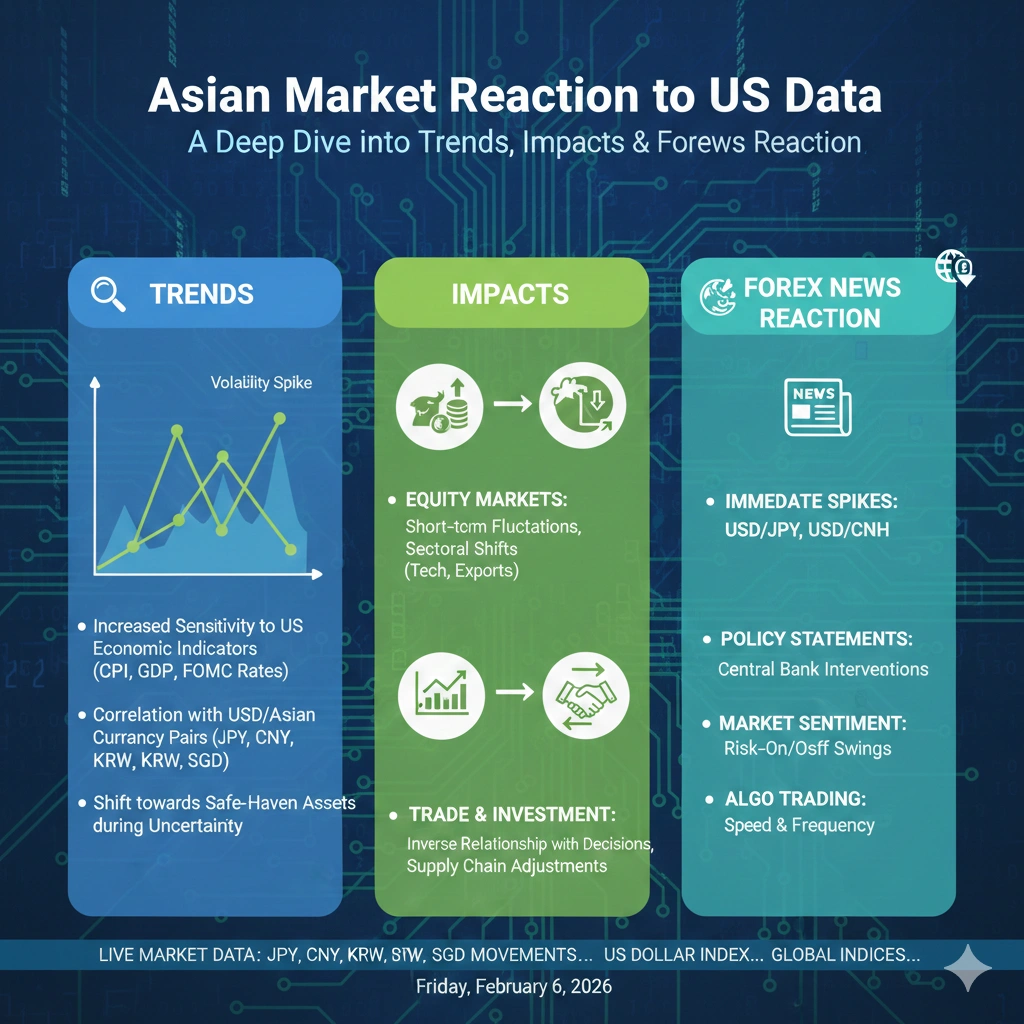
When traders wake up in Asia, the first thing they look at is not the local news but US data. The Asian market reaction to U.S. data usually predetermines stock, forex, and risk sentiment in the region. Jobs reports on inflation numbers; any US release can immediately redefine the momentum of the Asian market.
Quick Summary
| US Data Type | Asian Market Reaction | Why It Matters |
| US Jobs Data | Volatility in stocks & forex | Signals Fed rate direction |
| US Inflation | Risk-on or risk-off moves | Impacts dollar strength |
| Fed Statements | Sharp market swings | Guides global liquidity |
| Bond Yields | Pressure on Asian equities | Affects capital flows |
Why the Asian Market Reaction to US Data Matters in 2026
The response of the Asian market to the US data gives a significant contribution to the way Asia trades daily. Asian stocks and forex markets are quite responsive when key US numbers, such as jobs and inflation, are announced. The reason is that the US information will affect the Asian market in terms of interest rates, the movement of dollars, and the global sentiment of risk, which will usually result in a prompt reaction in terms of the forex news in the region.
Historical Context: US Data and Asia’s Market Pulse
The Asian market response to US data has always influenced the way the Asian markets trade. The Asian stock, currency, and bond markets tend to fluctuate depending on the strength or weakness of the US economic data.
- Equity Markets: Asian indices are tracked using US growth indicators.
- Forex Moves: Rapid forex news responses in the Asian currencies.
- Rate Effect: The US yields affect Asian borrowing rates.
Recent Data Trends: What’s Moving Asian Markets Now
The Asian market reaction to US data has always shaped how Asian markets trade, with traders responding to the employment figures, inflationary figures, and Fed indications.
- US Jobs Data Impact
The Asian stocks have been aided by weaker US data on jobs and have been indicating how quickly the US data has influenced Asia.
- US Inflation Signals
The soft inflation has boosted the mood and weakened the dollar, as well as provoking visible forex news responses in Asian currencies.
- Fed Communications
The Asian markets respond positively to the comments of the dovish Fed, and the markets in the region are cautioned by the hawks.
Stocks & Indices: Asian Market Reactions to US Data
- Japan’s Nikkei
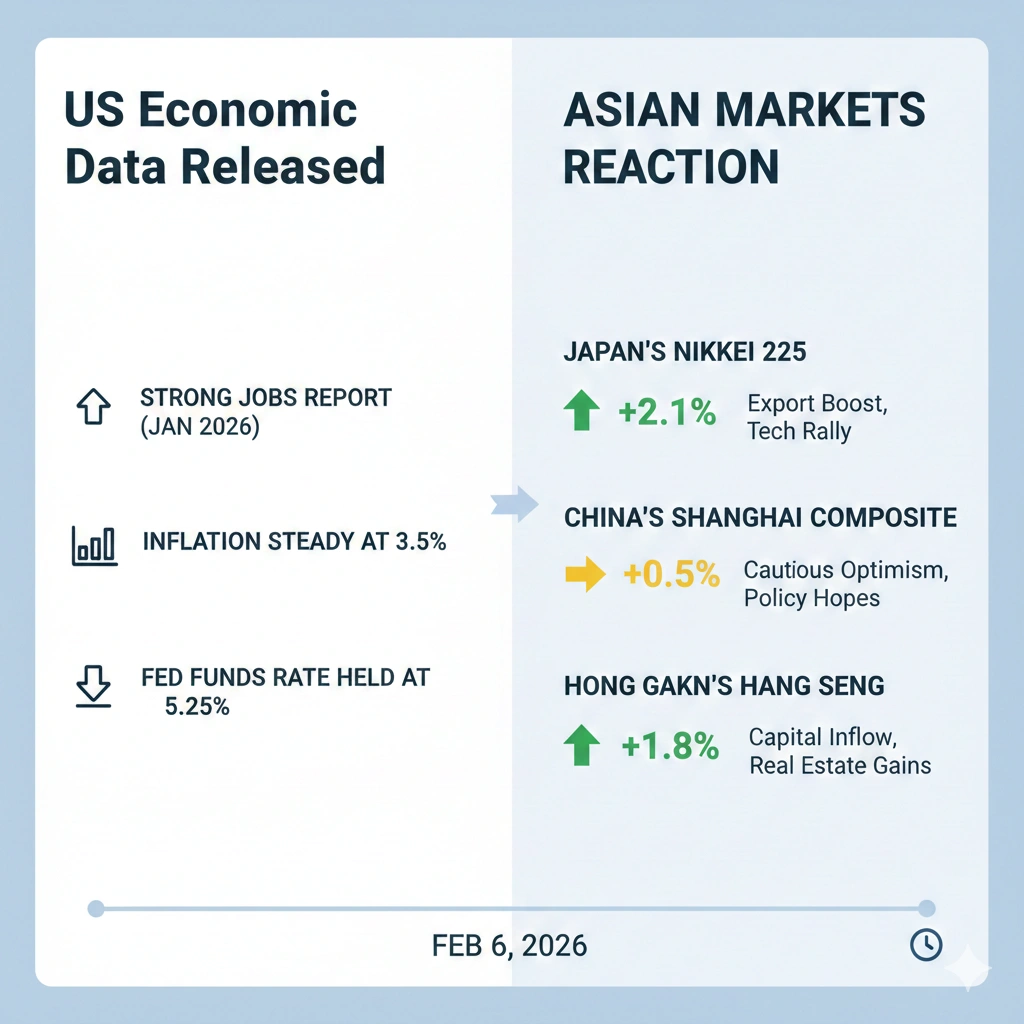
The Nikkei tends to gain when there is weak data in the US and take a downward trend when news of strong US data increases the rate-hike anxieties.
- Hang Seng & China Indices
The reaction of Chinese and Hong Kong stocks to the US dollar strength and global growth is depicted, so it has been seen that the US data have influence on Asia.
- South Korea’s KOSPI
KOSPI is a tight follower of US technology, and rapid market dynamics and forex news responses are the result.

Forex News Reaction: Asia FX Moves with US Data
-
US Dollar Influence
The dollar gains, and the Asian currencies, such as USD/JPY, USD/KRW, and USD/INR, respond.
-
Asian currencies and risk sentiment.
The Asian currencies usually respond to the weak US data, and strong data pressure them, which is demonstrated by quick responses to forex news.
Commodities & Asian Markets in a US Data World
- Gold and Safe-Haven Assets
Gold is more likely to increase with US inflation surprises or disappointing job data, as the general mood is characterized by risk aversion.
- Oil and Industrial Metals
The response of oil to the growth anticipations and the responsiveness of industrial metals to the global demand signals reflect the fact that the US data influence on Asia stretches further than the equities and the forex.
Expert Insights: Interpreting the Data Correctly
Traders know that not all releases in the US necessarily translate to Asia.
- Context is important: Markets respond to surprises, not the numbers.
- Asia can enhance movements following US information.
- Local news does not necessarily cause correlation, but it is also a factor.
Knowing the Asian market reaction to US data assists in making decisions that predict the short-term intervals and trade better.
How Traders & Investors Factor in This Reaction
US data are used to adjust Asian positions by the market participants.
- Short-term traders: Short-term trade volatility around the release of news in the US.
- Position traders: Change the exposure with regard to the outlook of the rates and international trends.
- Hedgers: Be in charge of currency and commodity risks, responding to the US data in Asia.

Risks & Challenges in Interpreting the Asian Market Reaction to US Data
Watching US data isn’t always straightforward.
- False signals occur when the expectations have already been priced
- The data of the US can be overshadowed by geopolitical risks or local events.
- Traders can be caught by their volatility soaring around big releases.
Even with the Asian market reaction to US data, it is important to be cautious to prevent losses in an unforeseen manner.
How Asian Markets Reacted to Recent US Data
Following weaker-than-expected US inflation data, Asian equity markets opened higher as Treasury yields softened and the dollar weakened. Japanese equities benefited from a weaker yen, while Asian currencies showed short-lived strength before stabilizing. This pattern reflects how Asia often amplifies US data moves during its opening session before local factors take over.
What’s Next for 2026: Data, Policy & Asia’s Outlook
In 2026, Asian markets will continue to be keen on the economic releases of the US.
- The US inflation trends and Fed direction are still crucial.
- Stocks, currencies, and commodities will be relayed by job reports.
- A rise in the risk in the US data may increase the risk appetite, and a fall in the sentiment may reinstate the data strength by displaying the real-time effect on Asia.
FAQs
1. What tools help track the Asian market reaction to US data?
Traders require economic calendars, real-time news feeders, charting systems, and sentiment indicators.
2. How does the forex news reaction affect Asia?
Currency moves after the US releases influence trade, trade flows, risk appetite, and portfolio decisions in Asia.
3. Can US data moves in Asia be predicted?
Trends are in place, but shocks are around—large numbers are predicted, but great numbers are achieved, which is the cause of most responses.
4. Which US data releases typically move Asian markets the most?
The most important ones are non-farm payrolls, CPI/PCE inflation, FOMC decisions, and ISM manufacturing statistics.
5. How do analysts quantify the US data impact on Asia?
By using volatility indicators, correlation, and fundamental and technical analysis.
Conclusion
Tracking the Asian market reaction to US data is essential for understanding what is going on in the US in order to observe the movement of Asian stocks, currencies, and commodities. Any employment news, inflation, or Fed statement in the US can cause sudden changes in sentiment and money flows. The US data impacts Asia, and it is one of the main priorities of the traders and investors.
Track how Asian markets react to key US data with Insightful Trade—get timely insights, smart analysis, and trade-ready signals to stay ahead of global market moves.
Author: Arihant Jain
Trading Experience: 5+ Years
Arihant Jain is a financial markets analyst and trading educator with expertise in Forex, indices, crypto, and risk-managed trading systems. His insights are based on real trading experience, data-driven analysis, and transparent market understanding. All content is reviewed for accuracy and aligns with Google’s EEAT guidelines.
Risk Disclaimer:
Trading involves substantial risk. All information is for educational purposes only and should not be taken as financial advice. Always do your own research.
Last Updated: 06 February 2026