Post Entry Mistakes Trading and Trade Management Errors

Introduction
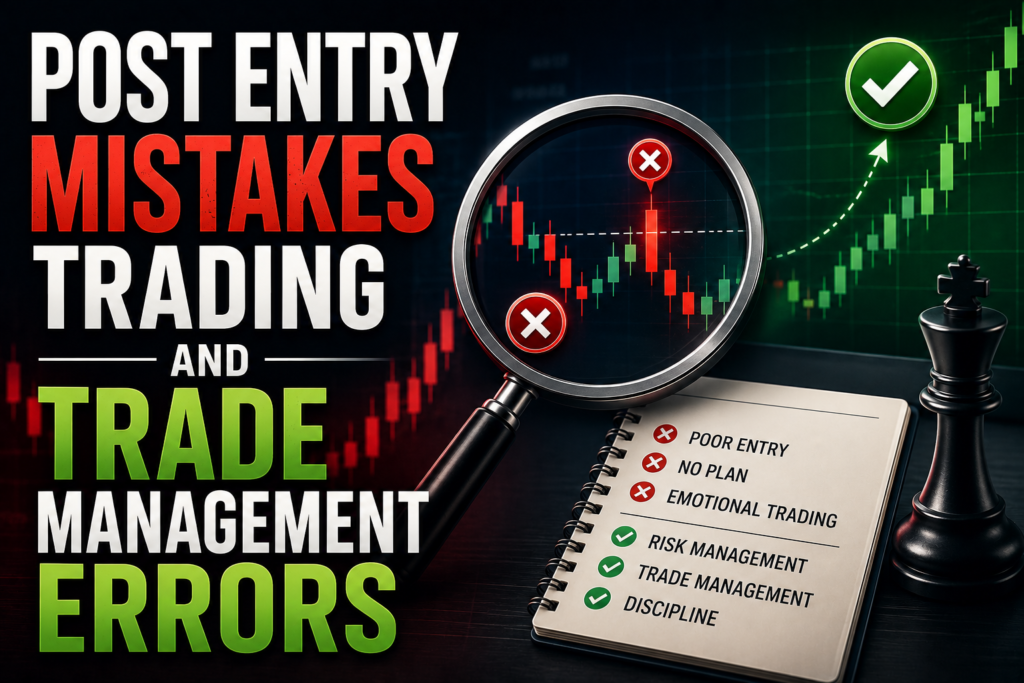
When you have already nailed a perfect entry and may still lose money, then you have already encountered the true villain: post entry mistakes trading. The hunt to get the best setup is the obsession of most traders; what occurs once the trade is entered is more important. Between the emotional interpretation of moving stop-losses to the untimely closing of winners, bad execution on trade management is one of the largest causes of traders remaining unprofitable.
I have witnessed numerous good EURUSD and US30 trades fail, not because of incorrect entry, but due to the pitfalls that occur after the entry. We will put together the most harmful post entry mistakes trading, the way emotional choices in trading are damaging your outcomes, and how you can go about trading your way in such a manner that your good deals ultimately do pay off.
Why Does Trade Management Execution Matter More Than Entry?
Getting into the trade only lands you in the trade, but the trade management performance determines whether you generate any money or not. Most trading post entry errors occur following a good entry and not prior to it. You may be correct in direction and still lose due to the common trading errors once in the market.
Real Example (EURUSD):
- Entry: Buy at 1.0800
- Stop-loss: 1.0770
- Take-profit: 1.0860
Trader mistake:
Stop-loss 1.0790 is prematurely struck – a typical stop-loss technical error in trading.
What Are the Most Common Post Entry Mistakes Trading?
- Emotionally relocating stop-loss.
You hedge your stop too soon and are stopped on a regular retracement. A classical stop loss error in trading.
- Closing winners too early
You wait and pocket a little in trepidation and miss the entire move. Weak trade management implementation.
- Over-leveraging positions
You are taking too many risks and are stressed and begin to make emotional trading choices.
- Not trailing profits
You are not safeguarding profit, and a single turnover erases your profit.
- Ignoring news events
Get stopped out. You remain in trades when news is high-impact. An elementary risk management trading mistake.
How Does Emotional Trading Lead to Post-Entry Mistakes?
The majority of errors made upon entry of post trades are not caused by bad analysis but by emotions. After getting into a trade, it becomes the fear and greed that begin to govern your trade management execution.
Fear = closing winners early
You leave too soon, and you do not see the entire movie.
Greed = removing stop-loss
You don’t accept a small loss. One of the classic stop-loss trading errors.
Hope = holding losers too long
You hope to get a miracle rather than cut the loss.
What Is the Correct Stop-Loss Formula?
To mitigate the post entry mistakes trading, you must have good execution in trade management, and this begins with correct position sizing.
Formula:
Position Size = Account Balance Risk percent/Stop Loss (pips).
Example:
- Account: $10,000
- Risk: 1% ($100)
- Stop-loss: 50 pips
Position Size = $100 ÷ 50 = $2 per pip
How Do Pip Values Affect Trade Management Execution?
Without knowledge of pip values, you will keep on committing post entry mistakes trading. Pip value determines how much you are going to win or lose out of each pip, and that translates to the performance you execute in your trade management.
| Pair | Lot size | Pip value |
| EURUSD | 1.00 | $10 |
| EURUSD | 0.10 | $1 |
| US30 | 1.00 | $1–$5* |
Broker dependent
On EURUSD, 1 lot = $10 per pip.
So a 30-pip stop-loss = $300 risk.
When you are scared of that risk, you will relocate your stop-loss or exit early – classic common trading mistakes after entry and post entry mistakes trading.
Why Do Traders Close Trades Too Early?
Trading errors are mainly made post-entry due to fear or confidence in the performance of the trade management.
Real Example (US30):
- Entry: Buy at 35,000
- Take-Profit: 35,300
- Closed early at 35.10
This price eventually reached 35,300 and lost potential profit.
Post entry emotions cause traders to leave prematurely rather than adhere to their trade management execution plan.

How Can You Trail Stop-Losses Properly?
Trailing stops correct post entry mistakes by safeguarding profits and enhancing the execution of trade management.
Methods:
- Fixed pip trailing- move stop a given number of pips.
- Structure-based trailing- below new highs/lows.
- ATR-based trailing – modifies stop depending on market volatility.
Example:
Price penetrates the lower bottom, and the stop shifted less higher below. This fixes profits and eliminates emotional trading errors once in.
Why Should You Avoid Revenge Trading?
Revenge trading is the cause of numerous post entry mistakes trading. Traders also make an emotional leap into the next trade after a loss, which is harmful to trade management execution.
And you wind up making even small losses when you chase trades. After the entry, a small break can be effective to curb the emotions and decrease frequent mistakes in trading.
How Do News Events Impact Trade Management Execution?
Spikes in news trading may cause post entry mistakes trading when trade management execution is not planned.
Example:
- EURUSD long before NFP
- No stop-loss adjustment
- 80-pip spike hits stop-loss
To prevent typical trading errors once in-trade, mitigate risk, or edge out trades before big news.
What Is the Ideal Trade Exit Strategy?
An adequate exit strategy will inhibit post-entry errors of trade and enhance the execution of trade management:
- Part-profit taking- take in some profits.
- Trail stops – defend profits and let winners run.
- Time-based exit-point – close slow trades.
This not only minimizes the errors made on the trading floor once you are in but also allows you to trade correctly.
How Can You Scale Out of Trades?
Scaling out results in fewer post-entry errors in trading and better execution of trade management.
Example:
- Close 50% at 1R
- Move stop-loss to breakeven.
- Let the rest of the trade run.
This cipher profits, reduces emotions, and prevents after-entry trading errors.
What Role Does Risk-Reward Ratio Play?
Risk-reward ratio curbs the mistakes that can be made after the entry trading and enhances the execution of trade management by balancing risk and reward.
Ideal R:R = 1:2 or higher
| R: R ratio | Win Rate Needed |
| 1:1 | 50% |
| 1:2 | 34% |
| 1:3 | 25% |
An effective risk-reward ratio reduces the emotional pressure and prevents the typical trading errors following the entry.
FAQs
Q.1 What are post entry mistakes trading?
Errors made on post-trade, e.g., emotional exits, bad risk management, or failure to observe the stop-loss guidelines.
Q.2 Why is trade management execution more important than entry?
The point of profitability is that it is more about your trades once made than your entry.
Q.3 How do I avoid closing trades too early?
Apply exit rules and trailing stop strategies.
Q.4 What is the ideal risk per trade?
1–2% of the account balance.
Q.5 How do I stop emotional trading?
Adhere to a trading strategy, record trading, and pause after trading losses.
Conclusion
The majority of traders struggle to be entry-oriented as opposed to being successful by not committing post-entry errors but instead perfecting the execution of trade management. It can happen due to common trading mistakes that come after entry, such as taking emotional moves on stop-loss, selling a winner before it can multiply, over-leveraging, or even not paying attention to news, all of which turn good setups into losses.
Incorporating appropriate stop-loss formulas, knowing your pips, trailing stops, leveraging, and a well-founded exit strategy will enable you to make fewer emotional trades and save your money. The trick to making regular entries, regular profits, and avoiding big trading mistakes that happen after posting the trade is learning how to trade decently.
Stop repeating post entry mistakes trading, and master real trade management execution with InsightfulTrade. Learn to manage trades properly, protect profits, and turn good entries into consistent results.
Author: Arihant Jain
Trading Experience: 5+ Years
Arihant Jain is a financial markets analyst and trading educator with expertise in Forex, indices, crypto, and risk-managed trading systems. His insights are based on real trading experience, data-driven analysis, and transparent market understanding. All content is reviewed for accuracy and aligns with Google’s EEAT guidelines.
Risk Disclaimer:
Trading involves substantial risk. All information is for educational purposes only and should not be taken as financial advice. Always do your own research.
Last Updated: 28 January 2026