
Introduction
Talking costs, most traders simply look at spreads, but that is where they all fall short. It is not only about the low spreads, but it is also about slippage vs spread and their effect on your actual analysis of the true trading cost. The former is visible at a glance, whereas the latter tends to be hidden in the process of high-velocity markets, news, or even significant orders.
You have the experience of it; either you have entered a trade at one price and got filled at a different price. It is important that forex traders, scalpers, and index traders understand the difference between slippage and spread to achieve predictable outcomes.
We will divide slippage vs spread in this guide in simple terms and demonstrate how such hidden costs will either make or break your trading strategy.
What Does “Slippage vs Spread” Actually Mean in Trading?
When traders refer to costs, they normally refer to spreads only—real costs are realized through slippage vs spread. To get a real analysis of your trading cost, you should know either.
Spread: This is the difference between the price you will purchase a trade at and the price you will sell it at.
Slippage: The difference between the actual performance price and the proposed price.
Combined, spread and slippage determine the true cost of a trade, particularly for active forex and index traders.

What Is Spread in Trading, and Why Does It Exist?
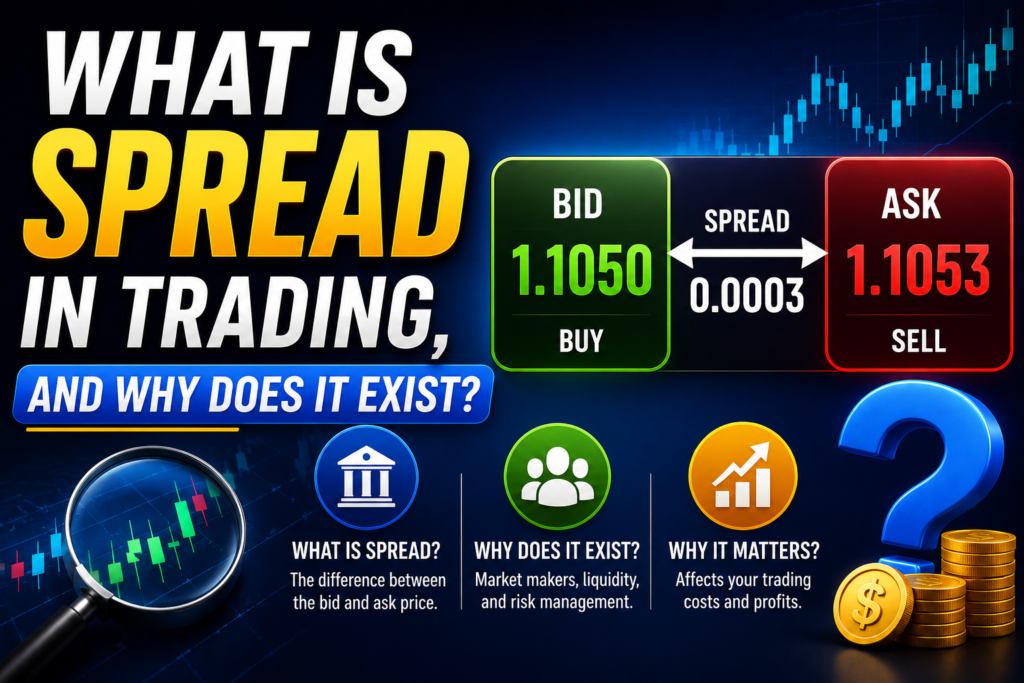
The basic cost that you pay when you trade is the spread, and a significant component of slippage vs spread is the real cost of trading. It is the difference between the sell price and the buy price, which you can see before making a trade.
Example (EURUSD):
- Bid: 1.1000
- Ask: 1.1002
- Spread: 2 pips
It denotes that each trade begins marginally at a loss. Spread may be seen and expected, but it is not the entire trading cost.
What Is Slippage in Trading and How Does It Happen?
Slippage occurs when your trade is filled at a price other than anticipated. In slippage vs spread, the concealed cost in the analysis of the actual trading cost is the hidden cost.
The slippage normally occurs due to:
- Fast market movement
- Low liquidity
- Market orders
- News events
In the majority of cases, slippage is not in favor of the trader.
How Does Slippage vs Spread Impact Your True Trading Cost Analysis?
Is it a slip vs spread that will determine the actual cost of a trade? It has spread, but the slippage has an additional hidden cost on the analysis of your real trading cost.
True Trading Cost Formula:
The actual cost of trading = Spread + Slippage + Commission.
Overlooking that slippery floors may make a good strategy look good on paper, but not on the trading floor.
Can You See Spread but Not Slippage?
Yes—and here the majority of traders fall into the rut. The slippage vs spread, where the spread is readily observable even before engaging in a trade, but slippage appears after the fact, and that creates a difference in your actual cost analysis of trading.
| Cost type | Visible Before Trade | Appears in Strategy |
| Spread | Yes | Yes |
| Slippage | No | Rarely |
| Commission | Yes | Yes |
Real EURUSD Example: Slippage vs Spread Breakdown
This example demonstrates the impact of slippage vs spread on the true analysis of your cost of trading in actual trading.
Trade Setup:
- Pair: EURUSD
- Lot Size: 1.0
- Spread: 1.2 pips
- Slippage: 0.8 pips
Cost Calculation:
| Cost component | Pips | Dollar value |
| Spread | 1.2 | $12 |
| Slippage | 0.8 | $8 |
| Total cost | 2.0 | $20 |
Slippage adds to the overall cost, although the cost distribution may appear low.
US30 Index Example: Why Is Slippage Worse on Indices?
The volatility of the indices, such as US30, is significantly greater than that of forex pairs, and this is the reason why slippage vs spread becomes a larger concern in this case. True trading cost analysis is further emphasized because prices are usually moving quickly, as well as the reduced liquidity at market openings.
US30 Trade:
- Spread: 2.5 points
- Slippage NY open: 3 points.
- Lot size: 1.0
Result:
| Cost | Points |
| Spread | 2.5 |
| Slippage | 3.0 |
| Total | 5.5 |
Although the spread fee is reasonable, the slipping costs are higher than anticipated. That is why most traders accuse their strategy, yet it is really bad execution on indices.
Does Slippage Affect Scalpers More Than Swing Traders?
Absolutely. Scalawags are affected by slippage vs spread as they deal with very small targets, and a single slippage will alter the results of the trade and your actual cost of trading analysis.
| Trading style | Slippage Impact |
| Scalping | Very high |
| Day Trading | Medium |
| Swing Trading | Low |
| Position Trading | Minimal |
Why Is Slippage Higher During News Events?
In news events, slippage tends to be significantly greater since in slippage vs spread, speedy fluctuating costs may severely alter your own trading expense analysis.
News creates:
- Liquidity gaps are when orders cannot be fulfilled immediately.
- The market shifts rather swiftly with rapid price fluctuations.
- Order queue imbalance in case of a large number of traders coming simultaneously.
Example:
NFP release EURUSD is 20 pips higher. NFP release: EURUSD jumps 20 pips; the broker fills at the next available price
Slippage is the difference between the promised price and the price executed.
How Do Lot Sizes Influence Slippage vs Spread?
Large orders are normally associated with higher slippage, which has a direct impact on your actual analysis of the true trading cost of slippage vs spread.
| Lot size | Slippage risk |
| 0.01 | Very low |
| 0.10 | Low |
| 1.00 | Medium |
| 5.00+ | High |
Trading tip: It is a common practice among institutional traders to divide large orders into smaller ones to decrease slippage and to maintain the execution as close to the expected prices as possible.
Can Slippage Ever Be Positive?
Yes—but it’s rare. In slippage vs spread, a positive slippage occurs in the instance of your trade being conducted at a better price than you had expected, and this enhances your true analysis of trading cost slightly.
- Positive slippage normally takes place when:
- The market is in your favor once you make an order.
- Price improvement passes at the time of execution.
It is important to keep in mind that the majority of brokers do not guarantee positive slippage, and it is always safer to assume that you will suffer negative slippage in your trade plan.
What Are the Most Common Trader Mistakes with Slippage vs Spread?
- Backtesting on paper—In theory, a strategy can work on paper, but in practice, it does not work in reality.
- Market trading news and market order- Fast markets generate a massive slip on news events.
- Excessive positioning—Larger lot sizes fatten the slip and risk of execution.
- Ignoring the execution reports—incomplete information on slippage cannot allow cost analysis.
FAQs
Q.1 What is the difference between slippage vs spread?
Bid-ask difference is referred to as spread, and the difference between the execution price is referred to as slippage. Both affect total cost.
Q.2 Is slippage always negative?
No, but negative is much more prevalent than positive.
Q.3 Which markets have the highest slippage?
Cryptocurrency, crypto, and news pairs.
Q.4 How can I avoid slippage completely?
It can be minimized, not removed, by performing it better and managing the risks.
Q.5 Is a low spread better than zero commission?
Not always. Commission savings can be overcome by slippage.
Conclusion
Knowledge of slippage vs spread will mean you know your real analysis of the cost of trade. Spread can be observed and expected, but slippage is unobservable and can silently consume profits, particularly among scalers, day traders, and index traders. Remember to always consider both of them in your strategy and apply appropriate order types, and keep an eye on their implementation.
By overlooking the slippage in the drive to attain low spreads, one may be led to believe that it is profitable. Having a watch on one and the other ensures smarter trades, minimization of unseen expenses, and elevated performance of trading in the long term.
Unlock smarter trading—discover how slippage impacts your bottom line versus spreads. Explore InsightfulTrade’s analysis tools to optimize execution, reduce hidden costs, and increase profits. Start your free trial now!
Author: Arihant Jain
Trading Experience: 5+ Years
Arihant Jain is a financial markets analyst and trading educator with expertise in Forex, indices, crypto, and risk-managed trading systems. His insights are based on real trading experience, data-driven analysis, and transparent market understanding. All content is reviewed for accuracy and aligns with Google’s EEAT guidelines.
Risk Disclaimer:
Trading involves substantial risk. All information is for educational purposes only and should not be taken as financial advice. Always do your own research.
Last Updated: 10 January 2026