Quick Summary
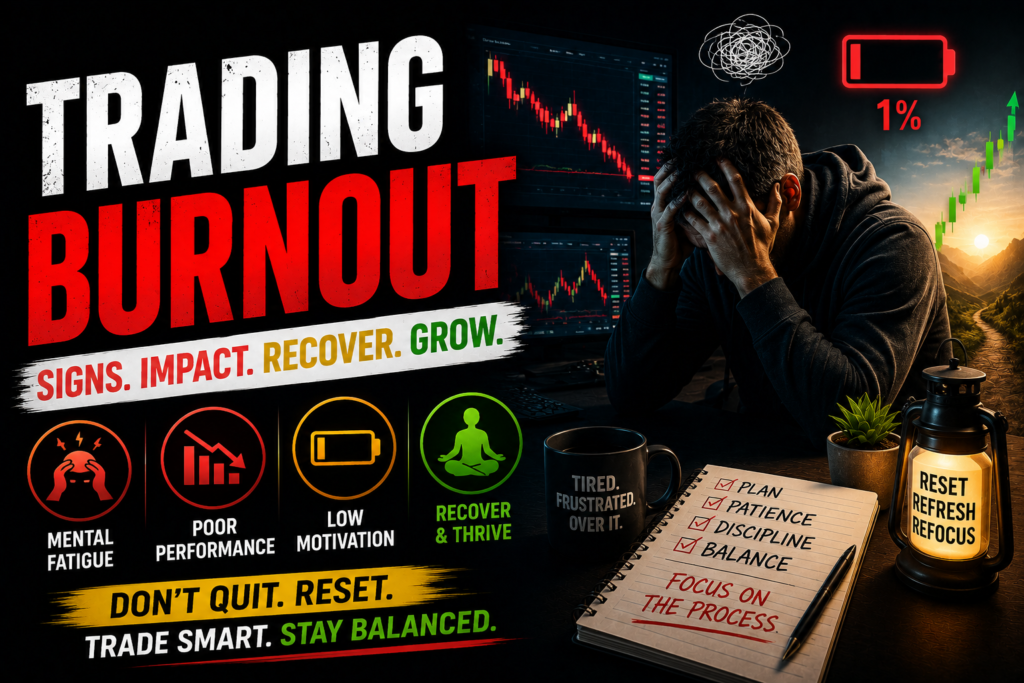
Trading burnout is basically what happens when your brain is exhausted. It’s that deep mental and emotional exhaustion that hits when you’re under constant market pressure without giving yourself a chance to recover. It actually ruins your result and your discipline more than any technical mistake ever could. Most traders think they’ve just lost their skills or that their strategy has stopped working. When in reality it’s just your emotions are overloaded and trying to live up to unrealistic goals.
In this blog, we break down why this burnout happens, how to spot the early signs of it and most importantly how we can prevent it or survive it.

Trading Burnout: Snapshot Overview
| Area | Impact on Trader |
| Mental Focus | Reduced clarity and slower decisions |
| Emotional State | Irritability, frustration, detachment |
| Trade Quality | Overtrading or hesitation |
| Risk Management | Inconsistent execution |
| Long-Term Growth | Loss of confidence and motivation |
What Is Trading Burnout?
Trading burnout refers to feeling tired when the market stays tough for too long. It’s when your brain has no battery left, your thinking slows down, and decisions that used to be easy to make, now feel heavy, confusing, and just exhausting.
Trading burnout usually creeps in when:
- The market feels like it needs your eyes on it 24/7.
- The emotional “hangover” from a win or loss never quite fades away.
- You start judging your own worth based on your daily profit and loss.
- You treat a lunch break or a day off like a “missed opportunity.”
You can identify physical tiredness, but realising trading fatigue is tough. As it’s something you need to identify from within, when while watching charts your focus starts to flicker, your calm disappears, and that inner confidence starts to feel like a distant memory.
Why Traders Are Especially Prone to Burnout
Trading is a mental workout like no other. Very few jobs cause:
- High uncertainty
- Immediate feedback (wins/losses)
- Financial risk
- Isolation
- No fixed schedule
This makes trading burnout more common than many traders realize.
1. Always-On Market Exposure
Markets like Crypto and Forex literally never sleep. Even though it feels like a great opportunity where there are no boundaries, it keeps your brain active 24/7 which eventually runs out of energy.
2. Emotional Compression
In trading, you can go from feeling a genius to feeling like a loser in a matter of minutes. Dealing with greed, fear and relief all in one hour is exhausting. This emotional compression is exactly what leads to that numb, burned-out feeling.
3. Self-Blame Culture
We start seeing losing trade as personal defeats. Even when a loss is just a normal part of the trading, we beat ourselves to avenge it. That constant self criticism drains your mental battery faster and leaves you exhausted.
4. Lack of External Structure
Being your own boss sounds great, but when there is no one to tell you to take a break or go on a holiday. The same freedom that draws us to trading often becomes the very thing that burns us out, because we don’t know how to give ourselves permission to stop.
Early Burnout Symptoms Trading Professionals Often Ignore
Catching the signs of burnout early is everything. Usually, your brain starts telling you that something is wrong before your performance actually falls off the cliff.
1. Emotional Numbness Toward Trades
You stop feeling anything when you win or lose. The trades feel empty or just plain annoying. The major red flag is when you stop caring, you stop being careful, and that’s when you start ignoring your risk limit.
2. Overtrading Without Conviction
You aren’t taking trades because when you find a perfect setup, you’re doing it because you’re restless or feel like you’ve to do something. Burnout often causes you to be more active, even though the quality of your trades are dropping.
3. Shortened Patience Window
Every setup starts feeling like it’s taking an eternity. You start exiting the trades early, or chasing a move because you’re too impatient to wait for a proper entry. 4.Increased Irritability and Self-Criticism
Tiny mistakes that used to be no big details now make you furious. You find yourself beating yourself up and playing a losing trade in your mind again-and-again even after closing your laptop.
5. Physical Symptoms
With time even your body starts showing signs. You start getting headaches, eyes start to feel strain, or waking up in between your sleeps. These are the clear signs of burnout.
Advanced Burnout Symptoms Trading Veterans Experience
Loss Trust in Yourself
You know your strategy works, but you’ve stopped trusting yourself to actually enter the trade. You lack your confidence.
Strategy Hopping
You start blaming your system instead of your stress. You jump from one indicator or market to another, thinking the strategy is broken when in reality you’re just mentally exhausted.
Avoidance Behavior
You avoid analysing and reflecting on your trades, you start feeling guilty for not being productive.
The Performance Cost of Trading Burnout
Burnout isn’t just a bad mood, it actually breaks your ability to trade well. Here’s how it affects your performance:
- You’re always a step behind
- Brain fog
- Impulse takes over
- Poor risk management
- Lower expectancy execution
Even the world’s best trading strategy doesn’t work when a person is exhausted from inside.
When you’re burned out your brain basically flips a switch into survival mode. It stops carrying about your big, long term goals and starts focusing on reducing your stress right now.
Why “Pushing Through” Makes Trading Burnout Worse
One of the most dangerous maths in trading is that being disciplined means pushing through even when you’re totally drained of your energy.
In reality, burnout actually kills your willpower.
When traders attempt to power through burnout:
- You ignore your own inner red flags
- You start getting used to sloppy and lazy trades
- You stop seeing the market as an opportunity.
You eventually end up in a loop where trading just makes you miserable, instead of being the tool that was supposed to give you freedom.
How to Recover From Trading Burnout (Without Quitting Trading)
Getting over burnout doesn’t mean quitting trading. It’s about taking smart breaks to get back on your track.
1. Reduce Exposure, Not Identity
You don’t need to quit trading entirely. Just a short break to avoid over-trading and over confidence.
This may mean:
- Fewer sessions per week
- Reduced position size
- Trading only A+ setups
2. Implement Hard Stop Rules
Trading without limit is the fastest way to cause burnout.
- Maximum daily screen time
- Maximum number of trades
- Mandatory off-days
Think of these rules as a way to protect your brain from setting fire. Having a solid structure protects your mental peace.
3. Separate Market Review From Execution
A lot of the stress that leads to burnout comes from trying to do your homework white you’re trading. It creates a lot of pressure for your brain to handle at once.
- Analyze the market while you’re calm
- Execute trades only when windows are open
4. Rebuild Confidence Through Process Wins
To rebuild your confidence and trading spark focus on:
- Sticking to your rules
- Keeping your trade size small and safe
- Clean execution
For a while, try to ignore the money entirely. Seriously. Recovering from burnout is all about learning to trust yourself again.
Mental Reset Techniques Used by Professional Traders
Professional traders don’t let such a situation occur. They use psychological resets as a regular part of their routine to stay sharp and focused.
- Scheduled trading breaks aligned with market cycles
- Moving their bodies, to burn-off the stress hormones
- Non-market hobbies that reintroduce novelty
- Journaling about feelings, to get them out of head
These practices aren’t just nice to have, they are high-performance tools that keep you in the game for the long run.

Preventing Trading Burnout Long-Term
The best way to manage trading burnout is to build a trading life that doesn’t let it happen in the first place. It’s about creating routine that’s actually meant to last:
Sustainable Trading Requires:
- Realistic expectations
- Defined trading seasons
- Acceptance of downtime
- Clear separation between self-worth and results
At the end of the day, trading is a long process and you’ll often feel tired in between. So slow down, take a deep breath and play the long game.
Conclusion
Trading burnout is like driving a car with flat tires, it ruins your focus, kills your mood and makes it impossible to stay consistent. Detecting the early signs of it, helps you hit the brakes before your result and your health starts to decline. Remember, getting back on your track isn’t about trying harder, it’s about slowing down, finding your inner peace and setting realistic goals.
If you want a counseling session or any kind of guidance you can always visit Insightful Trade’s website. Where the main focus is on building these calm, steady habits so you can trade for the long term instead of just burning out in a short time out of high-intensity stress.
FAQs
What is trading burnout?
Trading burnout is a state of mental and emotional exhaustion caused by prolonged trading stress, leading to poor decision-making and reduced performance.
What are the warning signs of burnout?
Look for brain fog feeling numb to results, revenge trading and a sudden drop in your usual discipline.
Is this the common issue for traders here in India?
Yes, often because of the isolation of trading alone and the stress of keeping up with complex local regulations.
Will taking a break hurt my result?
Not necessarily. In fact it recharges your focus and helps you stay sharp and resilient for long term.
Author: Kumkum Chandak
Experience: 3+ Years in Trading Research & Market Content Strategy
Kumkum Chandak is a trading content strategist and market research writer who specializes in simplifying technical analysis, trading tools, and strategy-driven educational content. Her work is optimized for EEAT, accuracy, and user intent, ensuring every article delivers practical insights for traders of all levels.
Risk Disclaimer:
All content is strictly educational and not financial advice. Trading involves substantial risk. Always perform your own analysis or consult a professional advisor.
Last Updated: 10 January 2026