
Quick Summary
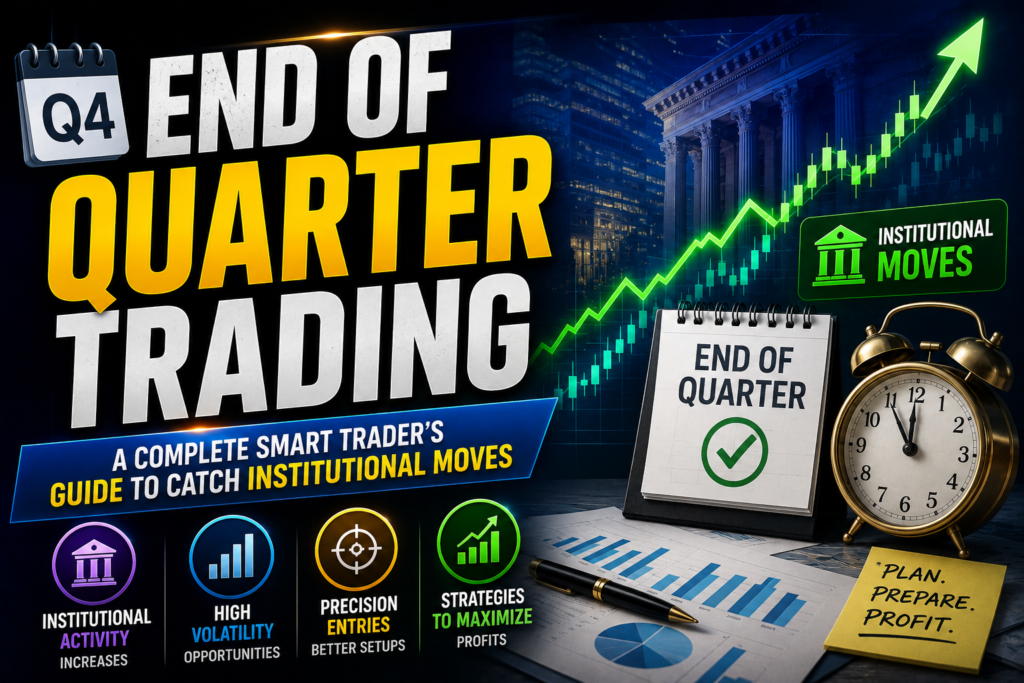
In the financial markets, the end of quarter trading is one of the important phases strategically. Many traders like you don’t understand it well. It makes the market behave very differently from normal trading days, and if you’re prepared for it, it can create high-reward opportunities.
Let’s explore this guide, where we’re going to learn:
- Which market is most affected by it?
- Step-by-Step End of Quarter Trading Strategy
- Most powerful end of quarter trading patterns
- Common mistakes and pro trader tips
What Is End of Quarter Trading, and Why Does It Matter?
It is that phase that occurs during the last 5-7 days of March, June, September, and December, which is driven by forced institutional money flow. At the end of these months, large institutions rebalance and close their books quarterly. At this time of this period, price is controlled by forced institutional money flow.
If you understand how to approach end of quarter trading, it proves incredibly beneficial for you and your trade. Want to know how?
- A large move is equal to better risk-reward
- Less news dependency
- Liquidity zones become highly predictable
- You get institutional direction instead of random noise
- Perfect for swing & positional traders
Let’s move forward to why it matters for traders:
The main reason is that during this period, market movement is driven by obligation instead of emotion.
- You start trading intention and stop trading noise
- Liquidity behavior becomes more predictable
- No matter what, institutions must move money
Which Markets Are Most Affected by End of Quarter Trading?
When we talk about the market, it is not necessary that during the end of quarter trading, every market react in the same way. Now, let’s make it clearer for you:
| Market | Why it Moves |
| EURUSD | Central bank & European fund rebalancing |
| GBPUSD | Pension fund adjustments |
| Gold | Safe-haven repositioning |
| USDJPY | Carry trade unwindings |
| NAS100/US30 | Fund inflow & quarterly performance display |
What are the Most Powerful End of Quarter Trading Patterns?
If you learn these patterns once, this phase becomes one of the easiest phases to read. Let’s learn about the patterns together:
- Trend Extension
- Liquidity Sweep & Reversal pattern
- Monthly-Quarterly Bias Shift Pattern
- Distribution After Trend Exhaustion
- Session-Based Liquidity Pattern
Step-by-Step End of Quarter Trading Strategy
Step 1: Identify Strong Quarterly Trend
If you align with this trend, it will help you in avoiding counter-trend trades and increase the chance of riding predictable and large moves.
Step 2: Mark Institutional Zones
It is very crucial because if you identify these zones alongside quarterly flows indices will help you enter trades with lower risk and high probability.
Step 3: Wait for Liquidity Sweep
It is very critical because institutions often push prices beyond obvious highs or lows to trigger retail stops before reversing.
Step 4: Enter on M15/M30 Reversal
Rather than chasing the spikes, it ensures that you’re entering with institutional momentum. So, wait for the confirmed reversal on M15 or M30 charts.
Real Market Examples (EURUSD)
| Entry | 1.0830 |
| Stop Loss | 1.0860 |
| Target | 1.0720 |
| Result | 110 pips |
Pip Value & Lot Size Table
| Lot Size | EURUSD Pip Value |
| 0.01 | $0.10 |
| 0.10 | $1 |
| 1.00 | $10 |
Pros & Cons of End of Quarter Trading
It offers the highest reward opportunities of the year with unique risks. If you understand both sides properly, it will help you approach.
| Pros | Cons |
| Strong institutional direction | Fake breakouts |
| High probability trend continuation | High speed & slippage |
| Predictable liquidity zones | Extreme volatility |
| Large pip & point movements | Not beginner-friendly |
| Best time for swing & positional trades | Gap risk near quarter close |
| Clear monthly bias formation | Psychological pressure |

Pro Trader Tips for End of Quarter Trading
Institutional-style traders used these tips to survive volatility, especially when quarterly flow indices like US30 and NAS100 are actively being rebalanced.
- Trade only during institutional sessions
- Reduce position size to protect capital
- Align with the quarterly trend
- Avoid holding over quarter close
- Journal every quarter-end trade.
- Watch the DXY and Bond yields
- Use limit orders instead of market orders
Common Mistakes Traders Make during End of Quarter Trading
If you misunderstand how institutional money behaves at quarter close, it can lead you to failure or make you make mistakes. Let’s see the mistakes that you can make during the End of quarter trading.
- Chasing breakouts without understanding liquidity
One of the biggest mistakes is chasing breakouts blindly without understanding. You can avoid it by waiting for a confirmation after a breakout, watching liquidity zones, or reducing lot sizes.
- Trading with a normal lot size
During the quarter-end, volatility is very high. So if you use the same position size, it will lead you to emotional decision-making or faster stop-outs.
- Overtrading during high volatility
It can be one of the biggest mistakes made by you because if you enter multiple trades without clear setups, it will lead you to an easily blown stop loss.
- Using tight stop losses
If you are using a tight stop loss, it is risky because stops placed too close will result in getting hunted quickly. So, to protect your capital, always stop beyond structural liquidity zones.
- Ignoring session timing
It is a common trap; if you ignore the session timing, you miss the clean liquidity sweeps and reversal setups that occur when institutions are active.
- Ignoring the quarterly trend
A major mistake is when you only focus on short-term charts and avoid the bigger picture. For higher-probability setups, always align trades with larger quarterly direction.
Frequently Asked Questions
1. Is end of quarter trading good for beginners?
If you’re a beginner, it is not recommended because this phase requires experience, and volatility is also high during end of quarter trading.
2. When does the end of quarter trading start?
Typically, it begins 5 to 7 days before the quarter ends, which is the final week of March, June, September, and December.
3. Which pair moves the most?
The pairs that move the most are EURUSD, US30, NAS100, GBPUSD, and Gold. From all of these pairs, EURUSD often provides the most reliable liquidity sweep and trend-extension setups.
4. Is news required?
No, end of quarter is not news-based because these moves are driven by institutional rebalancing, profit booking, and portfolio adjustments.
5. Can I scalp during quarter-end?
Yes, you can, but if you scalp during quarter-end, you need to reduce position size and also follow strict risk control rules.
Final Thoughts
If you are not prepared for this phase, it can feel unpredictable and chaotic. If you’re a retail trader, then it can be a little confusing or rewarding for you. If you learn to read the structure of quarterly, you will start your trading where money actually enters and exits instead of chasing candles.
To trade like institutions, you need to trade with patience, structure, and respect for volatility. So don’t rush. By trading lighter and staying disciplined, you can make the quarter-end one of your strongest windows of the year.
So, traders, are you ready to trade smarter during this phase of the year? Don’t get nervous, and master end of quarter trading with InsightfulTrade’s expert strategies. Start trading with confidence instead of guessing!
Author: Arihant Jain
Trading Experience: 5+ Years
Arihant Jain is a financial markets analyst and trading educator with expertise in Forex, indices, crypto, and risk-managed trading systems. His insights are based on real trading experience, data-driven analysis, and transparent market understanding. All content is reviewed for accuracy and aligns with Google’s EEAT guidelines.
Risk Disclaimer:
Trading involves substantial risk. All information is for educational purposes only and should not be taken as financial advice. Always do your own research.
Last Updated: 09 January 2026