
Introduction
Many of us spend so much time obsessing over indicators and chart patterns and still get inconsistent results. Usually the main problem is not your strategy, it’s actually where you enter the trade. Because being right about the market direction does not help if you enter at the wrong price, it could only double your risk.
That’s why a trade location strategy is so important. It’s about finding the best spot on the chart where your risk is less and the profit potential is huge. Rather than asking whether price will move up or down, traders learn to ask a more important question: is this the best trade location forex currently offers?
To understand the power of location, compare these two entry scenarios:
| Feature | Poor Trade Location (Chasing) | Prime Trade Location (Strategic) |
| Entry Point | Entering after a big move has happened | Entering at a “Value Area” (Pullback/Support) |
| Stop Loss | Must be wide (more money at risk) | Can be tight (less money at risk) |
| Profit Potential | Limited (market is already exhausted) | High (catching the meat of the move) |
| Psychology | High stress / FOMO-driven | Calm / Discipline-driven |
This blog explains how a bad entry can lead to so many unnecessary losses and how you can develop a clear plan to find the high quality trade using logic rather than just your gut feeling.
The Core Problem: Why Direction Alone Is Not Enough
Correct Direction, Poor Outcome
We have all faced this before at least once, where we are right about the market’s direction but still end up losing money. The price eventually moves exactly like you thought it would, but only after you have been taken out of the trade or because the setup just wasn’t worth the risk.
This usually happens because the trade was taken at an inefficient location. Without a trade location strategy, traders often enter:
- Late into trends
- In the middle of ranges
- At emotionally driven price levels
Direction without location exposes traders to unnecessary drawdowns and emotional decision-making.
Why Trade Location Matters in Forex Trading
Price Moves in Phases
Forex price movement is not random. Markets move through phases of expansion, retracement, consolidation, and continuation. The quality of a trade depends on which phase the trader enters.
A trade location strategy helps traders align entries with:
- Areas of reduced risk
- Logical invalidation points
- Favorable reward potential
This is why experienced traders emphasize best trade location forex rather than frequent entries.
What Is a Trade Location Strategy?
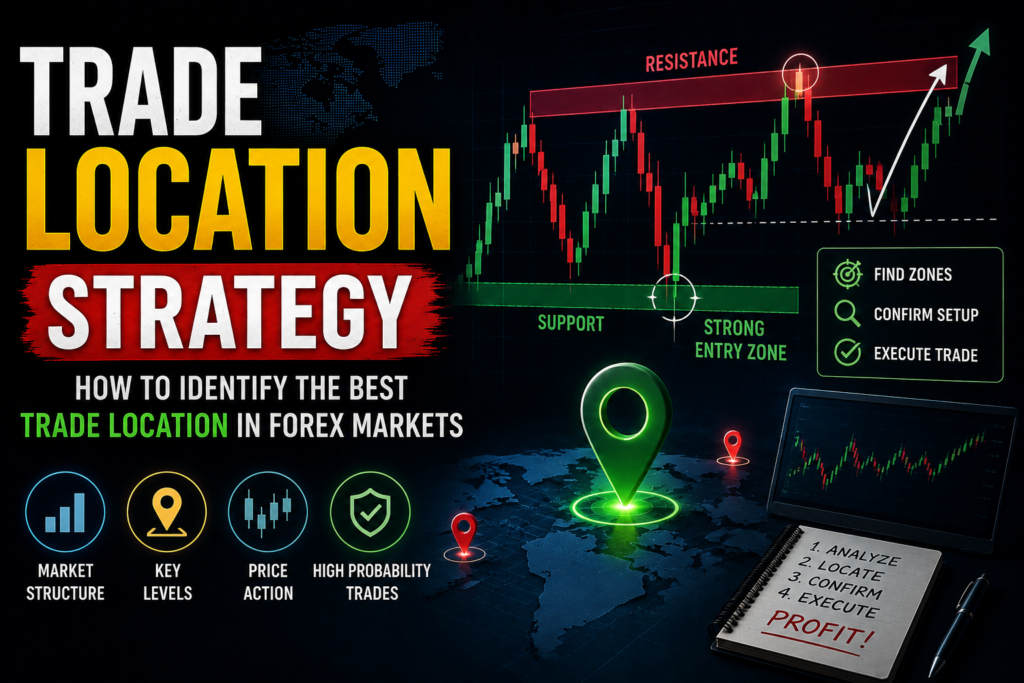
Think of a trade location strategy as your plan for picking out the perfect spot on the chart to enter a trade, no matter what signal you use. It looks at the market structure, finds where the money is hidden and even the time of day.
So instead of just chasing the price, it helps you stay patient and selective. A good trade spot does not guarantee success, but it makes your trading much more consistent and reliable over time.
Components of an Effective Trade Location Strategy
1. Market Structure Awareness
The prices through its highs and lows often tells us about the market structure. And trading in sync with the structures helps you spot the specific hotspot where price is most likely to bounce or turn.
For example:
- Buying at the buys zone where the big players have entered before.
- Selling at the resistance level that the price is struggling to break.
A good location based strategy focuses on the real structure areas instead of just reacting to some random indicator signal.
2. Risk-to-Reward Efficiency
The main reason behind looking for the best trade location forex: it makes your risk much more efficient. By entering near the level where your trade idea was proven wrong you can use a tight stop loss and set yourself up for a much bigger potential profit.
If your entry is sloppy, then you have to use a wider stop loss. Which ends up draining your overall success over time, even if you are still winning just as many trades as before.
3. Liquidity and Order Flow Context
The price loves reacting at spots where lots of orders are being placed. These are the areas where big institutions participate.
A smart way to enter a trade is by finding these spots and waiting for the market to tap into that money before real move finally takes off.
Best Trade Location Forex: Common High-Probability Areas
Pullbacks Within Trends
Entering during pullbacks rather than breakouts improves trade location quality. Pullbacks offer:
- Reduced risk
- Clear invalidation levels
- Improved reward potential
This is one of the most commonly applied best trade location forex principles.
Range Extremes
In ranging markets, the edges of the range offer better trade locations than the middle. Trades taken at range highs or lows allow for defined risk and logical targets.
The middle of the range often represents uncertainty, making it a poor trade location.
Higher-Timeframe Key Levels
The levels you spot on “big picture” charts are much more powerful. Since the major players watch these areas you get a more clear reaction.
This helps you stay disciplined and prevents you from overtrading every tiny, meaningless spike on the small charts.
Why Poor Trade Location Leads to Overtrading
If you enter a trade without a clear plan, it usually leads to:
- Chasing the price
- Getting in a way too late
- Ignoring the big picture
Over time, this behavior drains your account with extra fees and leaves you with nothing. So waiting for the best entry spot is the best option, choose quality over quantity.
Practical Trade Location Strategy Example
Example: Range-Bound Market Trade
Price trades within a clear range on EUR/USD. The trader avoids entries in the middle and waits for price to approach the upper boundary.
Why this is effective:
The best trade location forex in a range is near extremes, where invalidation and targets are clearly defined.
Why Trade Location Strategy Improves Discipline
Discipline is often misunderstood as resisting emotion. In reality, discipline is a result of having clear rules. A trade location strategy limits decision-making by defining where trades are allowed.
This reduces:
- Impulsive entries
- Emotional exits
- Inconsistent results
Traders no longer ask “should I trade now?” but “is this a valid trade location?”
Common Mistakes in Trade Location Strategy
Trading the Middle of the Move
Entering a trade after the price has already taken off is a classic trap, by the time you enter the trade the profit would be already gone and you will be forced to take a huge risk.
Ignoring Higher-Timeframe Context
If you are only looking at small timeframes avoiding larger timeframes then you are missing out on the bigger picture and this often leads to poor trade location.
Confusing Activity With Opportunity
Just because the price is moving a lot doesn’t mean that there is a good trade, don’t let the fast moving chart trick you into thinking you must do something.
Tools That Support Trade Location Strategy
You don’t need any high-tech tools to find the best trade, just a few simple tools can be enough help:
- Chat that let you see multi time frames at once
- Markers that track different market sessions
- And calculators to quickly check your risk to reward ratio.
These tools can make your analysis easier and help you find the best trade spot.
Trade Location Strategy and Risk Management
A trade location strategy works hand-in-hand with risk management. A great entry spot gives you:
- Tighter stop losses which means less money at risk
- Way more profit potential
- and it also reduces emotional pressure
Managing your money becomes easy when you enter at the rightly, planned level instead of just panicking and jumping in.

Regulatory and Compliance Considerations in India
If you want to trade in India you must ensure:
- To use only the brokers officially registered with SEBI.
- Stick to the specific currency pairs the law allows.
- And stay fully compliant with RBI and FEMA rules.
Following these rules makes your analysis more easier, and it helps you in avoiding any conflict with regulatory guidelines when applied responsibly.
Conclusion
A trade location strategy helps you in avoiding trading here and there, start looking for the best setups only. By focusing on exactly where you enter helps in improving your risk, keeping your emotions in control and finally finding some consistency.
So rather than just depending on the price or indicators, this approach teaches you to be patient and make logical decisions based on the bigger picture. And if you are looking for further guidance, visit Insightful Trade’s website. Here they help you trade with the proper structure and reasoning rather than just reacting to every spike on impulse.
Frequently Asked Questions (FAQs)
What tools work best for trade location strategy?
There are some basic tools that let you check different time frames. Using session markers and risk calculators can also be helpful to stay organised.
Is trade location strategy suitable for beginners?
Yes. Beginners benefit from learning to wait for quality locations rather than trading frequently.
Is the best trade location for forex always near support or resistance?
Not always. Best trade location depends on market context, structure, and risk-to-reward considerations.
Is forex trading legal in India?
Forex trading is legal in India when conducted through SEBI-regulated brokers and approved currency pairs.
Does a trade location strategy guarantee profits?
No strategy guarantees outcomes. Trade location strategy improves probability and risk efficiency but does not eliminate losses.
Author: Kumkum Chandak
Experience: 3+ Years in Trading Research & Market Content Strategy
Kumkum Chandak is a trading content strategist and market research writer who specializes in simplifying technical analysis, trading tools, and strategy-driven educational content. Her work is optimized for EEAT, accuracy, and user intent, ensuring every article delivers practical insights for traders of all levels.
Risk Disclaimer:
All content is strictly educational and not financial advice. Trading involves substantial risk. Always perform your own analysis or consult a professional advisor.
Last Updated: 9 December 2025