
Introduction
Most of the forex lessons focus on how to enter a trade, but they rarely talk about the most important skill: knowing when to stay away. Many losses do not occur because a strategy is flawed, but because trades are taken during unsuitable market conditions.
The truth is that the markets don’t always offer good opportunities. There are times when price gets erratic, volume disappears, or news makes things weird. Trading during these messy phases puts your money at risk, no matter how good your strategy may be.
| Market Factor | Trade (Good Conditions) | Stay Out (Bad Conditions) |
| Liquidity | Major session overlaps (London/NY) | Bank holidays or late Asian session |
| Price Action | Clear trends or respected ranges | “Choppy” movement with no direction |
| News Events | Calm economic calendar | High-impact data (NFP, CPI, Rates) |
| Spread/Cost | Tight, stable spreads | Widened spreads & high slippage |
| Mindset | Objective and disciplined | Emotional (Revenge trading/FOMO) |
This guide explores when not to trade forex, explains the reasoning behind bad market conditions trading, and provides structured examples to help traders recognize environments where staying out of the market is the more disciplined decision.
The Core Problem: Overtrading in Unfavorable Conditions
Why Traders Feel the Need to Always Trade
It’s a common trap that you think if you stay active every single day you’ll become profitable. In fact this mindset creates a lot of pressure on a trader to find a trade in every session, even when the charts look like a mess. But the truth is, the market isn’t always “open for business” in a way that makes sense for your strategy.
Successful trading depends on a few things lining up:
- Plenty of money moving through the market
- Big banks and institutions actually participating
- A calm economic news cycle
- A clear, readable chart structure
When these pieces are missing, trading becomes more of a gamble than a real plan. Knowing exactly when to step back isn’t “missing out”—it’s how you protect your bank account and your sanity for the moments when the high-quality trades finally show up.
Why Market Conditions Matter More Than Strategy
A trading strategy does not operate in isolation. Its effectiveness depends heavily on market conditions. A strategy that performs well in trending or liquid markets may fail during low-volume or erratic phases.
Bad market conditions trading often leads to:
- Increased stop-loss hits
- Slippage and poor execution
- Emotional decision-making
- Misinterpretation of price signals
Recognizing unsuitable conditions is not about avoiding losses entirely, but about avoiding low-quality risk.
Understanding Bad Market Conditions Trading
What Defines a “Bad” Market Condition?
Bad market conditions trading does not mean the market is inactive. In many cases, price is moving, but without structure, intent, or liquidity. These conditions make it difficult to apply analysis consistently.
Markets become unfavorable when:
| Feature | Favorable (Good) Conditions | Unfavorable (Bad) Conditions |
| Price Action | Clear trends or well-defined ranges | “Choppy” or erratic movement |
| Liquidity | High (Major session overlaps) | Low (Bank holidays, late Asian session) |
| Spreads | Tight and stable | Widened or fluctuating |
| Order Execution | Instant with minimal slippage | High slippage and re-quotes |
| News Environment | Quiet or factored-in data | High-impact “Black Swan” or fresh data |
Knowing when not to trade forex requires identifying these environments before committing capital.
When Not to Trade Forex: Key Market Scenarios
1. Low-Liquidity Trading Sessions
Forex markets may remain open 24 hours a day, but the big money is definitely not always active. The market goes through a quiet phase where very few traders participate.
Why this matters:
I notice that low liquidity raises the spreads and cuts the order flow reliability. I also notice that price movements, during those periods mislead traders and price movements make the technical setups less dependable.
In those markets bad market conditions trading happens. The price reacts to orders of meaningful institutional activity.
2. Choppy or Range-Bound Markets Without Clear Structure
Markets frequently consolidate, moving sideways within narrow ranges. While some strategies are designed for range trading, many trend-based or breakout strategies perform poorly in these conditions.
Why this matters:
Without clear structure, traders often misinterpret false breakouts as genuine moves. This leads to repeated small losses and frustration.
Understanding when not to trade forex includes recognizing when price lacks commitment in either direction.
3. High-Impact News Events and Data Releases
Major economic announcements such as interest rate decisions, inflation data, or employment reports can significantly distort price behavior.
Why this matters:
During high-impact news:
- The cost to trade (spreads) increases
- Your orders might get filled at much worse price than you intended (slippage)
- Prices can spike unpredictably
Even if you’re 100% correct about a trade, it can fail. Bad market conditions trading during news events exposes traders to risks unrelated to analysis.
4. Immediately Before or After Major Market Opens
Market opens, particularly London and New York, often involve rapid price adjustments as liquidity enters the market.
Why this matters:
Initial volatility may not reflect true market direction. Early moves can be liquidity-driven rather than trend-driven, leading to premature entries.
Waiting for structure to develop is often a better approach when deciding when not to trade forex during these periods.
5. After Extended Winning or Losing Streaks
Market conditions are not the only factor. Trader psychology also influences decision-making.
Why this matters:
After consecutive wins, traders may become overconfident and trade marginal setups. After losses, traders may force trades to recover quickly. Both situations increase the likelihood of bad market conditions trading, even if the market itself is neutral.
Practical Examples of When Not to Trade Forex
Example 1: Low-Volume Asian Session Trade
Suppose you are trying to trade a breakout strategy on EUR/USD during the quiet tail-end of Asian sessions.And the price passes to the resistance a little bit, but immediately reverses back and sinks.
Why the trade failed:
This trade failed due to low liquidity. Institutions were not active, making the move unreliable. This was a classic example of trading when not to trade forex.
Example 2: Trading During a Central Bank Announcement
Suppose you’re trading right before an interest rate announcement, expecting the current trend to continue.
Why the trade failed:
The market suddenly went wild, the cost of trade also spiked and you were kicked out early as your stop loss got hit. This is a perfect example of a trade failing not because of your analysis but because the market environment was not favourable.
Why Avoiding Trades Can Improve Long-Term Performance
Choosing to stay away from bad markets is a smart, and correct decision to stay safe.
By avoiding bad market conditions trading, traders:
- You protect your capital for a better day
- Stay calm and level-headed
- Stop yourself from trading out of boredom or FOMO
- Raise your chances of winning in the long run
And the end, successful trading isn’t about how many trades you take, it’s about the quality of trades you take.
Tools That Help Identify Bad Market Conditions
While no tool can replace judgment, certain tools support decision-making:
- Economic calendars for news awareness
- Session indicators to track liquidity phases
- Volatility measures to identify abnormal conditions
These tools help traders decide when not to trade forex, rather than forcing entries.
Regulatory and Compliance Considerations in India
Indian traders must trade within:
- SEBI-regulated broker frameworks
- RBI and FEMA guidelines
- Approved currency pairs only
Avoiding bad market conditions trading also aligns with responsible trading practices encouraged by regulatory bodies, as it emphasizes risk control and capital preservation.

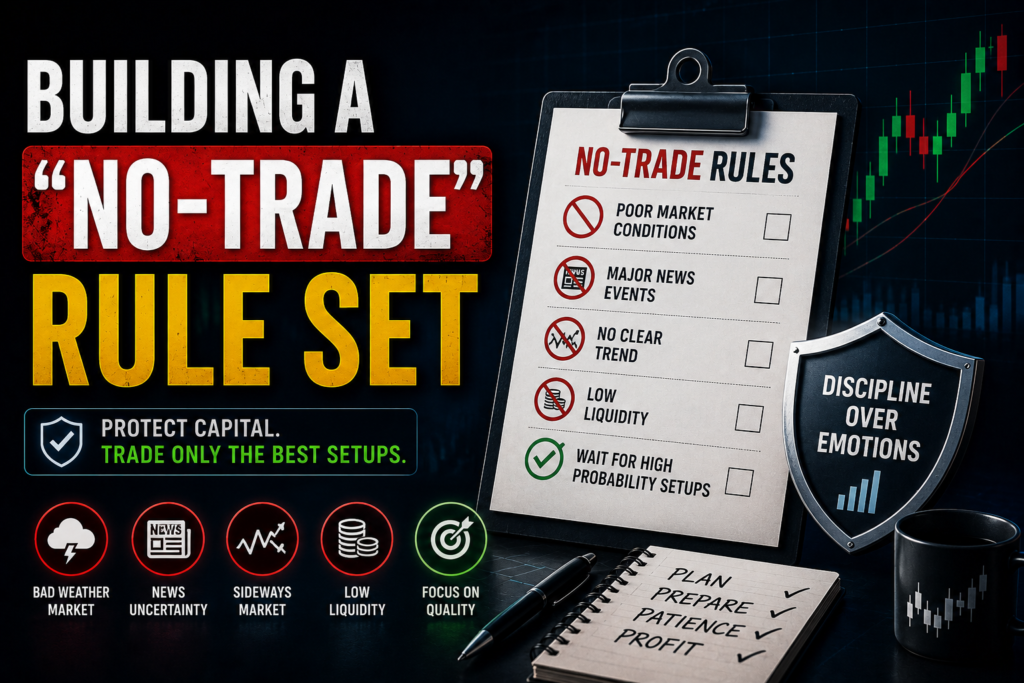
Building a “No-Trade” Rule Set
Just as traders define entry rules, they should define conditions under which they will not trade. These may include:
- Specific sessions
- High-impact news windows
- Excessive volatility or low volatility
- Emotional states affecting judgment
Having predefined rules clarifies when not to trade forex and removes uncertainty during live market conditions.
Conclusion
Understanding when not to trade forex is as important as knowing when to enter. Trading when the market conditions are bad is like putting your hard-earned money at risk, and often it has nothing to do with how good or bad your strategy was. That’s why learning how to spot those dead quiet periods or times when price is just jumping around unpredictably. You can avoid making bad decisions and saving both your energy and capital for the real opportunities.
That’s why platforms like InsightfulTrade focus on understanding the market’s mood. And they also provide guidance to traders on this concept, helping them in taking strategic decisions that support long-term consistency.
Frequently Asked Questions (FAQs)
How do I know when it’s better to avoid trading?
We don’t have any tools for this. But you can use economic calendars to avoid chaos of major market events, indicators which show when the market is too quiet to move and volatility tools that warn you ahead when the things are about to get messy.
Is avoiding trades considered good trading practice?
Yes. Avoiding bad market conditions trading is a form of risk management and discipline.
Is this helpful for beginners to learn?
Absolutely. Most of the time newbies think that they have to trade 24/7 to make money, which eventually leads to unfortunate losses. So it’s important for them to know when not to trade to protect their capital and confidence.
Is forex trading legal in India?
Forex trading is legal in India when conducted through SEBI-regulated brokers and permitted currency pairs.
If I avoid trading in a bad market can I reduce my losses?
There is no guarantee in trading, but it’s like staying at home during a storm. You might make losses, but you can avoid big losses when the market behaves badly. It’s like choosing quality over quantity.
Author: Kumkum Chandak
Experience: 3+ Years in Trading Research & Market Content Strategy
Kumkum Chandak is a trading content strategist and market research writer who specializes in simplifying technical analysis, trading tools, and strategy-driven educational content. Her work is optimized for EEAT, accuracy, and user intent, ensuring every article delivers practical insights for traders of all levels.
Risk Disclaimer:
All content is strictly educational and not financial advice. Trading involves substantial risk. Always perform your own analysis or consult a professional advisor.
Last Updated: 4 January 2026