Introduction
The NAS100 is one of the fastest and most exciting markets in the world, but it can also be scary sometimes. Because it works with tech giants and innovators, it behaves very differently from benchmarks like the Dow Jones. To trade it successfully, you can’t just depend on watching the charts—you have to understand the nas100 market drivers that are actually pulling the strings.
Everything from how the central banks handle interest rates to the latest breakthrough in AI can send the index soaring or diving in minutes. In this guide, we’re going to pull back the curtain on what really makes tech stocks tick. We’ll explain the mechanics in simple and clear language so you can build a clearer framework for your analysis and stop guessing about the next big move.

Understanding the NAS100 Index Structure
Before we start our discussion on various NAS100 market drivers, it is important for you to understand what the index represents. The NAS100 is a high-performance engine which handles the 100 largest non-financial companies listed on the Nasdaq exchange. It includes massive tech firms, global communication services, and innovative retail brands.
Key characteristics of the NAS100 include:
- The index is highly concentrated in some of the world’s largest tech companies.
- The main objective of these companies is long-term innovation and expansion.
- The companies within the index are extremely sensitive to the broader economy.
Because of these reasons, the NAS100 often reacts faster and more aggressively to market developments than broader indices.
Why NAS100 Moves Differently from Other Indices
The NASDAQ is fundamentally a growth index. Unlike “value” indices who depend more on what companies are making right now—the NAS100 lives and breathes on what might happen next. Which is why the NAS100 market drivers are extremely sensitive to any shift in the economic climate.
Key differences include:
- These stocks often have much more higher valuation multiples
- The index heavily depends on consistent innovation and expansion
- There is an increased sensitivity to the cost of doing business.
Understanding these distinctions helps traders interpret NASDAQ movement reasons more accurately.

Interest Rates as a Primary NAS100 Market Driver
Interest rates are among the most powerful NAS100 market drivers. If they go up, they pull everything down, and when they go down, tech stocks feel like they can fly. This happens to most of the companies because they are valued on the basis of the money they expect to make throughout the year, rather than just the cash they have in the bank today.
When interest rates rise:
- Investors use a higher discount rates to value future earnings
- High-growth companies high valuation pressure
- The NAS100 often starts to underperform, because investors start moving their money to safer options.
When interest rates fall:
- Growth-oriented stocks become much more attractive
- The Capital naturally starts flowing back to technology sector
- The strength of NAS100 also increases
This explains how the NASDAQ reacts to central bank commentary.
Tech Stock Fundamentals and Earnings Growth
Even though the mood of the market and interest rates matters a lot, in the long-term journey the nasdaq highly depends on strong tech stock fundamentals. If the tech giants are not growing and making more money then the market rally will eventually run out of stream.
Key fundamental factors include:
- Consistent growth of revenue with innovation
- Strong profit margins supported by scalability
- Guidance and future growth projections
Even when the general economy looks bullish, weak fundamentals can limit upside in individual NAS100 components.
Innovation Cycles and Product Expansion
Innovation is a very unique concept of NAS100 market drivers and it is often underestimated. Huge technology developments such as the rise of artificial intelligence, the switch to cloud computing, etc can bring massive changes in the index.
Innovation impacts NAS100 by:
- These changes will make new ways for companies to make money
- Innovation cycle acts like a magnet, attracting new big investors
- Successful innovation lead to long-term growth in valuation
Understanding innovation cycles helps traders identify structural trends rather than short-term noise.
Macroeconomic Data and NASDAQ Movement Reasons
Big economic reports like inflation, jobs or interest rates that we receive in every short while acts like a weather forecast for the market. These Macroeconomic indicators are massive NAS100 market drivers because they provide the data that traders use to guess the companies future earnings.
Key macro influences include:
- Inflation data is the top priority for traders.
- Employment data gives us an assumption on cucumber expendings and demands.
- Overall economic growth or GDP acts as a signal for corporate spending
But apart from the positive data, the expectations and results can also change the move of NASDAQ.

Market Sentiment and Risk Appetite
Because the NASDAQ is packed with growth-oriented companies it is common for traders to rush here when they feel optimistic about the market, but also to exit when they feel nervous. The collective is one the most important NAS100 market drivers, they often cause short-term swings in the market.
Sentiment-driven NAS100 market drivers include:
- The overall capacity for risk
- General volatility levels
- The way big institutions and retail traders are positioned
In most of the cases, the big NAS100 market drivers are rooted in these psychological shifts rather than fundamentals alone.
Liquidity and Capital Flows
Liquidity conditions influence how aggressively investors allocate capital to growth assets. Easy financial conditions often support NAS100 rallies, while tightening liquidity pressures valuations.
Liquidity affects NAS100 through:
- The availability of cheap capital
- Institutional portfolio allocation
- Overall risk tolerance across all asset classes
Understanding liquidity cycles strengthens long-term NASDAQ analysis.
Dollar Strength and Global Exposure
Many NAS100 companies generate significant revenue internationally. As a result, currency movements indirectly influence NAS100 market drivers.
When the U.S. dollar strengthens:
- International revenue shrink when they’re converted back to USD
- American products become more expensive for foreign customers
- Analyst often lower their future earning expectation
Dollar trends are therefore an important but often overlooked NASDAQ movement reason.
Regulation and Policy Risks
Regulatory changes can influence tech valuations, especially in areas such as data privacy, competition laws, and global trade policy.
Policy-related NAS100 market drivers include:
- Antitrust investigations
- Technology regulations
- International trade restrictions
These risks often create sector-wide volatility even when fundamentals remain strong.
Short-Term vs Long-Term NAS100 Market Drivers
Not all drivers influence the NAS100 equally across timeframes. Traders must distinguish between short-term catalysts and long-term structural trends.
Short-term drivers:
- Economic data releases
- Earnings announcements
- Central bank communication
Long-term drivers:
- Innovation cycles
- Demographic and digital adoption trends
- Structural capital allocation
Aligning strategy with timeframe improves decision-making.
Common Mistakes Traders Make with NAS100 Analysis
Many traders misunderstand NAS100 market drivers, leading to poor risk management.
Common mistakes include:
- Treating NAS100 like a value index
- Ignoring interest rate sensitivity
- Overtrading earnings volatility
- Focusing only on headlines
Avoiding these errors leads to more consistent NASDAQ trading performance.
Building a Professional NAS100 Trading Framework
Professional traders combine multiple drivers into a cohesive framework rather than relying on a single factor.
A structured approach includes:
- Monitoring interest rates and yields
- Tracking tech stock fundamentals
- Evaluating sentiment and liquidity
- Using technical levels for execution
This integrated method allows traders to interpret NASDAQ movement reasons with greater clarity.

Conclusion
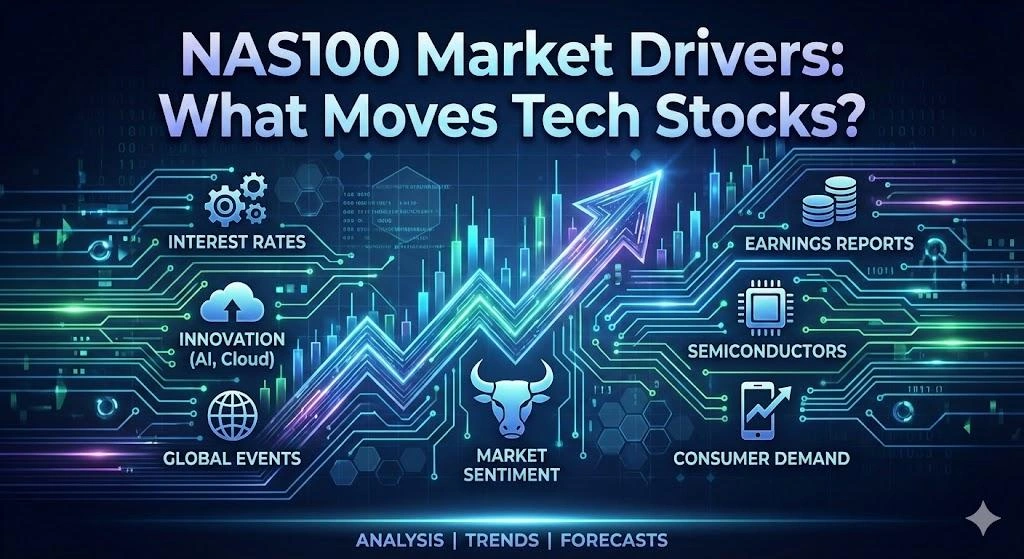
Even though the Nasdaq moves like a roller coaster, it does not move randomly — they follow a very specific logic. Factors like interest rates, company earnings, and the latest tech breakthroughs all work together to drive the price.
By learning how these factors work on Nasdaq, you can stop reacting emotionally to every market dip and start trading with real confidence. Instead of guessing, you’ll understand the actual “why” behind the price action.
At InsightfulTrade, we help you bridge the gap between complex market news and your actual trades. We provide the guidance you need to connect the big picture with a disciplined plan, helping you navigate the Nasdaq like a pro.
FAQs
- What are the main NAS100 market drivers?
The main factors that cause spikes in the NAS100 market are interest rates, earnings growth, innovation, sentiment, and liquidity. - Why is NAS100 sensitive to interest rates?
Because tech valuations rely heavily on future earnings expectations. - Do fundamentals still matter for tech stocks?
Yes, strong tech stock fundamentals are essential for sustained trends. - How does sentiment affect NAS100?
Risk-on sentiment supports growth stocks, while risk-off pressure hurts them. - Is the NAS100 suitable for beginners?
Yes, but understanding volatility and macro drivers is essential.
Author: Kumkum Chandak
Experience: 3+ Years in Trading Research & Market Content Strategy
Kumkum Chandak is a trading content strategist and market research writer who specializes in simplifying technical analysis, trading tools, and strategy-driven educational content. Her work is optimized for EEAT, accuracy, and user intent, ensuring every article delivers practical insights for traders of all levels.
Risk Disclaimer:
All content is strictly educational and not financial advice. Trading involves substantial risk. Always perform your own analysis or consult a professional advisor.
Last Updated: 25 December 2025