
Introduction
As an Indian trader, you could find it difficult to stay in business without being able to understand the US30 volatility India. The US30 or the Dow Jones Industrial Average does not conform to random movement, and its ups and downs can either make or ruin your trading day. Understanding the volatility of NAS100 in IST and the optimal time of day to trade indexes in India will enable you to trade with confidence regarding the entry, exit, and stop-loss points.
Think of trading when the market is open and at the right time, US30; you can be able to make larger moves without having to risk it unnecessarily. We are going to deconstruct all that, including the US3000 reaction in the Indian trading hours, practical advice, real-life examples, and even those strategies that actually work with Indian trading. At the end, you will be in a position to know when and how to trade US30 and NAS100 to maximize market volatility.

What Is US30 Volatility and Why Does It Matter in India?
Therefore, when trading in India, it is a necessity to know the US30 volatility India. The US30, the index that follows the top 30 industrial magnates in the US, does not move without a reason; its price fluctuations can be enormous, and knowing when and how it is going to change is all that matters.
- The US30 market opens at 7:30 PM IST, although the actual action commences between 8 PM and 11 PM IST.
- It is at this point that volatility is highest, i.e., larger swings—larger opportunity to make profits.
- Naturally, the larger the swings, the larger the rise, and you must be ready.
How Is NAS100 Volatility in IST Different from US30?
In case you are trading in India, NAS100 volatility in IST is slightly different from US30. NAS100 is sensitive to earnings and news, meaning it is faster to respond to them compared to US30.
| Index | Opening in IST | Average Daily Volatility | Best Trading Window IST |
| US$30 | 7:30 PM | 100–200 points | 8 PM – 11 PM |
| NAS100 | 7:30 PM | 150–300 points | 8:30 PM – 11 PM |
Key Takeaways:
- Swing NAS100 Swing is used in high-dollar, high-risk trades.
- US30 is more predictable—fewer difficult stops.
- The most important thing is timing; NAS100 will be high at about 8.30 PM IST, and US30 a little bit before that.
What Are the Main Drivers of US30 Volatility India?
- Economic Events: Non-Farm Payrolls, CPI, and FOMC meetings are major US data points that can lead to significant fluctuations.
- Corporate Earnings: Earnings of Dow 30 companies may result in unexpected rises in prices.
- Global Risk Sentiment: US30 and NAS100 volatility in IST are influenced by global risks, which are geopolitics, oil prices, and Fed announcements.
- Technical Levels: The most important support and resistance levels can result in stop-hunts, resulting in short-term volatility.
How Can Traders Measure the US30 Volatility India Effectively?
In India, it is not more difficult to trade US30 volatility India, knowing the correct tools:
- ATR (Average True Range): This is a measure of average price changes.
- Bollinger Bands: Expanding Bands = increased volatility.
- VIX (Volatility Index): Displayed are the anticipated swings in the market.
Example:
US30 ATR (15-min) = 50 points, and a 2-lot action is possible to swing one 6500.

What Is the Best Time to Trade US30 in India?
- 7.30 PM to 9.30 PM IST: Pre-market and early US session—ideal for detecting early trends.
- 9:30 PM – 11 PM IST: Liquidity is highest and news-driven—get larger intraday swings.
Error to be avoided:
It is dangerous to trade in US30 from 5 PM to 7 PM IST. The liquidity is poor, spreads can become spiky, and price action can be unpredictable, as it becomes easy to get stopped out.
How Does Index Volatility Timing India Affect Trading Strategies?
- Change lot size: Larger swings = smaller lots.
- Select a strategy: scalping, day trading, or swing trading according to volatility.
- Minimize risk: Reducing risk will help you not be stopped out during periods of low volatility.
Volatility vs. Trading Strategy.
| Volatility Range | Best Strategy | Risk Level |
| Low (<50 pts/hr) | Swing/Trend | Low |
| Medium (50-150) | Day trading/scalping | Medium |
| High (>150) | scalping/hedging | High |
How Do Lot Sizes Impact Trading During US30 Volatility India?
When you are trading the US30 volatility India, then it is all about lot size management. The larger the swings, the greater the profits—but the larger the losses. The choice of lot size also enables you to remain in the game without losing your account.
| Lot size | Approx. USD per Point | Example Profit/Loss (150 pts) |
| 0.5 lot | $5 | $750 |
| 1 lot | $10 | $1,500 |
| 2 lot | $20 | $3,000 |
What Are the Common Mistakes Traders Make With US30 Volatility?
With US30 volatility trading in India, be careful of the following errors:
- The high volatility was overleveraged.
- Overlooking overnight news that affects US30 and NAS100.
- Predetermined stop-losses and not based on ATR.
- Trading is low liquidity (5–7 PM IST).
Trade US30 Safely: Trade with ATR, economic calendar alerts, and the right amount of lots to trade in India.
How Can Traders Use EURUSD Volatility Insights to Trade US30?
- Both respond to the US news: CPI, NF, P, and FOMC act on EURUSD, then on US30.
- Huge EURUSD volatility: increased US30 swings. This is usually an indication of increased index volatility timing in India.
- Scalping handy: Helps to plan better US30 entries.
Pro Tip: When EURUSD runs ahead of the US session, then IST volatility of US30 and NAS100 will rise.
What Are Practical Tips to Reduce Risk in Index Volatility Trading?
- Apply trailing stops: These are used to capture profits when the US30 or NAS100 volatility in IST goes out of control at a moment.
- Do not trade ahead of significant news: News such as CPI or FOMC may institute erratic moves.
- Less risk than 2 per trade: It ensures that the losses are controlled during the high index volatility periods in India.
- Track broker liquidity: Slippage and spreads are prone to increase in case liquidity is low on Indian platforms.
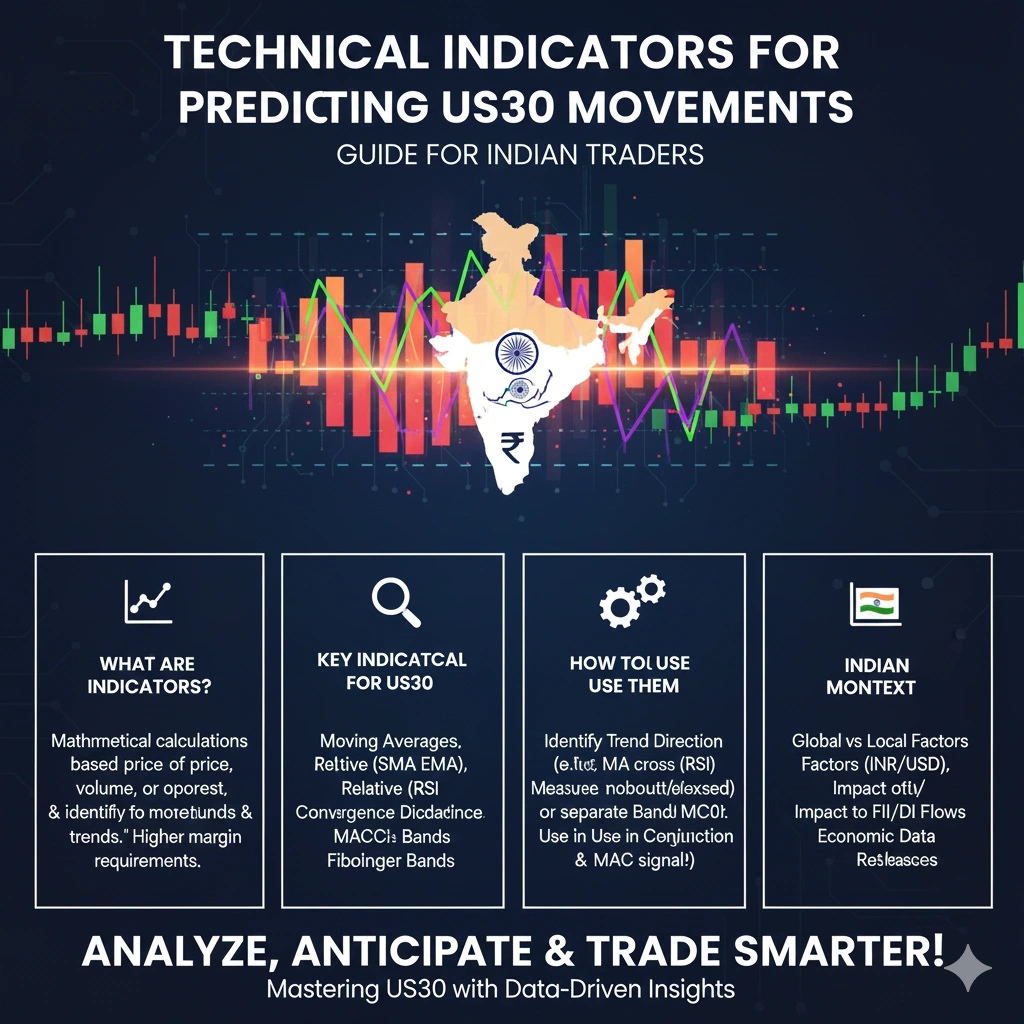
How Can You Use Technical Indicators to Predict US30 Movements?
Moving Averages (50 and 200 SMA):
It can assist you in identifying the trend fast. Bullish momentum is normally indicated by a price above the SMA.
RSI (14):
This informs you whether or not US30 is overbought or oversold, which proves extremely useful in India at times of high index volatility.
MACD:
This indicator is good when it is time to identify momentum changes and initial reversals, particularly when the US session is active.
Example:
When the US30 is above the 50 SMA and the RSI is below 70, the bullish trend may frequently persist—handy during the height of the US30 volatility India.
FAQs
Q1. What is the typical daily volatility of the US30 in India?
It varies between 100 and 200 points during prime US trading (8:11 PM IST).
Q2. How can I track NAS100 volatility in IST?
ATR indicators, economic calendars, and dashboards on brokers’ volatility.
Q3. When is the worst time to trade US30 in India?
5-7 pm IST, US markets are just about to open; wide spreads, low liquidity.
Q4. Can index volatility timing in India improve profitability?
Yes, traders can maximize risk-reward ratios by trading at extreme periods of liquidity and high volatility.
Conclusion
When you know the US30 volatility in India, you can transform your way of trading. You do not guess the timing of the right index volatility in India and NAS100 volatility in IST when you know the right volatility index in India and follow NAS100 volatility. The US30 is a high-paced currency, more so during the US session hours, and that is where the Indian traders get the real opportunities.
However, bear in mind that volatility is a two-edged sword, as only under the conditions of risk management do the profits increase. It is important to use appropriate lot sizing, economic calendar, and trade in high liquidity periods. Be disciplined and fear volatility, and the US indices can be an effective element of your trade program.
Master US30 volatility in India with InsightfulTrade. Get expert insights, real-time strategies, and smart risk management tools to trade confidently, avoid costly mistakes, and improve consistency today.
Author: Arihant Jain
Trading Experience: 5+ Years
Arihant Jain is a financial markets analyst and trading educator with expertise in Forex, indices, crypto, and risk-managed trading systems. His insights are based on real trading experience, data-driven analysis, and transparent market understanding. All content is reviewed for accuracy and aligns with Google’s EEAT guidelines.
Risk Disclaimer:
Trading involves substantial risk. All information is for educational purposes only and should not be taken as financial advice. Always do your own research.
Last Updated: 16 December 2025