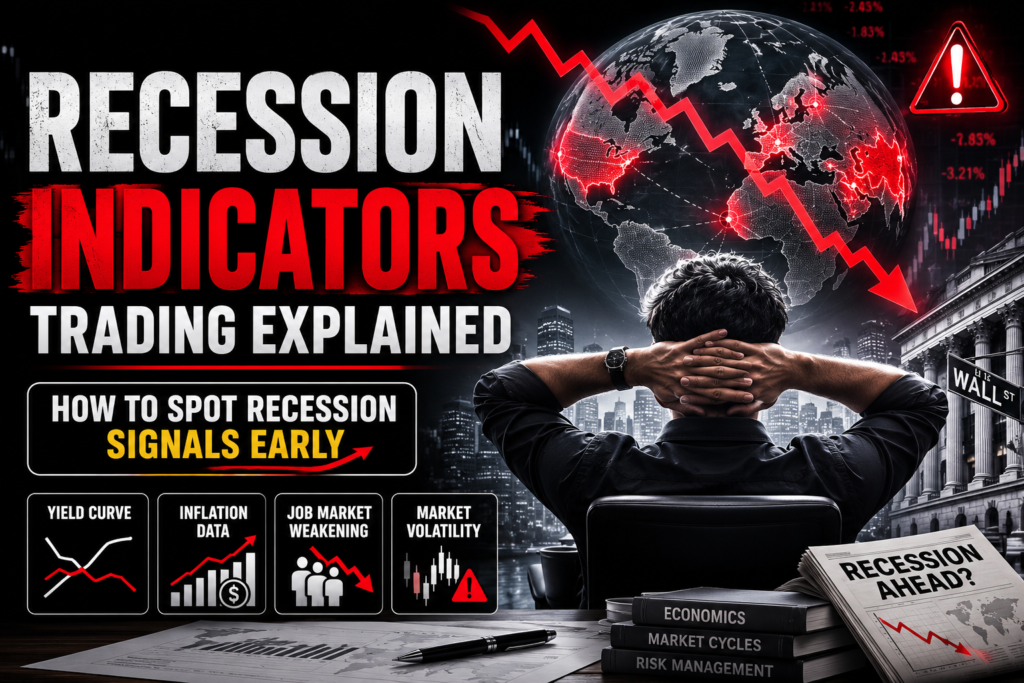
 Economic cycles are an unavoidable part of the financial world. The economy moves in cycles; it doesn’t just go up. Bad times are inevitable after good times. As a trader, knowing and understanding recession is a basic survival skill in trading. If you can identify early symptoms of recession, you can protect your hard-earned money, adjust your risk, and even find profitable opportunities.
In this article, we’ll explain the recession indicators trading, tell you how they influence markets, and give you smart strategies for navigating a downturn. This comprehensive economic slowdown trading guide will help you throughout your trading journey, whether you are a beginner or an experienced trader.
Why Recession Indicators Matter for Traders
A recession does not come out of the blue. It is preceded by months — sometimes years — of economic deterioration. Economists wait for official data to give them reports, while the trader has to act before the economic slowdown hits the front page of the news headline.
Tracking recession indicators trading helps traders:
- Anticipate shifts in market sentiment
- Be prepared for increased volatility in index and forex
- Organize exposure to risk-sensitive assets
- Identify safe-haven opportunities
- Time your entry and exit based on macroeconomic momentum
By spotting the risk early, you can get out of the risky situation before the news reaches the market.
Major Recession Indicators Traders Should Watch
Below are the most important recession signals that seasoned traders continuously monitor.
1. Yield Curve Inversion — One of the Strongest Recession Signals
The yield curve shows the relationship between short-term and long-term U.S. Treasury interest rates. Normally, longer-term bonds have higher yields. When short-term yields rise above long-term yields, the curve inverts, signaling an economic slowdown.
Why it matters
Historically, nearly every U.S. recession has been preceded by a yield curve inversion. It reflects investor fear of future economic conditions.
Impact on trading
- Forex: USD may strengthen initially due to flight-to-safety flows.
- Indices: Equity markets often weaken as investors anticipate slower growth.
- Bonds: Long-term bonds rise in value as investors seek safety.
Traders using recession indicators trading consider an inverted yield curve a critical red flag.
2. Rising Unemployment Rates
The unemployment rate is a direct reflection of economic health. When businesses anticipate lower consumer demand, they begin cutting jobs.
Key unemployment-related recession signals
- Increasing unemployment rate
- Decrease in job openings
- Higher-than-normal unemployment claims
- Slower wage growth
Impact on markets
- USD tends to weaken if job losses are significant
- US indices such as S&P 500 and Nasdaq often decline
- Safe-haven assets like gold and bonds rise
Monitoring unemployment trends is essential for any economic slowdown trading guide.
3. Slowing GDP Growth
Gross Domestic Product (GDP) is the broadest measure of economic activity. Multiple quarters of declining or stagnant GDP growth usually signal recession.
Trading implications
- Weak GDP data often drives risk-off sentiment
- Corporate earnings decline, pushing indices lower
- Forex pairs tied to cyclical currencies (AUD, NZD, GBP) weaken
Traders should track both quarterly GDP and high-frequency indicators like PMI for early warnings.
4. Consumer Spending Decline
Consumers drive most modern economies. When inflation rises, wages stagnate, or savings fall, consumer spending drops — a major recession indicator.
What traders monitor
- Retail sales
- Consumer confidence index
- Credit card delinquencies
Market impact
- Retail stocks fall
- Economic-sensitive currencies drop
- Gold and safe haven currencies like JPY appreciate
5. Weak Manufacturing and Services PMIs
Most economic data tells you what happened last month or last quarter. But PMI is different—it’s a survey of the managers who are actually buying supplies right now. PMI below 50 is a danger sign.
Why PMIs are critical recession signals
- Provide early warning of output reductions
- Show supply chain pressures
- Understand business expectations
Trading impact
- Lower PMIs drag indices down
- Oil and commodities fall due to demand fears
- USD and JPY may strengthen from risk-off flows
6. Corporate Earnings Decline
Earnings season offers traders a window into company health. If you notice that the company is making less profit or is running in losses it’s a major warning sign.
Trading implications
- Stock indices react sharply to disappointing results
- Sector rotation accelerates
- Volatility increases as expectations shift
Traders often see declining earnings as confirmation of recessionary pressures.
7. Increased Corporate Debt Stress
When companies borrow too much money (“leverage”) and suddenly it becomes expensive to pay it back, you get a credit crisis. This is often the spark that ignites a recession.
Debt-related recession signals
- Rising default rates
- Widening corporate bond spreads
- Higher interest expense burdens
Impact on trading
- Credit markets tighten, hurting equity performance
- High-risk sectors (tech, growth stocks) fall faster
- Safe-havens rise as investors flee risk
How Recession Indicators Affect Financial Markets
1. Stock Markets (Indices)
Recessions often lead to:
- Sharp corrections or bear markets
- Prices swing wildly (volatility)
- The companies don’t make profits
- Sectors like finance, retail, tech often falls
Defensive sectors (healthcare, utilities, consumer staples) are the most stable during this.
2. Forex Markets
Currency movements reflect economic health:
- USD often gets strong due to global risk-off sentiment
- Safe-haven currencies like JPY and CHF are tend to rise
- Currencies of emerging countries fall.
3. Commodity Markets
- Due to less demand, the price of oil and industrial metals declines.
- Gold is the opposite; when everything is falling, it rises, becoming a safe haven for investors.
4. Bond Markets
- Long-term bonds are the safest way to make smart money.
- Short-term interest rates fluctuate based on Fed policy
Understanding these patterns is essential for recession indicators trading.
Trading Strategies During Recession Signals

Below are practical strategies from an expert economic slowdown trading guide:
1. Use Safe-Haven Assets
During rising recession signals:
- Buy gold
- Buy JPY or CHF
- Reduce exposure to high-risk stocks
2. Hedge Positions
Traders may:
- Use options to hedge (puts, spreads)
- Consider inverse ETFs
- Reduce leverage
3. Rotate into Defensive Sectors
Prioritize:
- Utilities
- Healthcare
- Consumer staples
These sectors are the ones that have less impact from the market condition.
4. Follow Economic Calendar Closely
Monitor weekly releases of:
- Unemployment claims
- PMI
- GDP
- Consumer sentiment
- FOMC announcements
This data will help you predict the market conditions beforehand.
5. Short Weak Assets
If recession risk is high:
- Short cyclical stocks
- Short risk-sensitive currencies (AUD, NZD, GBP)
- Watch for breakdowns in major indices
Conclusion: Mastering Recession Signals to Trade Smart
Recessions are unavoidable; they are a part of every economic cycle. That’s why traders who are actively monitoring the movements in the economy, like unemployment trends or yield curve behavior, can protect their capital—and even find great opportunities while everyone panics.
That’s why we are here; InsightfulTrade provides the best educational source and gives regular informational updates, helping traders to have a smooth trading journey.
FAQs: Recession Indicators Trading
- What are recession indicators?
Recession indicators are the data and statistics that give the warning of when an economy starts to shrink or get worse. These are some of those indicators, like unemployment rates, GDP decline, and falling consumer spending.
- Why are recession signals important for traders?
If you know about this beforehand, you can protect your money and prepare a strategy before the panic starts.
- What happens in the stock market during a recession?
When the economy slows down, companies make fewer profits and people’s expenditure decreases. These situations lead to fear in investors, and they sell their stocks to get cash or move to safer options.
- Which indicator is the most reliable recession signal?
The yield curve inversion is one of the most reliable indicators; by using it, you get updates on recession in advance by 6–18 months.
- How can I prepare myself for a potential recession?
You can prepare by cutting off risky stocks and investing some into safe assets like gold, utilities, and healthcare stocks. And also staying up-to-date on news so that you aren’t caught off guard.
Author: Kumkum Chandak
Experience: 3+ Years in Trading Research & Market Content Strategy
Kumkum Chandak is a trading content strategist and market research writer who specializes in simplifying technical analysis, trading tools, and strategy-driven educational content. Her work is optimized for EEAT, accuracy, and user intent, ensuring every article delivers practical insights for traders of all levels.
Risk Disclaimer:
All content is strictly educational and not financial advice. Trading involves substantial risk. Always perform your own analysis or consult a professional advisor.
Last Updated: 7 December 2025