
The number of Vietnamese traders is growing rapidly, especially into instruments like forex, CFDs, and global indices. Many traders started trading without really knowing when the market actually moves. Instead of working with the market’s natural rhythm, they end up reacting to sudden price jumps.
This trading style often causes mistakes that could have been easily avoided. You learn about volatility trading not for excitement, but to know when the market is generally active and when it is not.
In this blog we explain Forex volatility in Vietnam by looking at different trading sessions. You will learn how some hours are busier than others and how traders in Vietnam and India can use the timing to make smarter, more responsible decisions.
Quick Summary
| Aspect | Key Insight |
| Core Focus | Volatile trading hours for Vietnam traders |
| Main Driver | Session volatility, not random price movement |
| Key Markets | Forex, indices, cross-border instruments |
| Regional Angle | Vietnam traders often overlap with India & Asia |
| Risk Factor | Volatility amplifies both opportunity and loss |
| Compliance View | Timing affects execution records and audits |
| Session | Vietnam Time (UTC+7) | Volatility Level |
| Early Asian | 6:00 AM – 9:00 AM | Low |
| Tokyo Active | 9:00 AM – 12:00 PM | Moderate |
| Asia–Europe Overlap | 2:00 PM – 6:00 PM | High |
| Europe Active | 3:00 PM – 10:00 PM | Very High |
Understanding Volatility: The Foundation
If you want to find the volatile hours in trading, you should first understand what volatility actually represents.
What Is Volatility?
Volatility measures:
- How fast prices are moving
- The size of price jumps and drops
- How often the market flips direction
Volatility isn’t good or bad; it just shows the reaction of that other side of traders who disagree on current price movement.

Why Volatility Is Session-Based, Not Random
Beginners easily get confused about volatility; they often think it happens randomly, but that’s not true, it follows a specific structure.
Why Volatility Clusters in Sessions
- Big banks and firms only trade during specific hours
- Important economic news drops at a specific set time
- Market overlap brings two different parts of the world together
The above reasons explain why volatility isn’t present for 24 hours a day and why it shows up at very predictable windows. Historical intraday volatility data shows that EUR/USD and USD/JPY typically record 35–50% higher average ranges during session overlaps compared to isolated Asian hours.
Vietnam’s Position in Global Market Timing
The Vietnam market begins at UTC+7, just perfectly synced with Asian trading hours.
Why This Matters
Vietnam traders experience:
- They trade actively with the entire Asian session
- Your day partially overlaps with Indian markets
- You catch the start of European market energy
In this, the volatility trading hours of Vietnam are mostly dependent on Asian and European market interaction.
Forex Volatility Vietnam: Session-Wise Breakdown
1. Early Asian Session (Morning in Vietnam)
The early Vietnam market aligns with Sydney and early Tokyo.
Volatility Characteristics
- Low, steady volatility
- Tighter price ranges
- The market is playing sideways.
Why Volatility Is Limited
- Fewer global participants
- Less big-bank order flow
This is the calmest period of the day for Vietnam traders in terms of forex volatility.
2. Tokyo-Driven Session (Mid-Morning Vietnam Time)
This period is where the action starts.
Why Volatility Increases
- More Japanese banks and exporters enter
- Regional hedging money begins to flow
- JPY and Asian currency pairs see more volume
This is one of the first volatile trading hours for Vietnamese traders to witness, especially for JPY and Asian currency pairs.
3. Asia Market Maturity Phase (Late Morning to Early Afternoon)
Here the window often leaves traders puzzled.
Volatility Pattern
- Market direction are clear
- The energy is steady, not explosive
- Institutional positions finally settle
This window lacks high-speed moves, but it works well for disciplined strategies.
4. Asia–Europe Overlap (Late Afternoon Vietnam Time)
This session is the centre of volatility.
Why This Is One of the Most Volatile Trading Hours for Vietnam Traders
- European market begins
- Liquidity surges
- Asian ranges are challenged or broken
This interaction between sessions creates volatility that is
- Faster
- More directional
- More emotionally demanding
Giving huge opportunities to traders, especially intraday.
5. Europe-Only Session (Evening Vietnam Time)
It’s the last session of the Asian market. The global market, especially Europe, which is still in the game.
Volatility Traits
- High momentum moves
- Strong reaction to European data
- Reduced Asian influence
This session offers the highest volatility to the traders, but it also comes with more risk.
Why High Volatility Is Not Always Desirable
A myth is circulating among traders that higher volatility always means better trades.
Why This Is a Risky Bet
- Price gaps get bad
- Stop-losses hits more often
- Emotional decisions
That’s why understanding session volatility will help you decide whether it suits your style or not, rather than chasing it blindly.
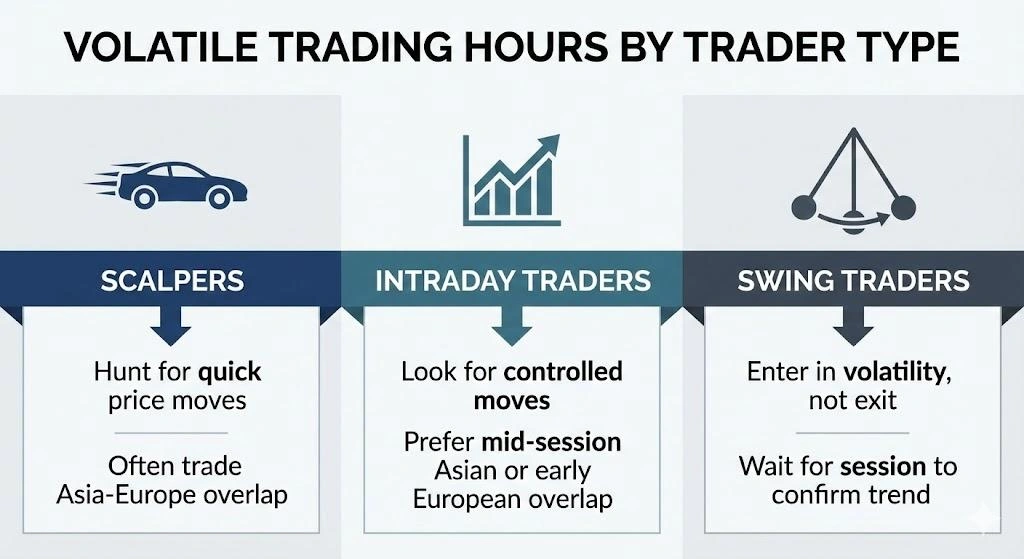
Volatile Trading Hours by Trader Type
Scalpers
- They hunt for quick price moves
- Often trade between Asia and Europe overlaps.
Intraday Traders
- They look for controlled moves
- Often prefer mid-session Asian or early European overlap
Swing Traders
- They enter in volatility, not exit
- They wait for session to confirm the trend
This is how you can trade during Vietnam’s busiest hours with real purpose, rather than trading out of habit.
Common Mistakes Vietnam Traders Make With Volatility
- Expecting big price jumps when the market is quite
- Overtrading when the market is wild
- Forgetting which market is in charge
- Using US strategy without local tweak
Try to avoid these myths when you’re trading during Vietnam’s busiest hours.
Tools That Help Track Forex Volatility Vietnam
Traders can track session volatility using:
- TradingView hourly range comparison
- Forex session indicator tools
- ATR (Average True Range) by hour
- Economic calendar time clustering
These tools help you implement your strategy for the desired outcome.
Why Volatility Should Be Planned, Not Chased
To trade during a volatile market, you need proper planning. You can’t just jump to trade blindly.
- Understand how volatility in Vietnam works
- Match timing to your strategy
- Manage risk effectively
This approach will help you achieve long-term success.
Solution-Oriented Approach to Volatile Trading Hours
Don’t only focus on finding the most volatile trading hours; instead, try to find which Vietnam trading hour fits your style and risk management.
Practical Steps
- Track trades by session
- Identify profitable volatility windows
- Reduce activity during unsuitable hours
- Adjust your position size according to the session speed
This will help you find the opportunities in volatility.
Many Vietnam-based retail traders access offshore brokers during Asian hours due to work schedules. Understanding volatility timing helps improve execution quality and reduce slippage during cross-border transactions.

Conclusion: Volatile trading hours for Vietnam traders
Overall, the volatility is never random; it happens because of various global events and crossing paths at specific times. And by learning how these sections move, you can make easy decisions, manage your risk effectively, and avoid entering into the market at the wrong time. Especially for traders in Vietnam and India, timing awareness is key to keeping clear records and clean documentation. Connect with Insightful Trade; they help analyze volatility by session so you can approach the market with a well-structured and local perspective.
FAQs: Volatile trading hours for Vietnam traders
1. What are the most volatile trading hours for Vietnam traders?
Usually after late afternoon, when the Asian and European sessions begin, it becomes more volatile for traders in Vietnam.
2. Is high forex volatility in Vietnam good for beginners?
Not always, even though it’s exciting, but it also increases the risk and demands a lot more discipline and focus.
3. How does session volatility affect execution?
It can lead to price slippage, faster moves, and wider gaps between buy and sell prices.
4. Are there tools to track volatility by session?
If you want to track volatility by sessions, then you should start with seeing how each session behaves.
Author: Kumkum Chandak
Experience: 3+ Years in Trading Research & Market Content Strategy
Kumkum Chandak is a trading content strategist and market research writer who specializes in simplifying technical analysis, trading tools, and strategy-driven educational content. Her work is optimized for EEAT, accuracy, and user intent, ensuring every article delivers practical insights for traders of all levels.
Risk Disclaimer:
All content is strictly educational and not financial advice. Trading involves substantial risk. Always perform your own analysis or consult a professional advisor.
Last Updated: 6 February 2026