
The journey of a US30 trader is never linear. Meet Raghav, a 27-years-old trader. The beginning of Raghav’s US30 trading journey is incredible, this journey of his becoming a confident trader has its own struggles and failures from whom he learnt and grew into an aspiring trader whose experience captures the emotional, strategic, and psychological evolution every beginner faces.
This story is a lesson to traders who think that trading is an easy task– because it’s not. This guide is a valuable source of knowledge for beginners on index trading with real life experience of Raghav’s wins, failures, mindset shifts, and gradual transformation. By the end you will walk away with practical lessons that you can apply to your own trading path.
1. The Beginning – Curiosity Meets Complexity
The moment Raghav began his US30 trading journey he was strongly attracted toward the structure and volatility of this index. As compared to other financial instruments the US30 moves quite fast producing strong uptrends, but followed by sharp pullbacks. This kind of volatility gives an idea of quick money to traders and attracts them. But he made one mistake that most beginners do, he believed that enthusiasm was enough to succeed. He felt that he was ready to “catch the market moves” by just watching some YouTube videos, reading a couple of blogs, but within his first few trades, he realized that US30 rewards preparation—never guessing.
What Raghav realised early on:
- That any high impact news or government policy can influence the US30, it can bring rallies or crashes in the market.
- And that the beginners often do not realise the seriousness of index volatility, entering impulsively without a strong plan—something he personally experienced.
These early realizations do not come with study — they come with experience and losses.
2. The First Wins – Confidence Arrives Too Quickly
After a little chaotic start, Raghav finally got his grip over his trades. He entered into a position during the New York session pullback, holding it on risk-reward ratio of 1:3. That win felt like an achievement.
This is a psychological trap where many traders have fallen and many will, it’s a never-ending phase of trading. With these small wins traders start believing that they’ve understood the market. Raghav became overconfident. He started trading with big lot sizes, ignoring his rules, and traded during periods he didn’t fully understand.
The turning point
FOMO the fear of missing out leads to quite disaster in trading, and just like that one day, Raghav entered a buy position just minutes before FOMC news. And the candle went against his making a sharp reversal, wiping out not just his gains from his past winnings but also a portion of his capital.
These little moments taught in trading give us one of the biggest lessons in US30 trading journey frameworks:
Lesson: A few wins don’t make you a skilled trader—discipline does.
3. Learning Market Structure – The Foundation He Never Knew He Needed
Raghav faced a lot of failure due to his emotions in his US30 trading journey; that’s why he decided to start fresh. With actual understanding of the market and its fundamentals, keeping predictions and guesswork out of his daily routine to achieve success.
He started studying concepts like:
- Break of Structure (BOS) and Shift of Structure (ChoCh)
- Liquidity sweep formations
- Premium vs. discount zones
- Retracement entry points and institutional footprints
How theory transformed his trading
Instead of reacting to candles, he began to:
- Analyze higher-time-frame direction before moving to smaller charts
- Identify liquidity pools left behind by retail traders
- Wait for retracement opportunities rather than chasing price
- Enter only when the market confirmed intention
4. The Real Struggle – Psychology and Discipline
Raghav struggled a lot with his emotions. Sometimes he jumped into trades out of FOMO, sometimes he hesitated too long, and other times he took revenge trades out of frustration.
US30 moves fast and is heavily driven by fear. If a trader can’t stay calm and in control, the market will take over their decisions—and losses become almost guaranteed.
Psychological breakthrough
Raghav began practicing:
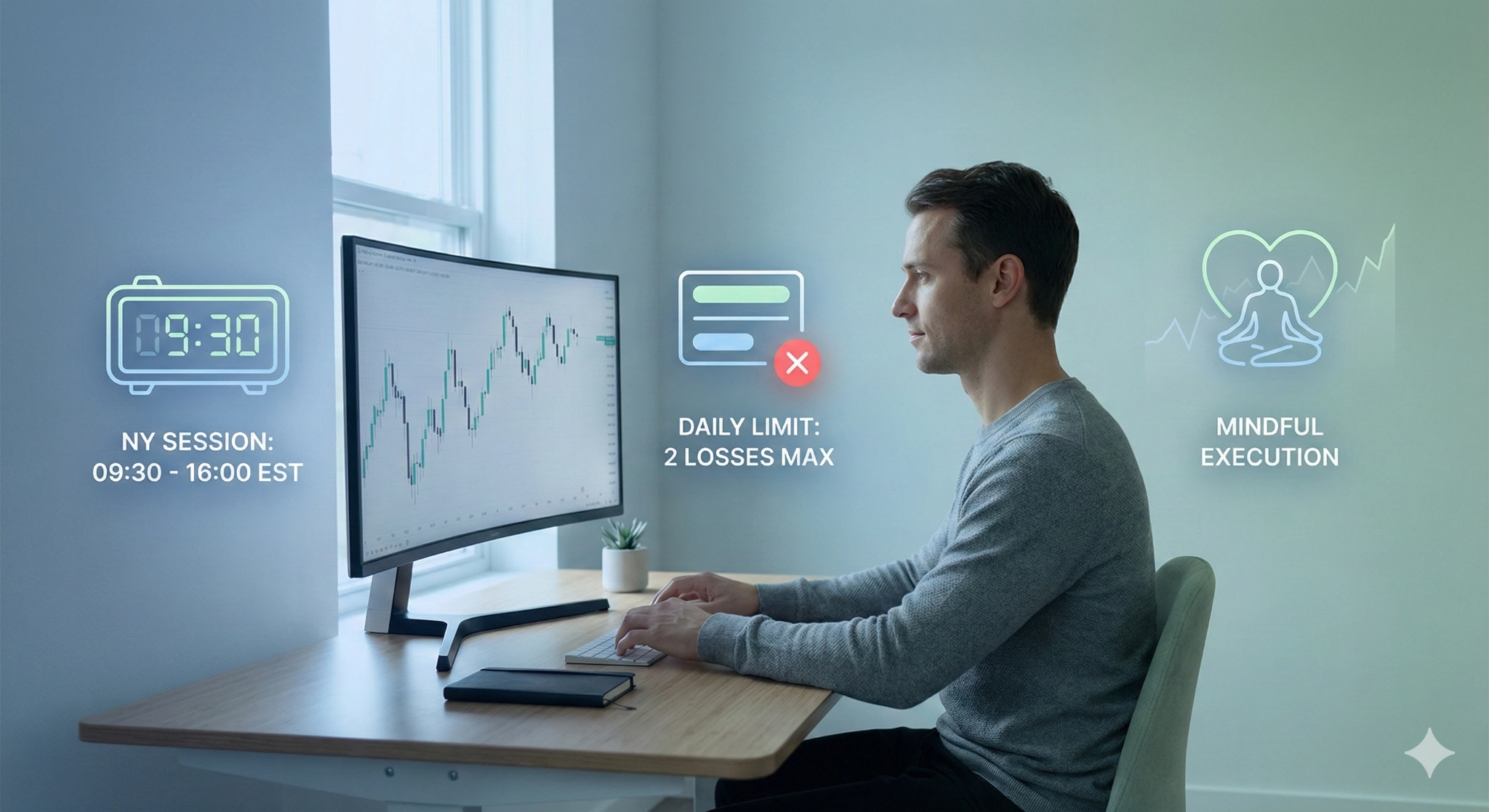
- Sticking to one session: he started trading only in the New York session because it matched US30’s movement the best.
- Setting clear loss limits: he avoided trading after two continuous losses in a day, to prevent emotional breakdowns.
- Letting go of the outcome: instead of focusing on the probability of winning or losing he focused on following his plan properly.
5. The Big Loss – The Lesson That Truly Changes Traders
You regret when you don’t follow your rules. Just like that, Raghav also broke his rule of not trading during high-impact news and made a huge loss. And during one session just before Powell’s speech he entered a trade with a bullish view, but faced sharp set-back losing huge amounts in seconds.
This loss made him realize that he was not disciplined enough. But instead of regretting it, he reflected on his mistakes.
This event refined his rulebook permanently:
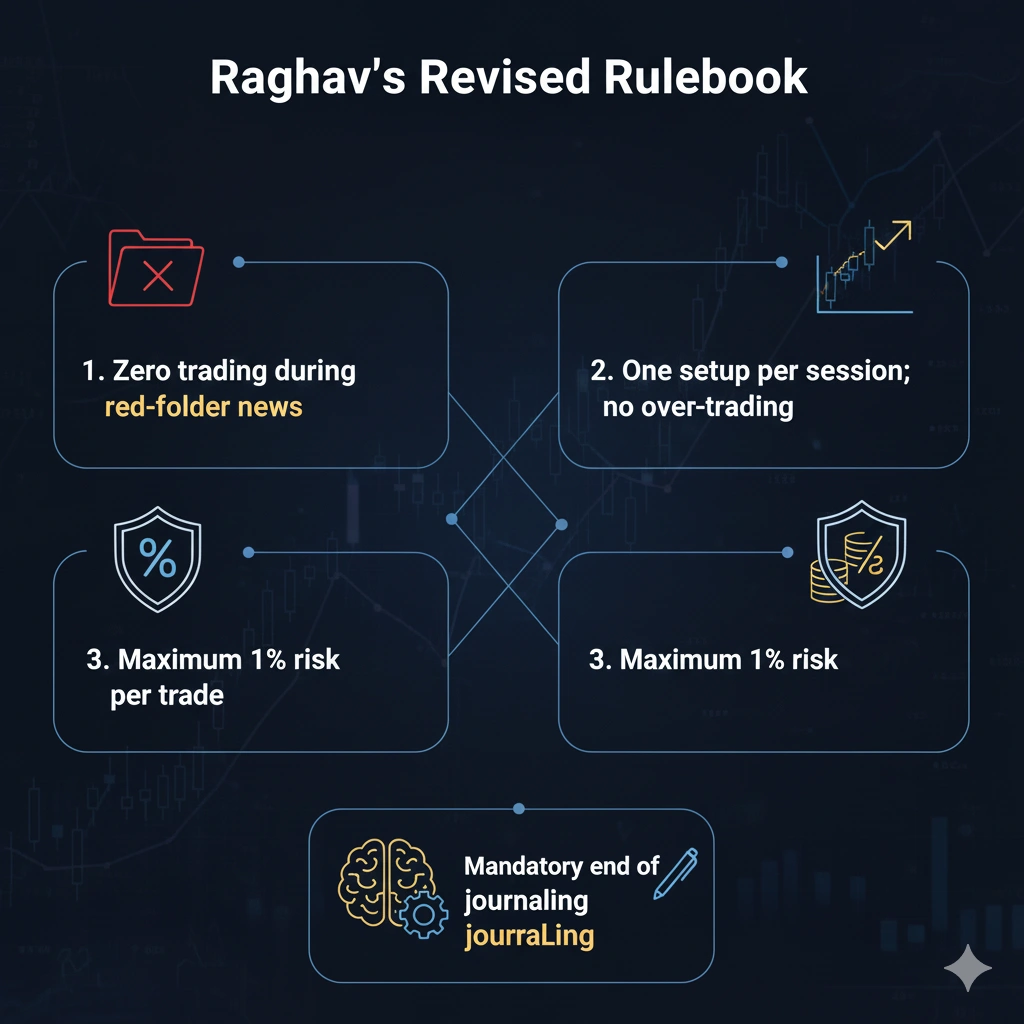
Raghav’s revised rulebook
- Zero trading during red-folder news
- One setup per session; no over-trading
- Maximum 1% risk per trade
- Mandatory end-of-day journaling
This is where his real transformation began.
6. A Clean Trade Example – How His Strategy Finally Clicked
To illustrate his growth, let’s break down one of Raghav’s cleanest trades in his US30 trading journey. This is the type of setup that traders aim for after developing structure-based skills.
Higher Time Frame Analysis
Analyze the charts in a higher time frame like the 15-minute chart, the market showed a clear break of structure to the upside. Price was heading toward liquidity above a previous high.
Entry Logic
When the price dipped into a “discount zone” near an imbalance, he didn’t jump in blindly. He waited on the 1-minute chart for a clear sign of strength. A quick liquidity sweep happened, and then a strong bullish candle confirmed the shift.
Execution
- Entry: After the confirmation candle closed
- Stop loss: Below the liquidity sweep
- Target: Liquidity pool on Higher Time Frame
Outcome
The trade went well giving a good 1:4 RR, strengthening everything he had learned through months of emotional and technical refinement.
7. The Mature Phase – Becoming the Trader He Wanted to Be
Now after going through so many phases, the trading has finally become a structured and disciplined process for Raghav rather than an emotional pursuit. He avoids trading if he isn’t sure enough. Instead, he stays calm and relies on the experience and lessons he’s gathered over the months.
How maturity shaped his trading:
- His trades have become more intentional rather than predictions; He looks for the conceptual principles of his strategy rather than reacting to every price movement, which helps him minimize losses and keeps traders focused by providing a clear structure and logic.
- Trading makes you mature, it teaches you patience and control. He understood that waiting for strong and profitable setups is more important than trading all the time.
8. Lessons From The US30 Trading Journey
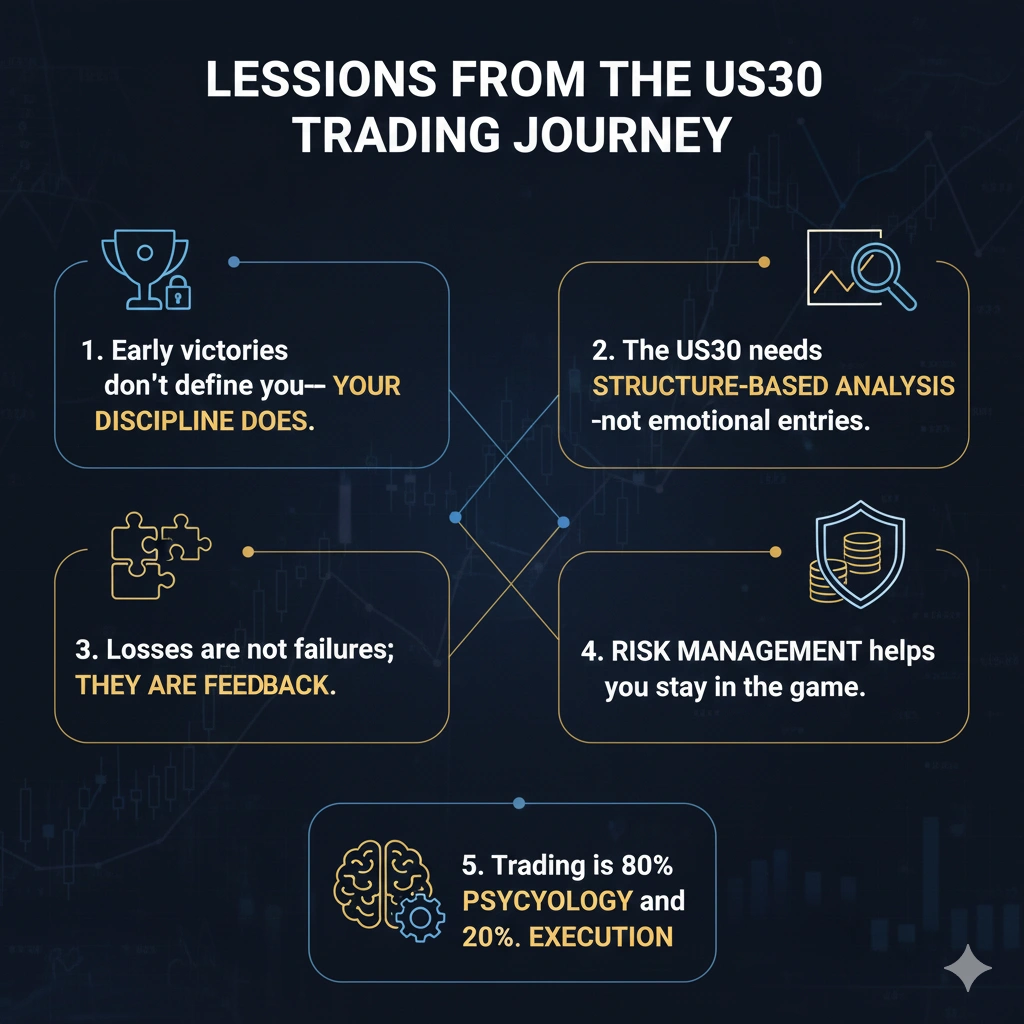
Raghav’s fictional journey highlights lessons every beginner should internalize:
- Early victories don’t define you—your discipline does.
- The US30 needs structure-based analysis—not emotional entries.
- Losses are not failures; they are feedback.
- Risk management helps you stay in the game.
- Trading is 80% psychology and 20% execution.
FAQs
- Is US30 suitable for beginners?
Yes, everyone can trade US30 if they are focused on understanding the fundamentals like volatility, structure, and risk instead of just doing guesswork.
- How much capital is ideal to start trading at US30?
It’s not fixed in trading how much capital you bring, but if you’re disciplined and know how to manage your risk effectively you can take back a lot.
- Should beginners trade during high-impact news?
No. during the high impact announcements the market is highly volatile you can’t predict it’s next move, so it’s better to avoid such events until you develop risk control.
- In how long will one become consistent?
It totally depends on the mind-set of the trader, on how long he takes to master structure, psychology, and disciplined execution.
Conclusion
Raghav’s US30 trading journey was incredible. He got to learn and experience so much that millions of traders want to achieve a clear understanding and control over their trades. With his journey you learn that you need to be patient and manage your risk effectively to stay in the market otherwise it will kick you out.
And if you don’t want to make mistakes like Raghav made, then visit InsightfulTrade. They have an experienced team that supports young traders by offering market analysis, guidance, and educational insights to help them build confidence in index trading.
Author: Kumkum Chandak
Experience: 3+ Years in Trading Research & Market Content Strategy
Kumkum Chandak is a trading content strategist and market research writer who specializes in simplifying technical analysis, trading tools, and strategy-driven educational content. Her work is optimized for EEAT, accuracy, and user intent, ensuring every article delivers practical insights for traders of all levels.
Risk Disclaimer:
All content is strictly educational and not financial advice. Trading involves substantial risk. Always perform your own analysis or consult a professional advisor.
Last Updated: 1 December 2025

