Let’s be honest—if you are a trader, then you must have probably Googled “how to grow a small account” at least once. Well anyone can make money if they have crores to spend, but growing a fortune with just ₹50,000 can be tough to survive.
But what does it actually look like to grind a small account up without gambling it all away?
In this trading case study, we are skipping the hype and looking at the math. Here we’re illustrating the story of “Arjun,” a trader who took ₹50,000 and grew it to ₹2,00,000 in four months. No magic, no guesswork, just pure dedication, discipline, and a high volatility market, the US30.
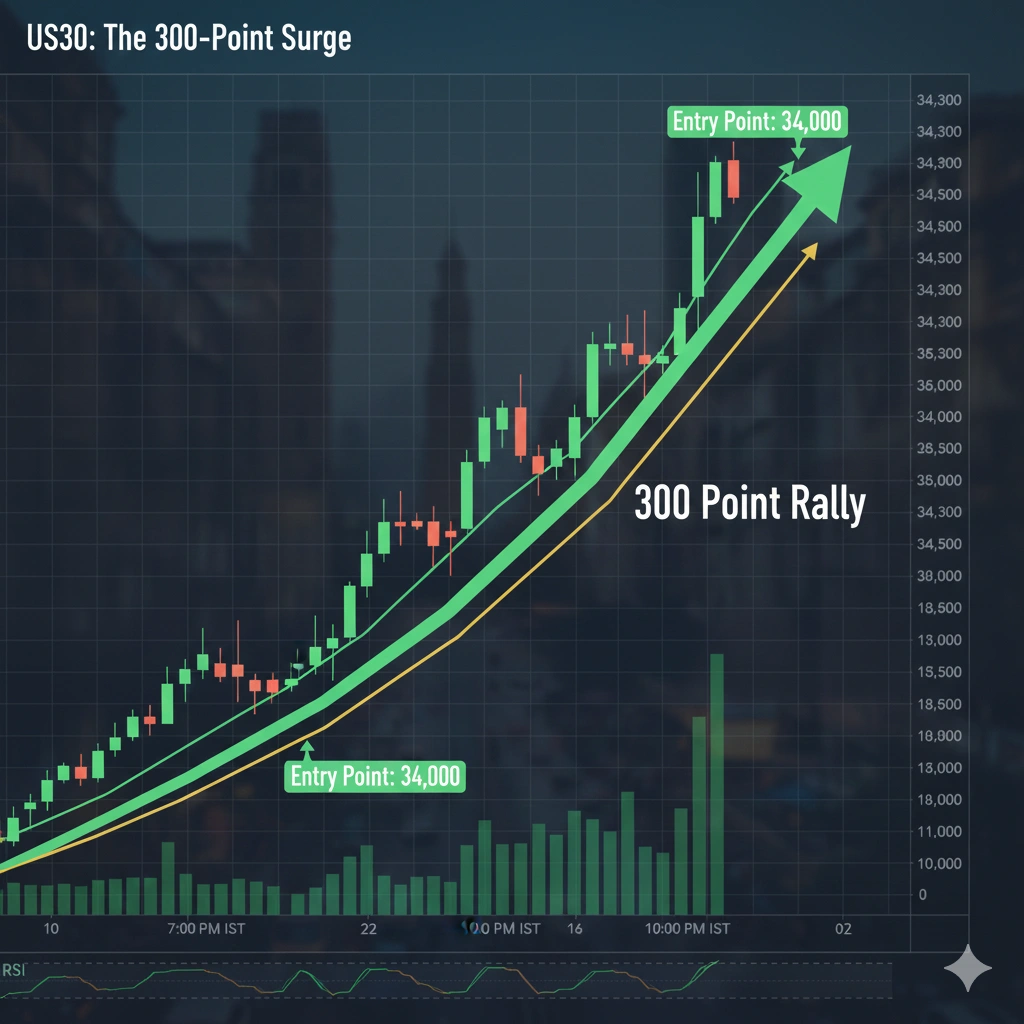
The Setup: Why US30?
Before we see how Arjun made ₹2,00,000 from just ₹50,000. We must know why Arjun decided to trade US30 instead of Nifty. Well, the US30 is highly volatile; where the Indian indices move only 1-2%, the US30 gives a movement of 300-500 points in a single day. And this kind of momentum is what a small account trader needs to build his empire.
Meet Arjun: The Hero Of This Trading Case Study
- Location: Bangalore, India
- Initial Capital: ₹50,000
- Experience: 2 Years experience in Price Action
- Trading Window: 7:00 PM – 10:00 PM IST (The New York Stock Exchange Open)
Phase 1: The Foundation (₹50,000 to ₹75,000)
Timeframe: Month 1
Arjun knew that the first month of trading with a small account is all about survival and consistency, because you know that a couple of small losses can wipe out your account.
The Strategy: NY Open Reversals
Arjun traded only during the New York (NY) Session Open (7:00 PM IST). The US market often creates a “fake move” in the first 15–30 minutes to trap retail traders before reversing.
The Setup:
- Mark the High and Low of the London session (1:30 PM – 6:30 PM IST).
- Wait for the NY Open to aggressively break one of these levels.
- If the price breaks the High but immediately rejects and closes back inside the range on a 5-minute chart, Sell.
- If the price breaks the Low but rejects, Buy.
Risk Management Rule:
He had fixed his risk for every 2% (1000), with an aim of 1:2 reward. With the win rate of 55%, he was not earning huge profits overnight but just taking small, consistent profits from the market.

Phase 2: Compounding the Edge (₹75,000 to ₹1,30,000)
Timeframe: Month 2 & 3
When Arjun earned a profit of ₹25,000 in a single game, his game changed. Now he wasn’t trading using his hard-earned money; instead, he was using the “House Money.” And the fear of losing vanished, allowing him to think clearer and trade sharper.
The Strategy: The “Aftershock” Entry
During these months, due to US data like CPI and NFP, the market was highly volatile. Most beginners try to trade during the news and get wrecked by slippage. Arjun did the opposite: he waited.
- The Wait: When news hit, US30 would spike 200 points up and down. Arjun sat on his hands for 30 minutes until the dust settled.
- The Entry: He used the chaos to get a discount. If the daily trend was Bullish, he waited for the news-induced drop to hit the 61.8% Fibonacci level.
- The Result: By buying the dip at a key math level—and slightly increasing his lot size—he compounded his account to ₹1.3 Lakhs much faster than his initial grind.
Phase 3: The “Home Run” Trade (₹1,30,000 to ₹2,00,000)
Timeframe: Month 4
To cross the ₹2,00,000 mark, Arjun caught one specific swing trade that defined his quarter. This is the US30 case study India example that highlights the power of patience.
The Trade Setup
- Context: The US30 had been falling for three consecutive days, and was approaching a major weekly support zone at 33,000.
- Confluence: The RSI (Relative Strength Index) on the 4-hour chart was oversold (<30), and a “Bullish Engulfing” candle formed at 8:30 PM IST.
The Execution:
- Entry: 33,050
- Stop Loss: 32,950 (100 points risk)
- Target: 33,550 (500 points reward)
- Risk: He risked 3% of his account (approx. ₹4,000) on this high-probability setup.
The Outcome:
It wasn’t instant gratification. He had to hold the trade overnight—breaking his own rule—which was nerve-wracking. But when he woke up for the Asian session, the market had ripped higher. He closed out for a massive 450-point gain.
- Profit: ~₹18,000 to ₹20,000 in one shot.
That one trade did the heavy lifting. A few small wins later, he crossed the ₹2,00,000 finish line.
5 Golden Rules for Trading US30 from India
If you are looking to replicate this US30 case study India-style growth, adhere to these rules:
- Respect the Spread: US30 spreads can be high during the Asian session (morning in India). Only trade when volume is high (7:00 PM IST onwards).
- Use a Stop Loss: US30 can drop 500 points in 5 minutes on a “flash crash. ” Never trade without a hard stop loss.
- Check Economic Calendars: Before opening your terminal, check sites like Forex Factory. If there is “Red Folder” news (CPI, FOMC), stay out.
- Withdraw Profits: Don’t compound forever. When Arjun hit ₹1,00,000, he withdrew his initial ₹50,000. This made the rest of his trading “risk-free” psychologically.
- Focus on One Setup: Don’t try to trade breakouts, reversals, and trendlines all at once. Master one specific time-based setup.

Conclusion
Let’s be real—Arjun didn’t have a crystal ball. Before entering the market he did his homework well, and made proper strategy and had the guts to stick to it, even when he took a loss. This trading case study serves as a reminder that you don’t need a massive bank balance to succeed in the markets; you just need to survive long enough for the math to work in your favor.
If you’re a trader and want guidance on how to manage your portfolio you can visit Insightful Trade’s website or contact them for counseling. You will get experts’ help and well researched content to learn more about trading and its other financial instruments.
FAQs: On This Trading Case Study
Q1: Is trading US30 legal from India?
A: Well, trading US30 is restricted in India as per the rules of FEMA, but still some traders do trading in it through foreign brokers or prop firms, which are allowed as they are the contractor.
Q2: How much capital do I need to trade US30?
A: In trading there is no limit set for the entry capital; you start with as little as ₹10,000, but it is recommended to have a capital of ₹50,000 at least for proper risk management.
Q3: What is the best time to trade US30 in India?
A: The best time is the New York Session Open, which is 7:00 PM IST (or 8:00 PM IST depending on Daylight Savings). This is when liquidity and volatility are highest.
Q4: Can I use this strategy for Bank Nifty?
A: Yes, in trading you can use the Support/Resistance and Risk-Reward everywhere. However, Bank Nifty is less volatile than US30, so your targets (points captured) will be smaller, and you may need to adjust your lot sizes accordingly.
Q5: What indicators are best for US30?
A: Well, price action (support/resistance) is the best, but you can also use the moving averages (20 EMA and 50 EMA) method to identify the trend and RSI for spotting overextended moves.
Author: Kumkum Chandak
Experience: 3+ Years in Trading Research & Market Content Strategy
Kumkum Chandak is a trading content strategist and market research writer who specializes in simplifying technical analysis, trading tools, and strategy-driven educational content. Her work is optimized for EEAT, accuracy, and user intent, ensuring every article delivers practical insights for traders of all levels.
Risk Disclaimer:
All content is strictly educational and not financial advice. Trading involves substantial risk. Always perform your own analysis or consult a professional advisor.
Last Updated: 3 December 2025