Introduction
You have probably heard that a trader like yourself can get caught out in the market at any moment, but have you realized that a trader is just as likely to attract the attention of taxing bodies because of their trading behavior? Trading audit triggers simply refer to red flags whereby tax departments are forced to scrutinize your accounts more closely. The strange activity or massive earnings can trigger an audit, whether you are trading forex, in indices such as US30, or even in crypto.
Here, in our guide, we will deconstruct the most prevalent trading audit triggers in the forex and stock markets, explain how the rules regarding the scrutiny of income tax trading apply, and provide you with practical tips on how to use your strategy. Knowing these triggers, you will be trading smarter, and you will keep the taxman away.
What Are Trading Audit Triggers?
Trading audit triggers are warning signals ensuring that tax authorities scan your trading dealings. They tend to come along when your trades exhibit unusual behavior, large profits, or high frequency.
Example:
- The trading audit trigger that forex can be associated with is trading EUR/USD frequently with 0.5-1 lot trades and profitability.
- The gains in US30 occurring rapidly or frequent small losses may trigger income tax scrutiny trading.
This is because, as a trader, by knowing these tax audit triggers, you will keep your records accurate, stay in compliance, and trade without unnecessary stress.
Why Does Income Tax Scrutiny Trading Happen?
Income tax cross-examination trading occurs when your transactions or the reported income seem odd. Audits may be triggered by high profits, small losses, or recurring or uneven reporting.
Example:
- The reporting of small losses in US30 and having a high account balance can trigger a trading check of an income tax scrutiny.
To prevent these triggers, keeping clear records and being honest in reporting can be a way to avoid them.

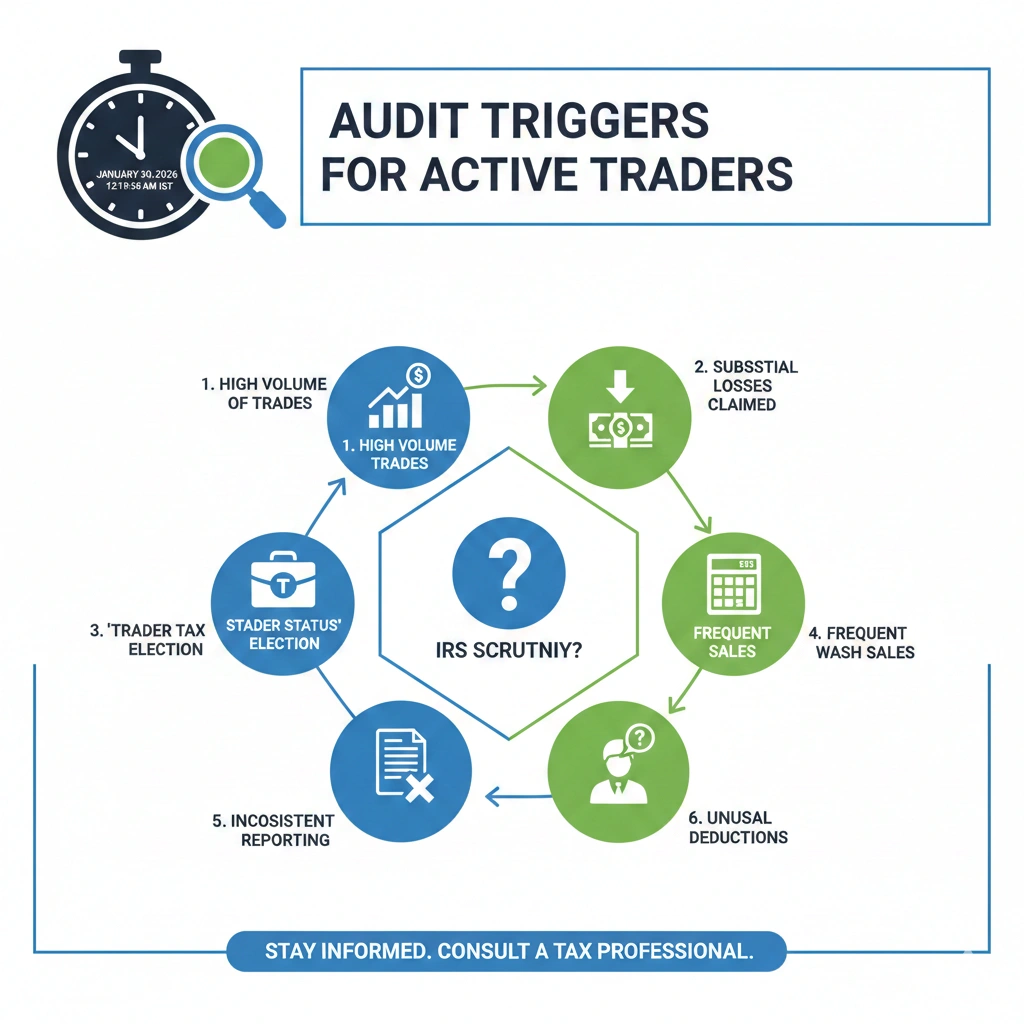
Which Trading Activities Trigger Audits Most Often?
Certain trading practices are a cause of concern. The trading audit triggers are not of the usual or consistent activity.
Common Triggers:
- Without reported revenue – lots of money but not reporting profits.
- Big profits within a very short time span – EUR/USD or US30 sudden profits could be noticeable.
- Unmatched reporting of profits and losses – incomparable reports and statements with real trades.
- International trading without suitable declarations- trading in a foreign country without reporting the revenue.
- Market norms are greatly violated- trading habits that are too different to be the norm in the market.
How Does Trade Volume Affect Audit Triggers?
Audits can be caused by high trade volume. Trading audit triggers will frequent your account in case your account has excessively high trades or regular large profits.
| Asset class | Audit Volume Threshold |
| Forex | > 200 trades/year |
| Stocks | > 100 trades/year |
| Indices | > 50 trades/year |
Monitoring lot size, pip gains, and losses will prevent triggers of tax audits in trading.
Can Losses Trigger a Trading Audit?
Yes! Trading audit triggers can even be triggered by losses, particularly when they are considered suspicious from a tax purposes perspective.
Example:
- It is noteworthy to report such repeated small losses in EUR/USD (such as 5-10 pips/day) to reduce taxable income and get attention when your account balance remains high.
Misconception: Believe that you are safe from audit due to your losses. As a matter of fact, the unusual or frequent losses may also stimulate the income tax scrutiny of trading.

How Does Income Level Influence Audit Triggers?
Trading audit triggers can be affected by the trading income that you declare. Higher income is likely to have an audit effect, especially when you do not live in a lifestyle commensurate with your income.
Real Example:
- Trading may come into the spotlight of the income tax authorities by a trader who reports an annual gain of $50,000 on US30 trades but is living opulently.
Pro Tip: Reporting any trading income is always accurate in order to expect no audit attention.
Which Trading Patterns Are Considered Risky?
Certain trading patterns may trigger trading audit reviews when they appear unusual or could be unreported.
Risky Patterns:
- Too much trading of the day without accounting.
- Wash trading (purchasing and selling a certain asset the same number of times)
- Inequalities in margin trading with incomplete reporting.
- Tax-free cross-market arbitrage.
TIP: To minimize the trading of income tax avoidance, these risky operations should be avoided and proper records kept.
How Can You Reduce Audit Risks in Trading?
It is not as difficult as you may imagine to reduce trading audit triggers by remaining organized and transparent.
Steps to Stay Safe:
- Keep good trading records – record all trades, entry and exit, and gain/loss.
- Bill’s monthly reconciliation statements- compare your broker statements with your own records.
- Avoid artificial patterns of losses – do not trade to be allowed a tax deduction.
- Take professional tax advice- a tax professional can guide you through the trading rules of the income tax scrutiny.
- Report all cross-border profits – never conceal overseas deals
Tip: Excel sheets to follow the lot size, pip values, and profits/losses.
What Are Pip Values and Lot Sizes in an Audit Context?
Pip values and lot sizes allow one to avoid trading audit triggers and ease reporting
| Pair/instrument | Standard lot | Pip value |
| EUR/USD | 1 lot | $10 |
| US30 Futures | 1 contract | $1 |
| GBP/USD | 1 lot | $10 |
Trading tip: Track every trade using the following formula:
Profit = Pip Value × Pips Gained × Lot Size
i.e., 1 lot EUR/USD, 50 pips = $500 gain. Helps eliminate trading triggering of tax audit.

How Do Brokers Report to Tax Authorities?
The majority of brokers will automatically report your annual gains and losses, which will lead to audit trigger trades in the event that your records do not match.
Example:
- When your broker makes a report of a profit of 10000 dollars in EUR/USD, and you make a personal record of 8000 dollars, it can cause income tax scrutiny.
Pro Tip: You must always match your personal trading records with those of your broker to keep the records safe and legal.
Can International Trading Cause Tax Scrutiny?
Yes! Trading audit triggers may be initiated by cross-border trading in the event that your gains are not reported correctly.
Example:
- When a US broker trades EUR/USD outside the country, then he or she has to report the trade under international tax regulations. Otherwise, income tax scrutiny trading will likely be invoked.
Hint: Never leave any foreign earnings unreported, and maintain detailed records on the same that will save unwarranted audits.
FAQs
Q1: What is the main trading audit trigger?
Abnormal or uneven trade activities with huge profits or continuous losses are the primary catalyst.
Q2: Does frequent day trading increase audit risk?
Yes, and when not duly duplicated and charged to taxes.
Q3: How can I prepare for an income tax scrutiny trading audit?
Keep proper records, prepare broker statements, and consult the tax planner.
Q4: Are losses reported for tax purposes risky?
They are so when they appear to be artificially repeated so that the taxable income is less.
Q5: Can cross-border trading trigger audits?
Yes, non-disclosure of international gains may raise the level of scrutiny.
Conclusion
The knowledge of audit triggers in the trading process is important to every trader who wishes to be in compliance and stress-free. In unusual patterns, income tax scrutiny trading may be triggered by high-frequency trades as well as huge profits in EUR/USD or US30 trading.
The trick is easy: maintain proper records, monitor lot sizes and pip value, reconcile broker statements, and report all the income truthfully. These steps will ensure you trade with a lot of confidence and minimize the risk of audits, as well as ensure that you are on the right side of the tax man without leaving your strategy.
Stay ahead of trading audit triggers! Join Insightful Trade today for expert tips, smart strategies, and practical guides to trade confidently while avoiding tax scrutiny. Start protecting your trades now!
Author: Arihant Jain
Trading Experience: 5+ Years
Arihant Jain is a financial markets analyst and trading educator with expertise in Forex, indices, crypto, and risk-managed trading systems. His insights are based on real trading experience, data-driven analysis, and transparent market understanding. All content is reviewed for accuracy and aligns with Google’s EEAT guidelines.
Risk Disclaimer:
Trading involves substantial risk. All information is for educational purposes only and should not be taken as financial advice. Always do your own research.
Last Updated: 29 January 2026