Quick Summary
Toxic flow is one of the big concepts that many traders don’t understand. If you have dealt with delayed trades, rejected orders, wider prices, or sudden account limits, it is probably not random; it’s because of the broker’s toxic flow. This term refers to the trading style that puts the broker or their order providers at a disadvantage, usually because of timing and some of the hidden edges. Understanding this will help you understand the reasons behind why your trade might be acting up and help you build strategies that work in the real market condition.
Toxic Flow Trading Overview Table
| Aspect | Non-Toxic Flow | Toxic Flow Trading |
| Order Timing | Random/delayed | Highly time-sensitive |
| Information Advantage | None | Present |
| Liquidity Impact | Neutral | Adverse |
| Broker Toxic Flow Detection | Not triggered | Triggered |
| Execution Treatment | Standard | Restricted / filtered |
| Platform Stability | Stable | Controlled |
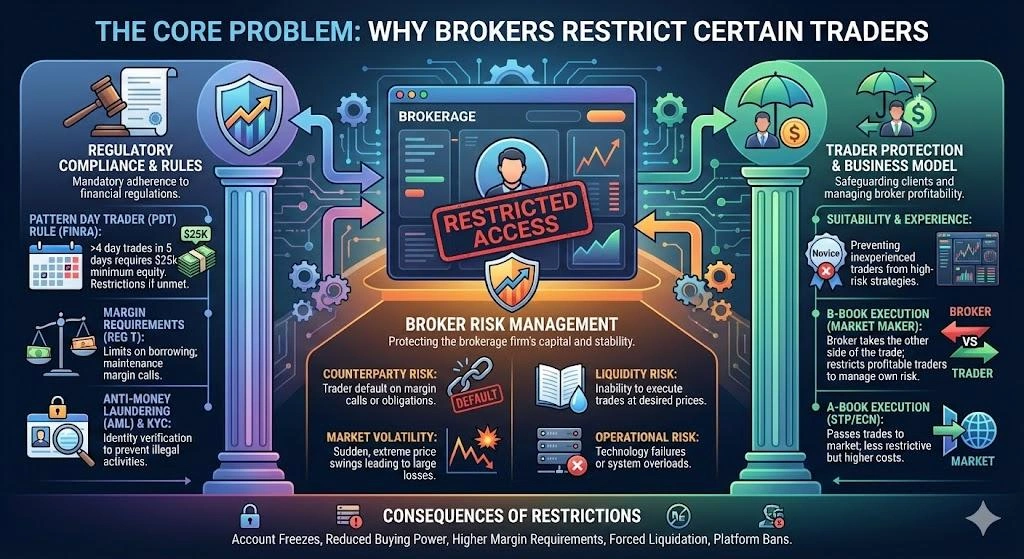
The Core Problem: Why Brokers Restrict Certain Traders
A common trader go through this:
- Everything starts off great
- But over time your trades starts slowing down
- The gap between buy and sell prices grows, and orders get delayed
- The broker starts putting limits on your orders
A lot of people think the broker is just biased or manipulating the system. In reality, it’s usually because the broker’s systems have flagged your trade as toxic flow.
What Is Toxic Flow Trading?
Toxic flow is basically trading that creates risk for the broker or big firms providing the orders. It’s not called toxic because it’s illegal, but because it’s so good at grabbing profit using speed or hidden timing edges.
Broker toxic flow detection systems monitor:
- Exactly when you enter trades compared to price changes
- Whether you’re winning too much when market is wild
- If your trade always seems to get goods side of a price jump
- How often you’re canceling your orders
The broker decides whether you’re using toxic flow trading using math and data, not because they have personal feelings about your trades.
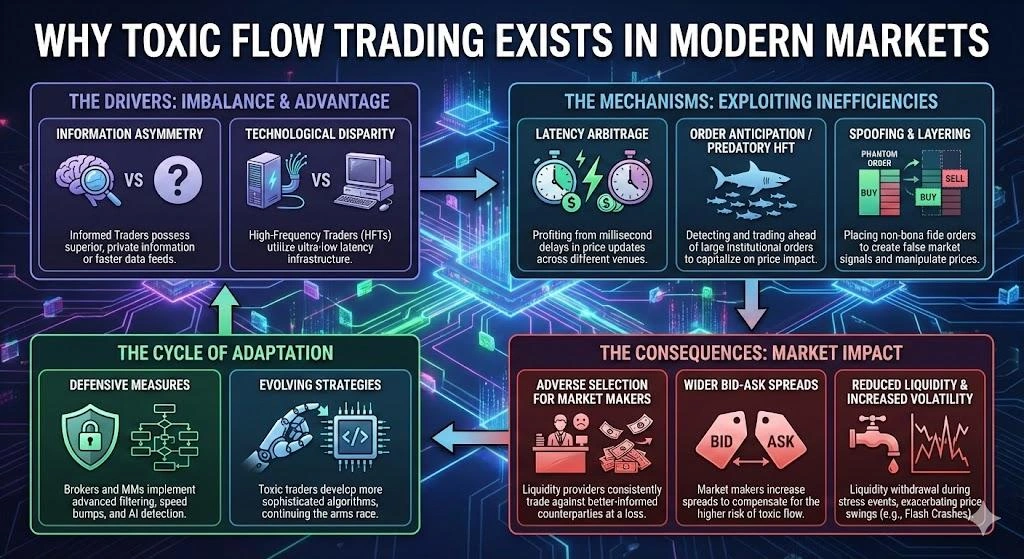
Why Toxic Flow Trading Exists in Modern Markets
Today’s market is:
- Fast and automated
- Spread out across many different sources
- Sensitive to even the smallest bit of time
This creates a chance for some traders to jump in just before the price shift, leaving the big banks and firms at a disadvantage. Leading to the broker using toxic floor detection simply to protect themselves from that risk.
Toxic Flow Trading vs Profitable Trading
There is a big difference between being a good trader and having toxic flow.
Toxic flow usually looks like this:
- Huge profits in a very small amount of time
- Always getting good prices
- Doing incredibly well even when the market is crazy
- And sudden failure the moment brokers changes how your trades are handled
Long-term, slower trading styles almost never get flagged by these systems.
Practical Example: News Event Trading
Scenario
Suppose a trader places an order just milliseconds after some big news comes out, right before the price has fully changed; the big firms end up filling the order at the old price.
Outcome
The trader keeps making money, while the firms providing the trades keep losing it. This pattern is immediately flagged as toxic flow even if the strategy itself is perfectly legal.
Why Brokers Must Detect Toxic Flow
If brokers don’t detect toxic flow:
- The big banks providing the trades would just walk away
- Prices would get more expensive for everyone
- The quality of trading would drop for all the brokers clients.
Basically, these detection systems are there to keep the market honest and stable, not just to protect the brokers interests.
How Broker Toxic Flow Detection Works
Even though brokers don’t show exactly how their system works, but most of them look at
- How your trade timing matches up with price change
- Whether you’re getting more good price jump and bad once
- How long you hold your trades
- Whether your orders are actually moving the market
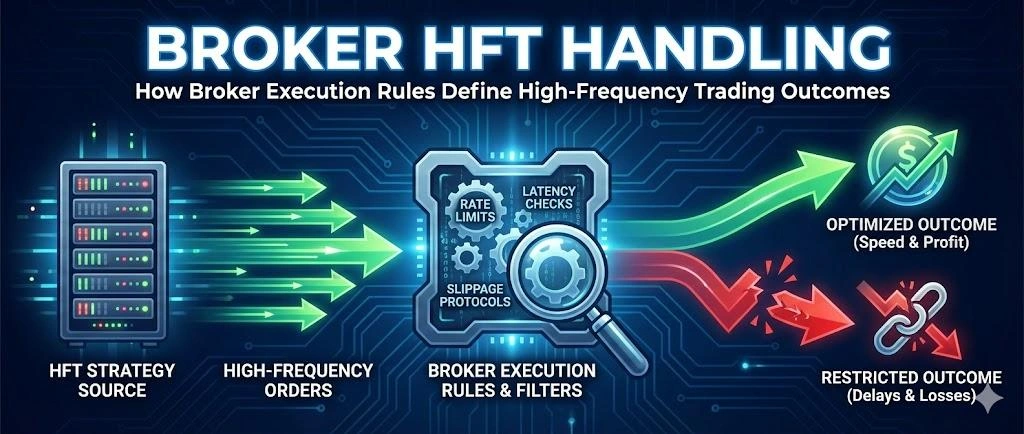
Once these spot a toxic pattern, the broker will change how they handle your trades.
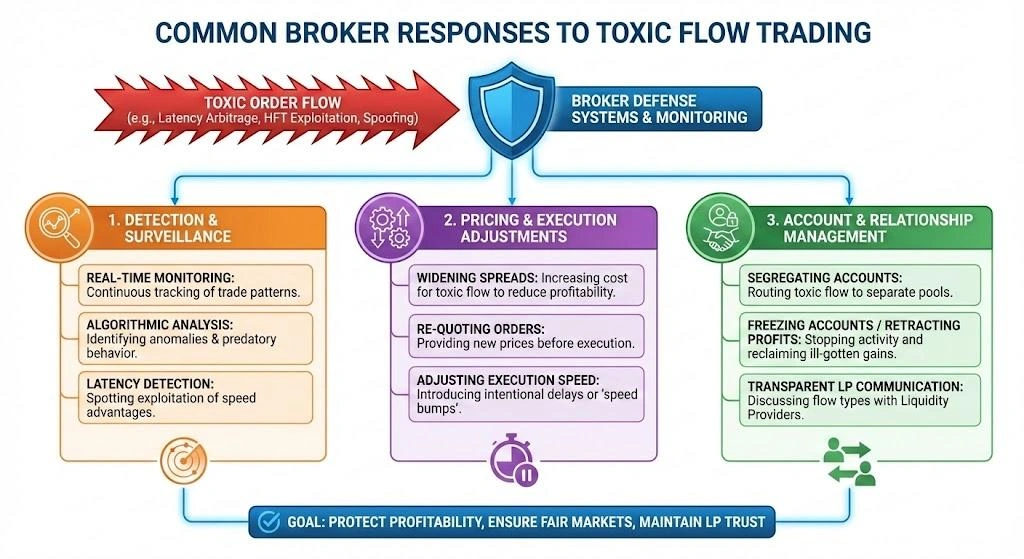
Common Broker Responses to Toxic Flow Trading
If a broker flags you, they might:
- Slow down your trades
- Widen the gap between buy and sell price
- Put a limit to your trades sizes
- Ban certain strategies
- Manually review your account
Remember, these are safety measures to protect the broker, not punishment for winning.
Platform Role in Toxic Flow Trading
Platforms affect these through:
- How fast it handles orders
- How accurate its time-stamps are
- How the trades are processed
Fast apps combined with a super quick connection can sometimes look like they’re exploiting tiny timing gaps, which increases the risk of being flagged.
Broker Models and Toxic Flow Sensitivity
Market Maker Brokers
- These brokers handle everything inside their own system, so they are very sensitive to any toxic behaviour.
STP/ECN Brokers
- These brokers send your trades out of the market, but they still watch for toxic flow to keep the relationship with big banks healthy.
No matter which type of broker you use, they are all keeping an eye on your trading style.
Indian Context: Toxic Flow Trading
Indian Traders Using Global Brokers
If you’re an Indian trader using a broker based outside of India, you might:
- Trade during the busiest global sessions
- Use bots and fast servers
This makes you much more likely to be flagged by your broker if your trades are consistently hitting those tiny timing gaps.
Compliance Perspective (India)
SEBI focuses on:
- Fair trading for everyone
- Being honest about your risk
- Making no fake promises
Toxic flow trading isn’t illegal, but brokers still have to manage it to keep things fair for everyone.
Tools That Reveal Toxic Flow Classification
You can tell if you’ve been flagged by looking for:
- You’re getting a better price than you wanted
- Your trades are getting slower over-time
- Suddenly there are new rules for your specific strategy
- You receive an official notice from your broker
These are all signs that the broker’s detection system has triggered.
Common Misconceptions About Toxic Flow Trading
- Toxic flow means you’re cheating
- Only high-speed trading triggers the system
- Broker pick and choose who to flag by hand
- The system is out to get specific people
- Just changing brokers will fix everything
The reality is that these systems are automatic and only care about your actual trading behavior.
Institutional View on Toxic Flow Trading
The big pro firms try to avoid being labeled as toxic by:
- Mixing up how they make their trades
- Being less predictable
- Expecting that not every trade will be perfect
Regular traders can definitely learn a lot from these tactics.
Conclusion
To wrap it up, toxic flow is a huge part of how today’s brokers and platforms work, and it’s what determines how they react to your trades. These detection systems are there to protect brokers from the risk created by traders who have a speed or timing advantage.
Knowing how toxic flow works helps you understand why a strategy can act differently in the same world compared to a simulation. Connect with InsightfulTrade for expert guidance on tech performance and broker selection.
FAQs
1. Is toxic flow trading illegal?
No. It’s just a way for brokers to categorize risk, not a legal or regulatory violation.
2. Does broker toxic flow detection apply to Indian traders?
Yes, both Indian and international brokers use a similar system to monitor clients.
3. Can changing brokers remove toxic flow issues?
Not for long, since the detection is based on how you trade; the same behavior will eventually get you flagged at a new broker too.
4. Does SEBI regulate toxic flow trading?
SEBI focuses on making short trading fair and transparent. Managing toxic flow is considered to be a part of brokers’ risk management.
Author: Kumkum Chandak
Experience: 3+ Years in Trading Research & Market Content Strategy
Kumkum Chandak is a trading content strategist and market research writer who specializes in simplifying technical analysis, trading tools, and strategy-driven educational content. Her work is optimized for EEAT, accuracy, and user intent, ensuring every article delivers practical insights for traders of all levels.
Risk Disclaimer:
All content is strictly educational and not financial advice. Trading involves substantial risk. Always perform your own analysis or consult a professional advisor.
Last Updated: 24 January 2026