
In trading, it is common for people to consider that the market moves randomly. But when they start noticing that the market is repeating the same pattern again and again, first breakouts failing, stop-losses getting hit, and reversals right after the stop-loss level hits a trade. This is where the concept of smart money manipulation becomes important. Instead of relying on basic indicators, you need to understand how institutions, banks, and large players move the market with purpose.
This blog tells the story of a new trader named Veer, a beginner trader who went from getting trapped by these moves to finally understanding the logic behind them.
Veer’s Beginning: Confusion, Losses, and a Common Pattern
One good thing about Veer is that when he entered the market, he was optimistic, enthusiastic, and confident, and he did his homework beforehand by studying about the indicators that would help him in trading. But the market is very confusing; the more he traded, the more confused he became. Every trade he entered failed; continuous stop-losses were hit before the trade had actual breakouts. It felt as if the charts were reacting to him.
But, after losing multiple trades on US30, he finally started questioning why this keeps happening.
The First Realization: Markets Move Toward Liquidity
In the beginning, when most of his trades failed right after entering, he was confused why this was happening. Then he met Ram from a trading group, who helped him understand where he was making mistakes. That made him part of a high-liquidity cluster.
Ram explained liquidity through a simple story:
- Liquidity is formed when thousands of traders place stop-losses below equal lows.
- Institutions need this liquidity to fill their massive buy orders.
- So the price dips below the lows, grabs the liquidity, and then reverses upward.
This was Veer’s first clear liquidity grab example story, helping him see that smart money manipulation isn’t random—it’s intentional.
Why Smart Money Moves the Market This Way
Ram explained to him why this sort of manipulation happens, as the large institutions cannot simply buy or sell whenever they want. Because their positions are huge, and without liquidity, the market would slip violently.
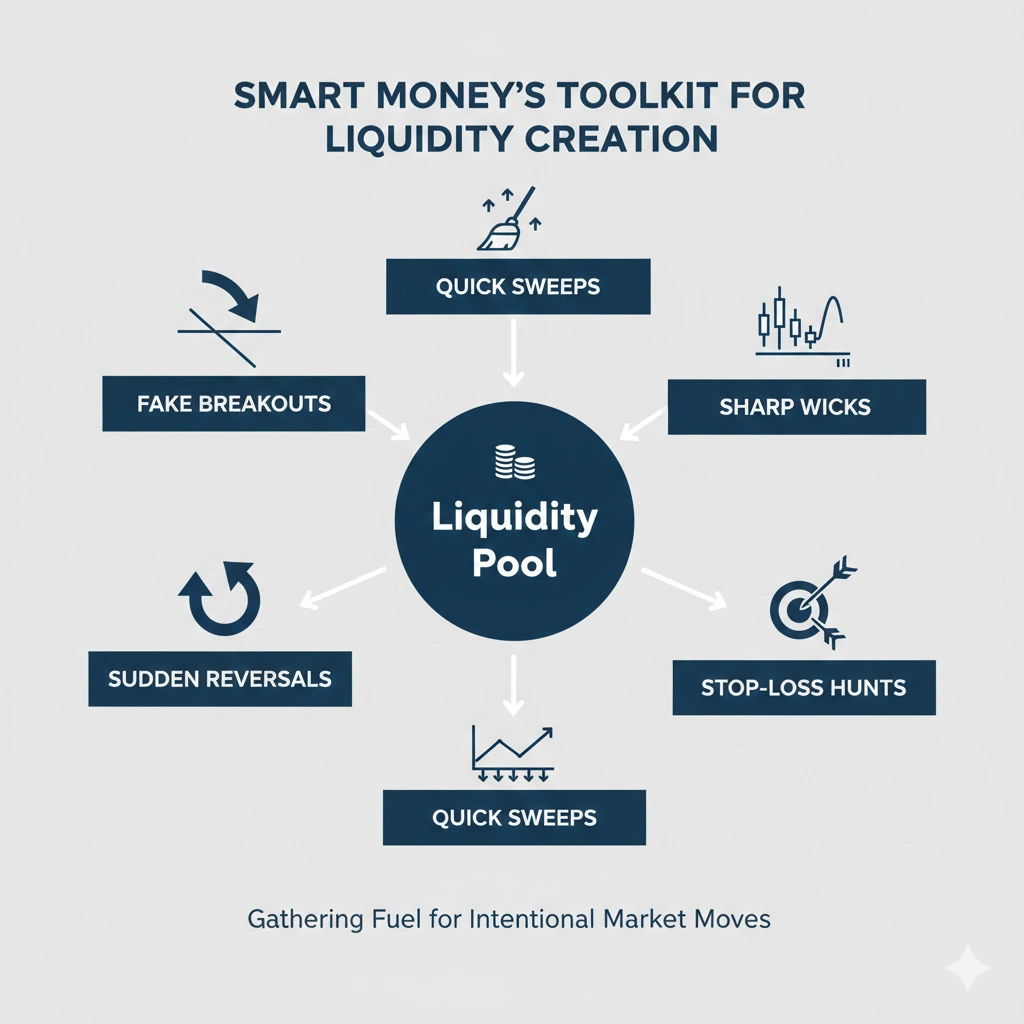
So they engineer situations to create liquidity:
- Fake breakouts
- Stop-loss hunts
- Sharp wicks
- Sudden reversals
- Quick sweeps before moving in the actual direction
These moves, known as smart money manipulation, are simply the market’s way of gathering fuel before moving.
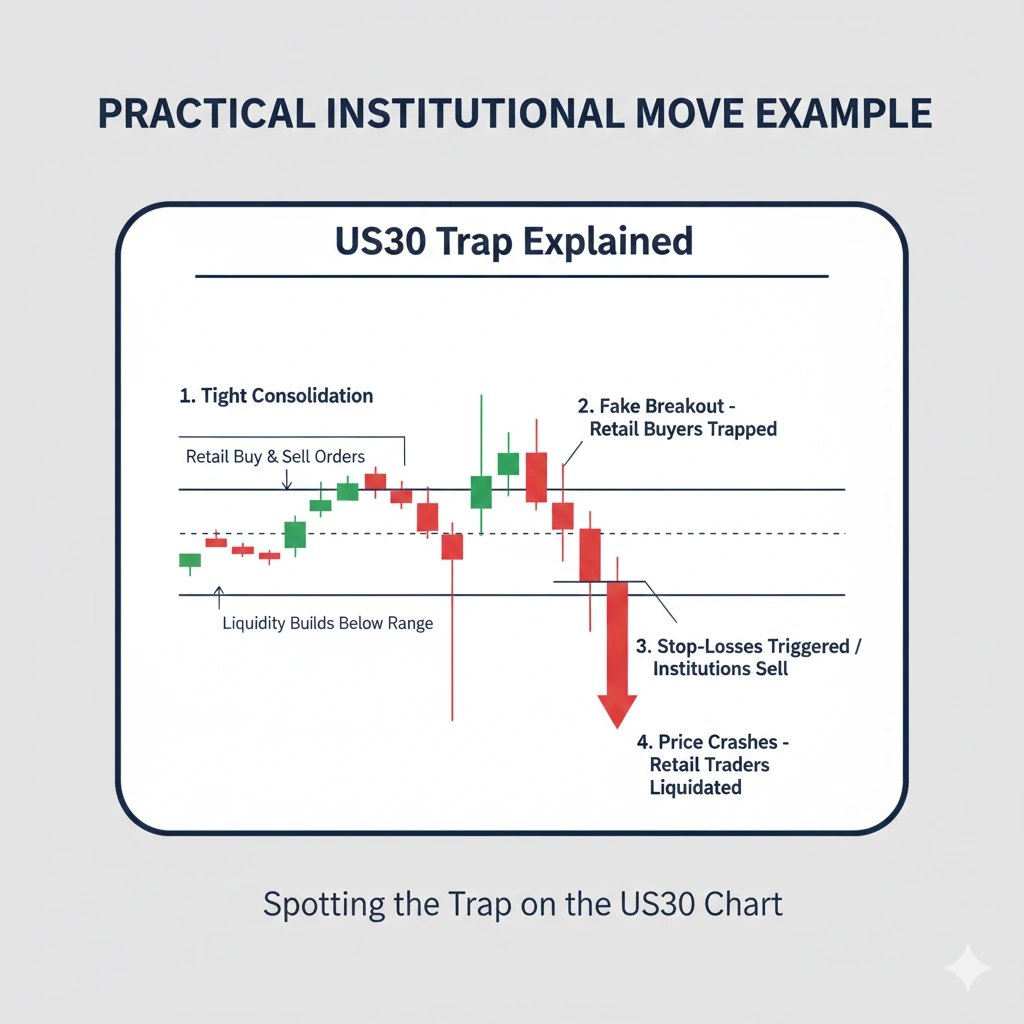
A Practical Institutional Move Example
To make it more real, Veer showed Veer a recent US30 chart:
Scenario:
US30 was consolidating tightly. Suddenly, a strong bullish breakout candle appeared—every beginner bought it. It looked like a clean breakout, but it reversed within minutes.
What was happening?
- The consolidation attracted retail breakout traders.
- Their stop-losses were placed below the range.
- Institutions pushed the price up to trap buyers.
- Once enough liquidity was collected, they sold heavily.
- Prices reversed sharply, leaving retail traders stuck.
This was Veer’s first true institutional move example unfolding in front of him.

Veer Learns Market Storytelling (Not Just Levels)
As Veer continued learning, Veer taught him how markets tell a story.
This concept helped him focus less on drawing endless lines and more on understanding the “why” behind price movement.
The Market Story Looks Like This:
- The Setup: Retail traders build a bias, creating pools of liquidity.
- The Trap: Price fakes a move to grab that liquidity.
- The Real Move: Institutions enter, driving the true trend.
- The Chase: Retail traders realize they were wrong and join late.
- The Reset: The trend reverses, and new liquidity forms for the next cycle.
The Turning Point: Veer Spots a Setup Himself
A few days later, Veer saw US30 forming equal lows again. Retail traders were selling hard betting for a breakdown. But Veer didn’t because he knew this pattern:
- Equal lows → liquidity
- News approaching → volatility
- Retail bias → predictable traps
He waited patiently.
Veer waited patiently for the price to dip, taking the stop-losses of traders after the resistance. And just after the stop-loss when stock regained the range he made the entry.
This was his first win based on understanding smart money manipulation, and it gave him a huge boost of confidence.
What Veer Now Does Differently (Key Lessons)
Instead of guessing, veer follows a strict routine to plan his trades:
- Find the Trap First, Direction Second: He first identifies where the retail traders are stuck. Before making an entry.
- Wait for the Fake-Out: He never makes the first move. Instead, he waits for a fake breakout to happen and hunts for the stop-losses of retailers. Then make the entry.
- Enter after the chaos: He trades the reaction, not the prediction. The move that happens after the liquidity grab is usually the real one.
- Hide the Stop-Loss: He stopped putting his stop-loss just below the entry price. And started moving his trade as per the institution’s movement to avoid it getting hit.
- Read the Room: He analyzes and studies the market conditions together with the indicators.
Why Understanding Smart Money Manipulation Helps You Survive
Learning about smart money manipulation won’t guarantee you overnight success, but it will save you from being an easy target:
- Don’t let your emotions react to the breakouts
- Stop trading in FOMO over every breakout
- Try to see the reason behind the sudden spikes
- Stay informed,; read news related to banks movement
- Trust your trade to avoid paining on small dips
Conclusion: Market Doesn’t Hate You; You Just Need to See Its Logic
Veer’s story proves one important thing: the market isn’t chaotic, and it definitely isn’t personal. It’s not trying to trick you—it’s just doing business. Those sudden stops and reversals? That’s just “smart money” balancing the books and finding liquidity.
By the time you understand the logic behind them, everything changes. You stop guessing and start seeing clear setups. If you want to fast-track that learning curve, Insightful Trade is a great place to start. They will help you understand the complex concepts in simple, actionable lessons—helping you recognize where the trap is set, control your emotions, and ultimately trade with a plan.
FAQs
- What is smart money manipulation?
In this, usually the big banks or investors try to drive a force in the market with fake breakouts to gather liquidity to trigger the stop-losses before pushing price in the intended direction.
- Why does the market grab liquidity?
Institutions need liquidity to fill large orders. Areas where retail traders place stops or pending orders become ideal liquidity pools.
- What is a common liquidity grab example story?
When the price touches the resistance high. Retail traders often try to buy such breakouts. While the big banks or investors start selling here, trapping the retail traders.
- How can I avoid the traps?
Don’t jump to the action on every breakout. Instead, let the market manipulation happen first. Wait for the fake move to settle down before making entry.
- What is an institutional move example?
It’s usually the clean, strong move that happens after the messy stuff. If you see the market quickly sweep below a recent low (trapping sellers) and then rocket upwards, that strong upward move is the institution stepping in.

Author: Kumkum Chandak
Experience: 3+ Years in Trading Research & Market Content Strategy
Kumkum Chandak is a trading content strategist and market research writer who specializes in simplifying technical analysis, trading tools, and strategy-driven educational content. Her work is optimized for EEAT, accuracy, and user intent, ensuring every article delivers practical insights for traders of all levels.
Risk Disclaimer:
All content is strictly educational and not financial advice. Trading involves substantial risk. Always perform your own analysis or consult a professional advisor.
Last Updated: 4 December 2025