
Quick Summary
A strategic framework that allows you to focus on market sessions like Asia, London, and New York is known as session based trading plan. It optimizes profitability and reduces unnecessary risk, and you can enhance precision and discipline if you align your trades with session-specific market behaviors.
If you integrate a time-based trading strategy into your session plan, that refines your approach. In this comprehensive guide, we will explore what exactly it is with real examples.
Key Highlights at a Glance
| Topic | Glance |
| What is session based trading plan? | A trading strategy that aligned with market sessions |
| Why it matters | Enhance risk management, improve focus |
| Benefits | Optimized trade timing and better consistency |
| Tools & Resources | Trading platforms, economic calendars, and charting software |
Introduction: Why Every Trader Needs a Session-Based Approach
The most frustrating aspect of trading is inconsistent results. Have you ever noticed that on some days everything seems to be going perfectly, and on other days the trade that looks simplest also fails?
With the help of session based trading plan, you can easily improve risk management and improve consistency because it reduces emotional decisions and avoids low-probability setups, which results in turning your trade into a disciplined and high-probability system rather than guesswork.
What Is a Session Based Trading Plan?
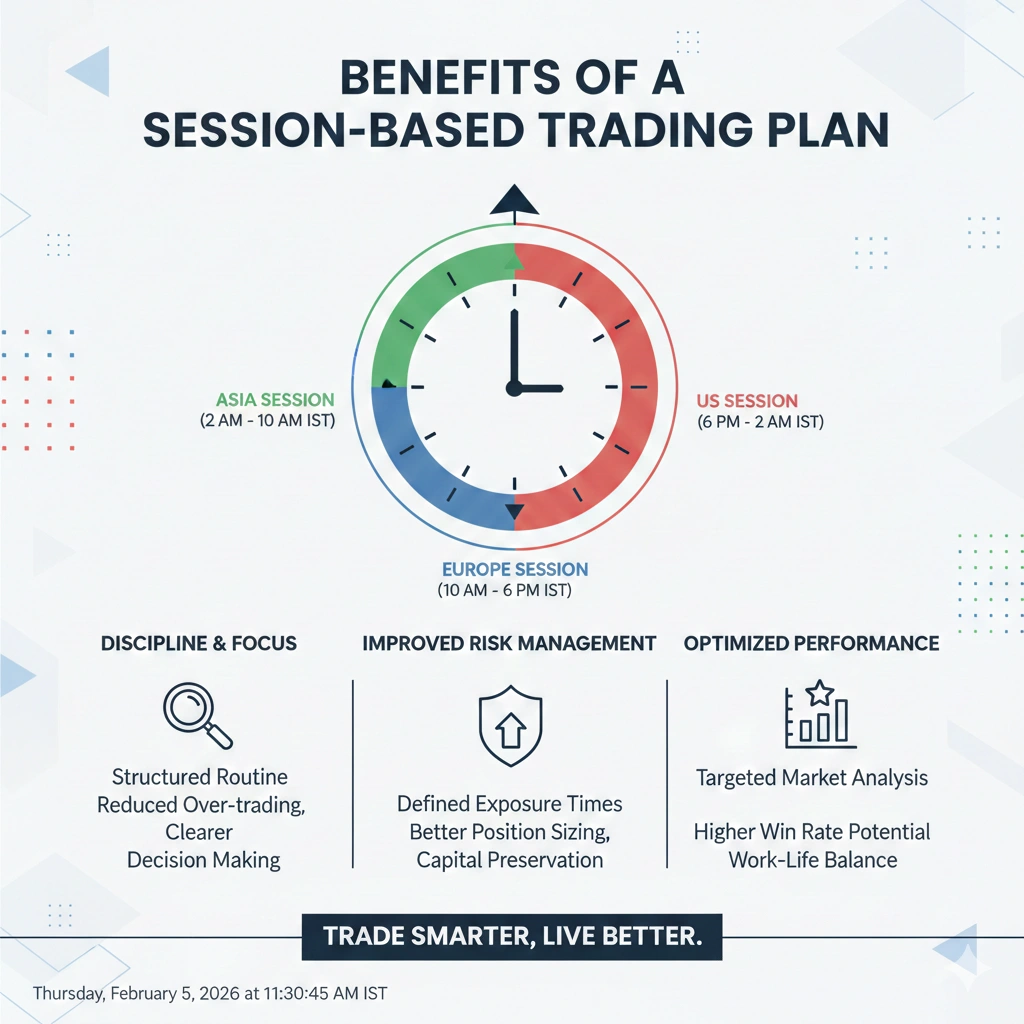
A session-based trading plan is a framework for your trading where the activity of your market aligns with specific global trading sessions, such as Asia, London, and New York. Here is described each session with its own characteristics:
- Asian Session: Low Volatility, range-bound markets, and perfect for scalping and range strategies
- London Session: High volatility, breakouts, and trending moves, and ideal for swing and momentum trading
- New York Session: Good for news-based and breakout trades, high volatility during overlaps with London
| Trading Session | GMT Time | IST Time |
| Asian Session | 00:00 – 09:00 | 05:30 – 14:30 |
| London Session | 08:00–17:00 | 13:30–2:30 |
| New York Session | 13:00–22:00 | 18:30 – 03:30 |
Who Should Use a Session Based Trading Plan?
It is ideal for you if you want focus, structure, and high-probability setups. Here’s who can benefit the most:
- If you are a intraday trader with limited screen time
- If you trade Forex, indices, and liquid crypto
- Want structured routines instead or random setups
- Who are struggling with emotional entries and overtrading
Who Should Avoid a Session Based Trading Plan
It is powerful for many traders but not for everyone. Let’s see for whom it is not suitable:
- Who trade all sessions without specialization
- Unable to follow fixed market hours
- Without session context, depend only on indicators
- Long-term positional traders holding for weeks/months
Benefits of a Session Based Trading Plan
It offers several benefits to you when you implement session based trading plan, such as
- It gives you a structured trading routine to reduce randomness
- It focuses on trading activity, which makes it more time-efficient
- Limit trades to session that helps you in optimized risk management
- Better market adaptation that improves accuracy in your trade
- Enhances precision by integrating with Time-based trading strategies
Tools to Enhance Your Session-Based Trading Plan
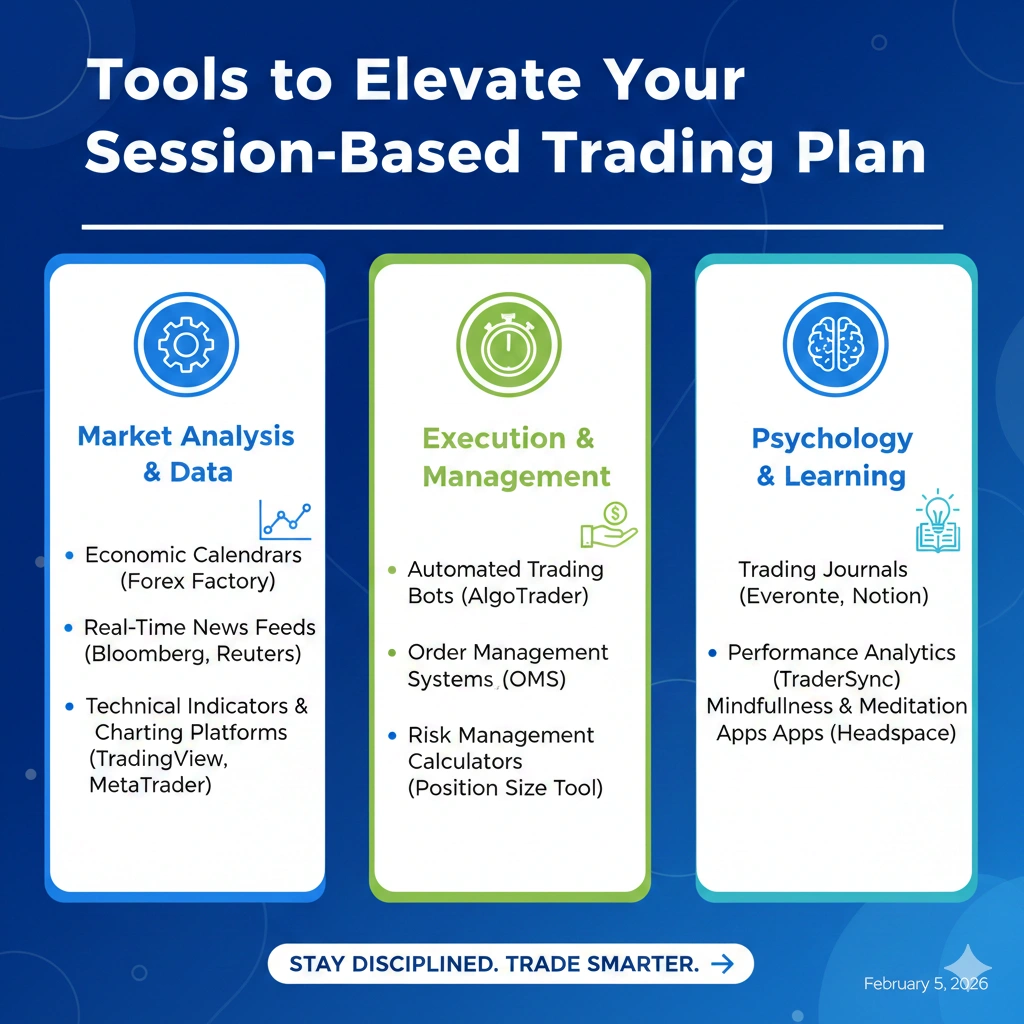
To build a successful session based strategy plan, you also need the right tools that help you to analyze, execute, and review your trades with precision.
Platforms for Trading
TradingView, NinjaTrader, or MetaTrader ⅘, which allows you to monitor multiple markets across different sessions and execute trades efficiently.
Session & Time-based Indicators
These indicators help you by marking Asian, London, and New York on charts visually, making it easier.
Economic Calendars
These calendars from sources like Forex Factory or Investing.com help you anticipate volatility spikes, which are caused by major economic releases.
Trading Journals
If you want long-term success, it is essential because it allows you to refine both your session based trading plan and your time-based trading strategy.
Volatility & Technical tools
RSI, ATR, Bollinger Bands, and moving averages help you to adapt strategies to session-specific volatility.

Common Mistakes Traders Make
Being a trader, if you have an understanding of the session based trading plan concept, there can also be inconsistent results because there are many mistakes that are avoidable. Let’s see what they are:
- If you are trading all sessions without specialization
- Overtrading due to boredom
- Ignoring time-based filters within a session
- Review performance by session and time
- Risk management across sessions
How to Combine Session-Based and Time-Based Strategies
If you combine session based trading plan with time-based strategies, it will improve the quality and consistency of your trading by creating a powerful framework.
Here’s a practical framework for combining both:
- First of all, select the core session that aligns with your strategy and risk tolerance
- Identify recurring patterns by using historical data
- Align strategy type with timing, such as breakout strategies, range strategies, and momentum strategies
- Journaling performance and trades by session and time of execution
- Adjust risk with position sizing and stop-loss placement
If you combine session structure with precise timing, it results in reducing emotional decisions and focusing only on high-quality setups.
Example of a Session Based Trading Plan
When we talk about a strong session based trading plan, it includes a market that is clearly defined, timing, strategy, session, and risk rules. Here is an example: a EUR/USD London session plan may focus on breakouts from the Asian range during the first 90 minutes of the London open with 1% risk. It makes session selection critical because most intraday volatility occurs during the London-New York overlap. Being a trader, you should follow a checklist covering session choice, strategy alignment, and disciplined risk management.
Conclusion
At last, if you are also serious about consistency and risk management, then session based trading plan is very important for your trade. You can easily focus on high-probability trades and improve overall performance by combining them with a time-based trading strategy.
Combining both allows you to improve risk-reward efficiency and filter out the setups with low quality. Most importantly, it provides clarity, focus, and scalability even if you are a beginner or an experienced trader.
Use InsightfulTrade, which offers trusted strategy & educational guides if you are also looking to deepen your understanding of structured trading frameworks and provide you with long-term trading success.
Is a Session Based Trading Plan Profitable?
The profitability largely depends on discipline, risk control, and execution. It does not guarantee profits, but if you align it with specific market sessions, it can reduce low-profitability setups and improve consistency.
FAQs: Session Based Trading Plan
Q1. What is the difference between a session-based and a time-based trading strategy?
When you talk about session-based, it focuses on global market sessions. On the other hand, time-based trading emphasizes trading at specific times within those sessions.
Q2. Which trading tools are essential for a session-based plan?
It includes a reliable trading platform, such as MetaTrader or TradingView, economic calendars, session indicators, and a trading journal.
Q3. Can beginners use a session-based plan?
Yes, definitely. If you are also a beginner, then without feeling overwhelmed, you can also benefit from risk limits, structured routines, and focused sessions.
Q4. How often should I review my session-based trading plan?
If you review it on a weekly basis, it will refine entries, exits, and session selection, while reviewing monthly assesses overall profitability.
Q5. Does InsightfulTrade offer educational guides on session trading?
Yes. For session-based trading plans, InsightfulTrade provides educational guides and tutorials to help you, whether you are a beginner or an experienced trader.
Author: Arihant Jain
Trading Experience: 5+ Years
Arihant Jain is a financial markets analyst and trading educator with expertise in Forex, indices, crypto, and risk-managed trading systems. His insights are based on real trading experience, data-driven analysis, and transparent market understanding. All content is reviewed for accuracy and aligns with Google’s EEAT guidelines.
Risk Disclaimer:
Trading involves substantial risk. All information is for educational purposes only and should not be taken as financial advice. Always do your own research.
Last Updated: 04 February 2026