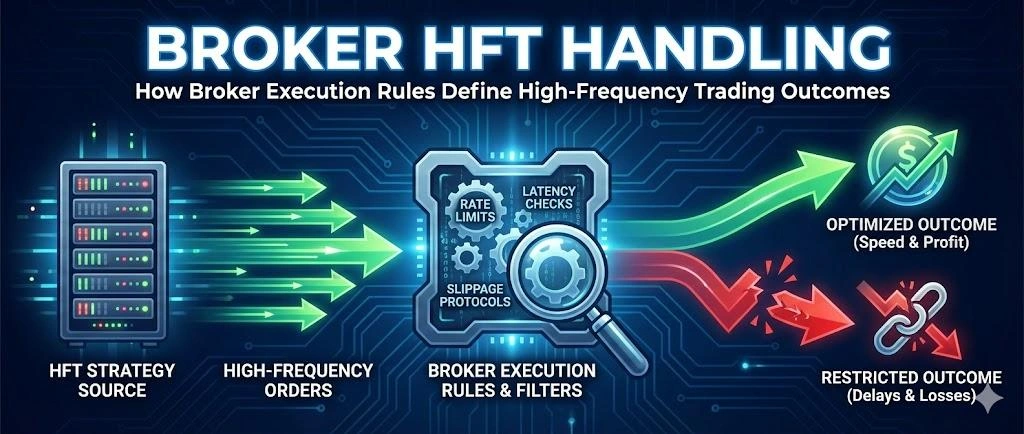

Requotes in forex trading can be one of the most frustrating experiences for traders, and this is particularly frustrating when attempting to buy or sell the market at the most ideal price. You already experienced requotes firsthand when you ever clicked the buy or sell button, only to be redirected to the new price displayed immediately.
Simply, in the case of forex trading, requotes occur when a broker is incapable of fulfilling your order at the requested rate. It is also necessary to know the reasons behind the occurrence of requotes and how they are connected to the most common reasons for rejecting an order to select the appropriate broker and trading platform.
Quick summary
| Issue | What It Means |
| Requotes | The broker can’t fill your order at your price and offers a new one |
| Cause | Fast market moves, low liquidity, or slow platform |
| Impact | Missed trades, delayed entries/exits, and higher trading costs |
| Fix | Pick fast brokers, use modern platforms, and avoid volatile news |
Are Requotes Good or Bad for Traders?
Requotes are not illegal and are a normal part of forex trading during fast market conditions. However, they act as a signal of execution quality—frequent requotes usually indicate slow platforms or dealing-desk intervention. For scalpers and news traders, repeated requotes create a poor trading environment due to missed or delayed entries.
Why Requotes in Forex Trading Matter
Let’s be honest, the requotes in forex trading may simply tear up a fine trade. When your order fails to work on time, your plan fails.
They matter because they impact:
- Scalping schemes that are based on real-time implementation.
- Trading news in fast-moving markets.
- Frequency of execution: it is all about speed.
- Accuracy of stop-loss and take-profit.
In Broker and Platform Analysis, frequent requotes in forex trading are common reasons for order rejection, and they are an indication of the bad quality of broker execution.
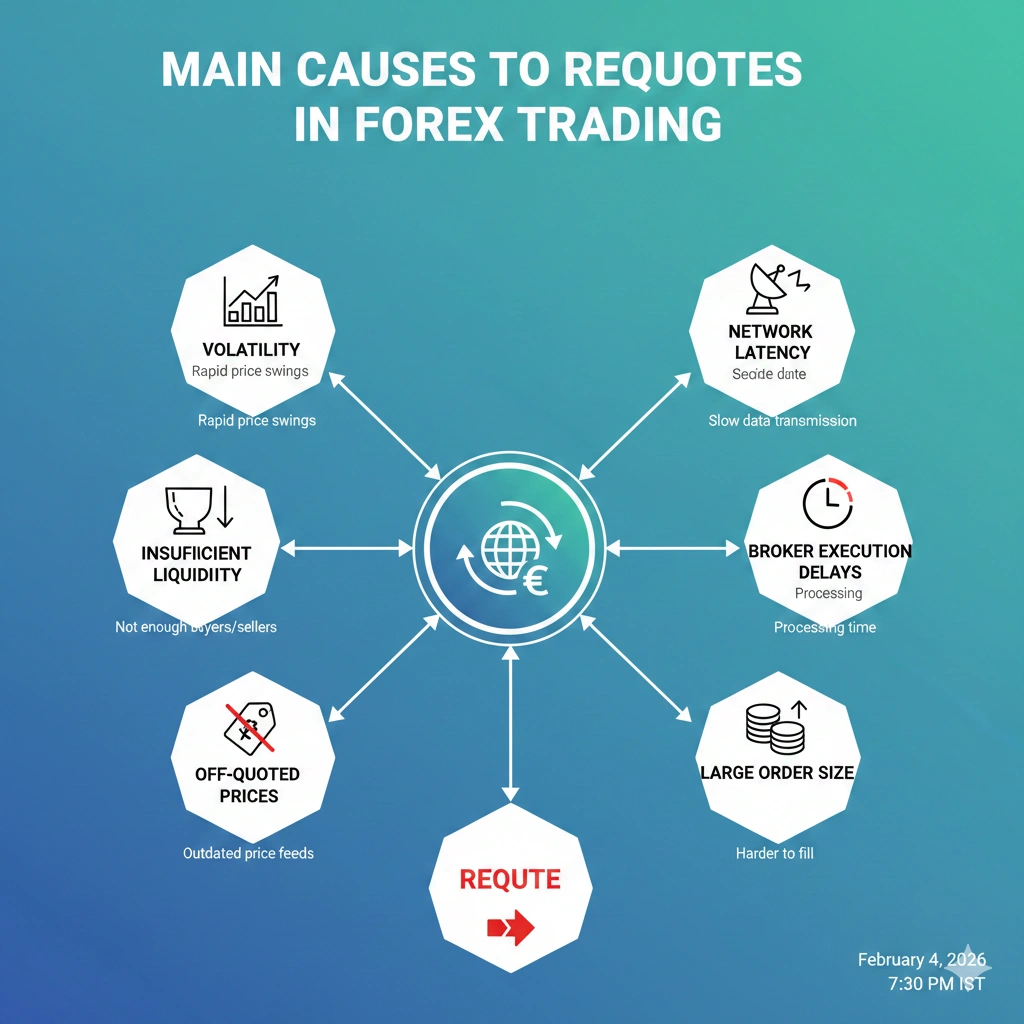
Main Causes of Requotes in Forex Trading
Let’s talk honestly about as to why requotes do occur in the trading of foreign exchange. In the majority of cases, it is not by chance: it is due to the manner in which the market, broker, or platform functions.
1. Market Volatility
As soon as the market becomes too fast, your order will be overtaken before completion.
- This usually happens during:
- NFP releases
- Interest rate decisions
- CPI and inflation news
The reason traders experience one of the main reasons of order rejection is volatility.
2. The Market Maker Brokers (Dealing Desk) of Bank of America.
Trades are done manually by brokers working off dealing desks, and it results in:
- Increased requotes in forex trade.
- Greater order rejection reasons.
- Slower execution
The broker risk is sometimes managed by the use of requotes.
3. Low Liquidity Conditions
In times of liquidity, it is tricky to execute, particularly at:
- Market opening hours
- Session overlaps
- Weekend gaps
This enhances requotes in forex trading and failed orders.
4. Platform Execution Speed
Slow or old systems will not be able to keep pace with the rapid changes in pricing and this leads to:
- Requotes in forex trading
- Price mismatch errors
- Execution failures
This is one of the major considerations in Broker & Platform Analysis.
5. Tight Slippage Controls
Price flexibility is not permitted by some brokers. Even small price moves can:
- Reject the order
- Farewell, slippage in forex trading instead of requotes.
- This is usually an invisible reason for rejecting orders.
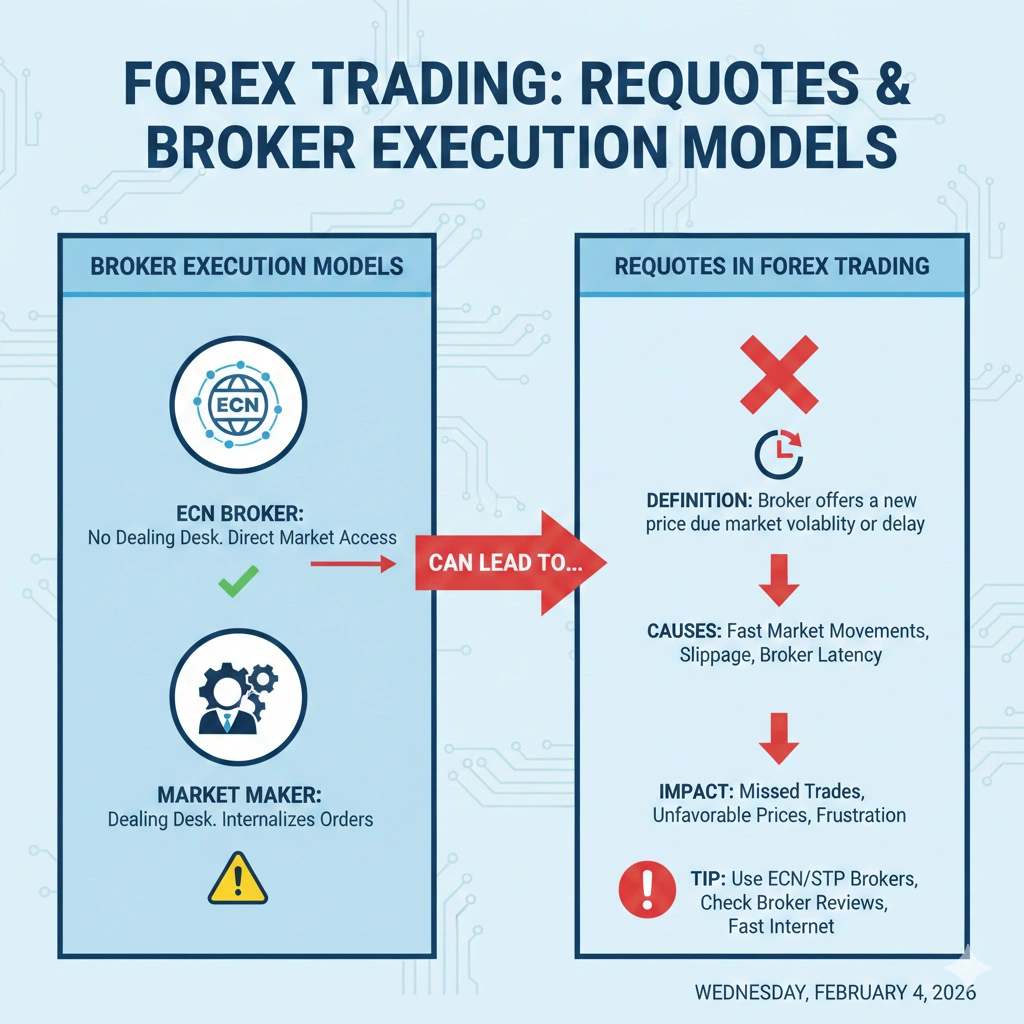
Requotes vs Other Order Rejection Reasons
Let’s keep it clear. Better Place Requotes in the foreign exchange market do not decline your order, but simply present a different price.
Other reasons for rejecting orders include:
- Low margin of your account.
- Illegal or wrong volume of trade.
- During limited market trading.
- Price being out of range
- Liquidity provider declining the order.
In the Broker and Platform Analysis, requotes in forex trading are not the same since the trade is stalled, as opposed to other reasons that cancel the trade.
Broker Execution Models and Requotes
Market Maker Brokers
According to publicly shared broker execution disclosures (2025), some large retail brokers report requote rates below 5% during normal market conditions, while ECN/STP execution models typically show significantly lower requote frequency due to direct market access and automated order routing. This difference highlights how broker execution structure directly impacts requotes and overall trade quality.
You’ll often see:
- Increased requotes in forex trade.
- Manual trade handling
- Alterations in faster markets have more reasons to reject orders.
This renders Market Maker brokers unfavorable to scaling up and high-speed trading in Broker and Platform Analysis.
ECN / STP Brokers
Let’s keep it short. Forex trading Requotes often tend to be significantly lower with ECN and STP brokers because the orders are passed straight to liquidity providers.
You’ll typically get:
- Less foraging in forex trading.
- Faster execution
- Less reason of order rejection.
This is why active traders prefer ECN and STP brokers in Broker and Platform Analysis.
High vs Low Requote Brokers
| Factor | High Requote Broker | Low Requote Broker |
| Execution model | Dealing Desk | ECN/STP |
| Slippage Policy | Strict | Flexible |
| Platform | Older MT4 | MT5/ Modern |
| Best for | Long-term trading | Scalping / News |
Platform Technology and Its Role in Requotes
Let’s keep it simple. In forex trading, requotes are sensitive depending on the trading platform and not entirely the broker.
Platform differences:
-
MetaTrader 4 (MT4)
In MT4, traders are prone to:
- Increased forex trading in high volatility requires more requotes.
- Pop-ups with price changes that have to be confirmed by hand.
- Declines in speed in fast markets.
- Scalper has higher-order reasons of rejection.
- MetaTrader 5 (MT5)
With MT5, you usually get:
- Less requotes in forex trading than in MT4.
- The order execution is also faster and smoother.
- Harboring of better order and depth of market.
- Probably reduced order rejection causes.
MT5 is found to be favorable in Broker and Platform Analysis, where traders would want to receive a superior execution and reduced requotes.
How Requotes Impact Trading Strategies
Let’s be honest, requotes in forex trading have varying effects on various strategies.
Scalping
Scalpers feel it the most. Quick trades of forex trading can be spoiled by requotes due to:
- Missed entries
- Delayed exits
- Increased spreads
News Trading
Forex trading risks trades with news being requoted frequently because of:
- Sudden market volatility
- Liquidity gaps
- Broker execution limits
Swing and Position Trading
There are fewer requotes in forex trade by long-term traders, yet the causes of order rejections may affect the entry and exit points.
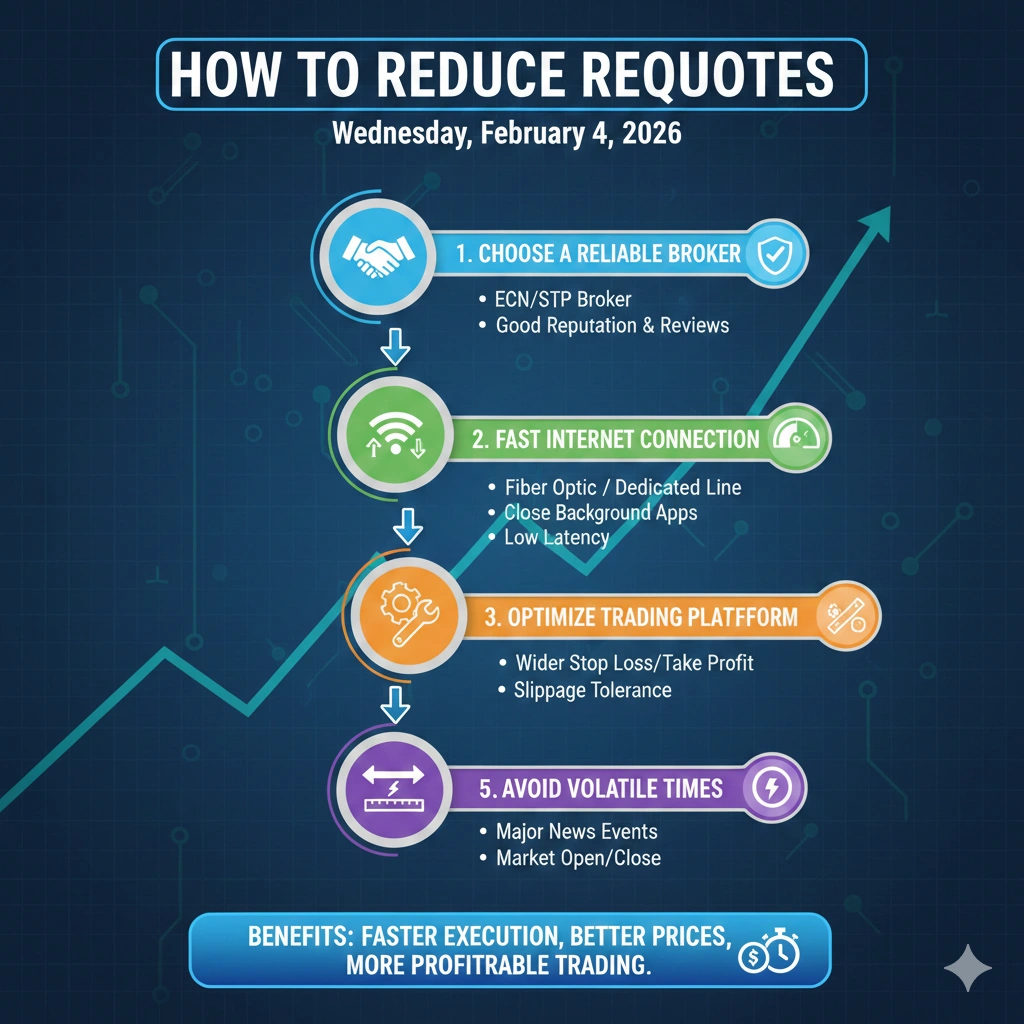
How to Reduce Requotes in Forex Trading
Being honest, quotas in forex trade can be irritating, yet they can be reduced cleverly.
Choose the Right Broker
Pick brokers with:
- ECN or STP execution
- Low requote history
- Open implementation policies.
Upgrade Trading Platforms
The modern faster platforms minimize:
- Requotes in forex trading
- Ordinary reasons for rejection of the order.
Trade in a quiet market, not when it is very volatile.
Requotes are commonly done because of big news releases or abrupt market movements in forex trading. Avoid them when possible.
Take Market Orders Selectively.
Market orders that have a reasonably high slippage tolerance tend to be fewer requotes than instant execution orders.
FAQs
1. Which tools help analyze requotes in forex trading?
The trade logs, execution reports, and platform analytics tools assist traders in quantifying requotes in forex trading and determining the reasons behind order rejection.
2. Are requotes more common on certain platforms?
Yes. The forex trading with older platforms or brokers that apply instant execution models has increased requotes.
3. Can regulated brokers still issue requotes?
Yes, but controlled brokers are required to publish the reasons for order rejection and maintain fair practices in the execution.
4. Is slippage better than requotes?
In many cases, yes. Slippage enables continuity in execution, whereas requoting in forex trading may result in lost trading opportunities.
5. How does Broker & Platform Analysis reduce trading risk?
Through spotting execution flaws, breaking down requotes in forex trade, and knowing why an order was rejected before investing the capital.
6. Do requotes indicate broker manipulation?
Not always; it depends on the execution model. Look for patterns, not one-off events.
Conclusion
In short, requotes in forex trading are not some irritating pop-ups; they demonstrate the speed of a brokerage firm and the trustworthiness of a certain platform. Knowledge of requotes and other order rejection causes will enable you to select the appropriate broker and trading service. Smart Broker & Platform Analysis will result in less trouble in executing, improved trading, and an overall better experience by serious traders in swiftly moving markets.
Ready to reduce requotes and improve your trading execution? Explore InsightfulTrade for expert broker analysis, platform reviews, and actionable tips to trade smarter and faster in forex markets today!
Author: Arihant Jain
Trading Experience: 5+ Years
Arihant Jain is a financial markets analyst and trading educator with expertise in Forex, indices, crypto, and risk-managed trading systems. His insights are based on real trading experience, data-driven analysis, and transparent market understanding. All content is reviewed for accuracy and aligns with Google’s EEAT guidelines.
Methodology: This article is based on platform execution mechanics, broker disclosures, and real trading observations across MT4 and MT5 environments.
Risk Disclaimer:
Trading involves substantial risk. All information is for educational purposes only and should not be taken as financial advice. Always do your own research.
Last Updated: 04 February 2026