
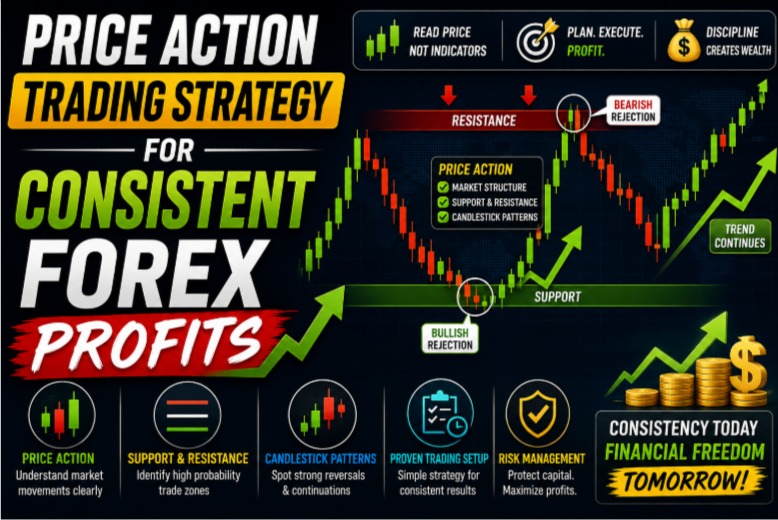
Introduction to Price Action Trading
Among all trading methodologies available in the forex market, price action trading strategies remain one of the most widely used and respected approaches. Professional traders, institutional participants, and retail investors often rely on price action because it focuses on interpreting raw market behavior rather than depending solely on indicators.
The primary goal of price action trading strategies is to analyze how price moves over time and use that information to anticipate future market direction. Instead of cluttering charts with numerous indicators, traders study candlestick formations, support and resistance zones, and overall market structure.
One of the greatest advantages of price action trading is its flexibility. Traders can apply price action techniques to all currency pairs and across multiple timeframes. Whether trading intraday, swing trading, or long-term position trading, price action principles remain relevant.
Developing profitable price action trading strategies requires patience, discipline, and continuous practice. However, traders who master these principles often develop a deeper understanding of market dynamics and improve long-term consistency.
Understanding Forex Price Action
At the heart of successful trading lies forex price action. Forex price action refers to the movement of currency prices over time and the interpretation of that movement without excessive reliance on indicators.
The concept of forex price action is based on the idea that all available information—including economic data, geopolitical events, and market sentiment—is ultimately reflected in price itself. As a result, analyzing price movements can provide valuable insights into buyer and seller behavior.
Forex price action traders focus on market structure, momentum, trend direction, and key support and resistance zones. By studying how price reacts around important levels, traders can identify high-probability trading opportunities.
Understanding forex price action allows traders to make objective decisions based on actual market behavior rather than predictions or emotions.
Why Price Action Trading Strategies Are Effective
The effectiveness of price action trading strategies stems from their simplicity and adaptability. Since price action reflects the collective decisions of all market participants, it provides direct insight into supply and demand dynamics.
Unlike many indicator-based systems, price action trading strategies do not suffer from excessive lag. Traders can react to current market conditions rather than relying on delayed signals.
Another advantage is versatility. Price action trading strategies can be used in trending, ranging, and volatile market conditions. This adaptability makes them attractive to traders with varying styles and objectives.
Additionally, traders using price action often develop stronger market intuition because they learn to interpret price behavior directly.
The Role of Candlestick Trading in Forex
One of the most important components of candlestick trading is understanding how individual candles reflect market sentiment. Each candlestick represents the battle between buyers and sellers during a specific period.
In candlestick trading, formations such as pin bars, engulfing candles, inside bars, and doji patterns provide valuable information regarding potential market reversals or continuation opportunities.
Candlestick trading allows traders to identify shifts in momentum and market sentiment. For example, a bullish engulfing candle appearing at major support may indicate strengthening buying pressure.
Successful traders often integrate candlestick trading into broader price action trading strategies to improve timing and trade confirmation.
Understanding Support Resistance in Price Action Trading
Support and resistance form the foundation of many successful support resistance trading methods. Support represents areas where buying pressure historically prevents further declines, while resistance identifies zones where selling pressure limits price advances.
The relationship between support resistance and price action is particularly important because markets frequently react around these levels.
Traders using price action trading strategies often wait for price to approach significant support resistance zones before searching for confirmation signals.
Strong support resistance levels frequently provide the basis for high-probability trading opportunities and help traders define risk parameters effectively.
Building a Trading Setup Using Price Action
Every successful trader relies on a structured trading setup to identify and execute opportunities consistently. A trading setup refers to a predefined set of conditions that must be present before entering a trade.
A high-quality trading setup based on price action may include trend analysis, support resistance levels, and candlestick confirmation.
For example, in an uptrend, traders may wait for price to retrace toward support before looking for bullish candlestick trading signals.
Developing a consistent trading setup reduces emotional decision-making and improves overall trading discipline.
Market Structure and Forex Price Action
Market structure plays a central role in forex price action analysis. Traders must determine whether the market is trending upward, trending downward, or consolidating.
In trending markets, price action trading strategies typically focus on trading in the direction of the prevailing trend. During ranging conditions, traders often rely on support resistance levels to identify reversal opportunities.
Understanding market structure helps traders align their trading setup with broader market conditions.
Accurate interpretation of forex price action significantly improves trade selection and overall consistency.
Candlestick Trading Patterns Every Trader Should Know
Several candlestick trading patterns appear regularly in forex markets and provide valuable trading signals.
Pin bars are among the most widely used formations because they indicate strong rejection of a particular price level. Engulfing patterns often signal momentum shifts, while inside bars frequently suggest consolidation before expansion.
Integrating candlestick trading patterns into price action trading strategies improves trade timing and confirmation.
However, traders should avoid relying exclusively on individual patterns. Context remains essential for successful market interpretation.
Using Support Resistance to Improve Trade Entries
The combination of support resistance analysis and price action often produces highly effective trading opportunities.
When price approaches significant support resistance zones, traders monitor market behavior closely. Strong rejection candles or bullish and bearish engulfing patterns frequently provide confirmation.
Support resistance analysis also helps traders determine logical stop-loss placement and profit targets.
Professional traders rarely ignore support resistance because these levels often influence institutional order flow and market sentiment.
Creating High-Probability Trading Setups
A profitable trading setup requires more than simply identifying a chart pattern. Traders should seek confluence, where multiple factors align to support a potential trade.
For example, a high-probability trading setup may involve an uptrend, price retracing to support resistance, and bullish candlestick trading confirmation.
Combining several analytical elements strengthens confidence and reduces the likelihood of low-quality trades.
Consistency in applying predefined trading setup criteria often leads to improved long-term performance.
Price Action Trading Strategies for Trending Markets

Trending markets provide some of the best opportunities for price action trading strategies. In strong trends, traders generally focus on continuation setups rather than countertrend trades.
Forex price action analysis helps traders identify pullbacks within trends and locate favorable entry points.
Candlestick trading patterns appearing near support resistance levels often provide excellent continuation signals.
Trading in alignment with the prevailing trend generally improves probability and enhances consistency.
Forex Price Action in Range-Bound Markets
Not all markets trend continuously. During consolidation phases, forex price action traders adapt by focusing on support resistance boundaries.
Range-bound markets often present opportunities to buy near support and sell near resistance. Price action confirmation remains essential because false breakouts frequently occur.
A disciplined trading setup helps traders avoid emotional decisions during uncertain market conditions.
Understanding market context remains vital when applying price action trading strategies in ranging environments.
Risk Management and Price Action Trading
Even the most effective price action trading strategies occasionally produce losing trades. Consequently, risk management remains essential.
Traders should determine acceptable risk levels before entering any trading setup. Position sizing, stop-loss placement, and disciplined execution protect trading capital.
Support resistance analysis often assists with defining logical stop locations, while candlestick trading confirmation helps improve entry precision.
Strong risk management ensures that individual losses remain manageable and supports long-term sustainability.
Common Mistakes in Price Action Trading
Many traders struggle because they misuse price action trading strategies. One common mistake involves overcomplicating analysis by searching for too many signals.
Another error is ignoring broader market structure and relying solely on candlestick trading patterns.
Some traders also neglect support resistance analysis, resulting in poor entry locations and increased risk.
Additionally, inconsistent application of a trading setup frequently leads to emotional decision-making and reduced performance.
Recognizing and avoiding these mistakes significantly improves trading consistency.
Long-Term Success With Price Action Trading Strategies
Achieving long-term profitability requires more than technical knowledge. Traders must consistently apply their price action trading strategies, maintain discipline, and continuously refine their skills.
Successful traders understand that mastering forex price action, candlestick trading, support resistance, and structured trading setup development takes time.
Continuous learning, journaling, and performance evaluation help traders improve over time.
Patience and consistency remain the foundation of sustainable trading success.
Conclusion
Price action trading strategies offer traders a powerful and flexible approach to navigating the forex market. By mastering forex price action, understanding candlestick trading, utilizing support resistance analysis, and developing structured trading setup criteria, traders can significantly improve their decision-making and consistency.
Price action trading emphasizes simplicity, discipline, and market understanding rather than excessive reliance on indicators. While no strategy guarantees success, traders who consistently apply these principles with proper risk management are better positioned to achieve long-term profitability and consistent forex profits.