
Introduction
Risk management is one of the most important aspects of successful forex trading. Many traders focus heavily on entry strategies and market analysis while ignoring the importance of capital preservation. One of the biggest reasons traders fail is poor forex position sizing. Without proper forex position sizing, even profitable trading strategies can lead to significant losses over time.
Professional traders understand that controlling risk is just as important as finding profitable trades. Learning effective forex risk management strategy techniques can help traders survive market volatility and improve long-term consistency. Among the most popular methods used by traders are the Kelly criterion forex approach and the fixed percent method.
The Kelly criterion forex model is a mathematical formula designed to optimize position sizing based on probability and expected returns. On the other hand, the fixed percent method is a simpler and more conservative approach widely used in retail trading. Both methods play an important role in effective forex position sizing and overall account protection.
Many beginners also search for how to calculate position size in forex because proper lot sizing directly impacts trading performance. Understanding how to calculate position size in forex allows traders to control losses and maintain emotional discipline during difficult market conditions.
This guide explains the concept of forex position sizing, compares the Kelly criterion forex method with the fixed percent strategy, and discusses the best approaches for building a strong forex risk management strategy.
Understanding Forex Position Sizing
What Is Forex Position Sizing?
Forex position sizing refers to determining how much capital to risk on a specific trade. It helps traders decide the appropriate trade size based on account balance, risk tolerance, and stop-loss distance.
Many traders underestimate the importance of forex position sizing, but it is one of the most critical factors in long-term trading success. Even highly accurate strategies can fail if traders risk too much money on individual trades.
A proper forex risk management strategy focuses on protecting trading capital during losing streaks while allowing consistent growth during profitable periods. Effective forex position sizing helps traders maintain emotional control and avoid excessive drawdowns.
Understanding how to calculate position size in forex is essential because different market conditions require different risk exposure levels. Traders who learn how to calculate position size in forex properly are more likely to achieve consistent performance.
Why Position Sizing Matters in Forex Trading
Protecting Trading Capital
One major purpose of forex position sizing is protecting trading capital from large losses. Forex markets can be highly volatile, and sudden price movements can quickly damage accounts when risk is not controlled.
An effective forex risk management strategy ensures that no single trade can significantly impact the trading account. This is why professional traders prioritize risk management before focusing on profits.
The Kelly criterion forex method and fixed percent method both aim to improve capital protection through structured position sizing. Traders who understand how to calculate position size in forex can better manage market uncertainty.
Reducing Emotional Trading
Improper forex position sizing often causes emotional stress. Traders who risk too much money may panic during market fluctuations and make irrational decisions.
A strong forex risk management strategy helps traders remain disciplined because losses stay within acceptable limits. Learning how to calculate position size in forex correctly also improves confidence and consistency.
The Kelly criterion forex approach attempts to optimize risk exposure mathematically, while the fixed percent model simplifies decision-making for retail traders.
The Kelly Criterion Forex Method
What Is the Kelly Criterion?
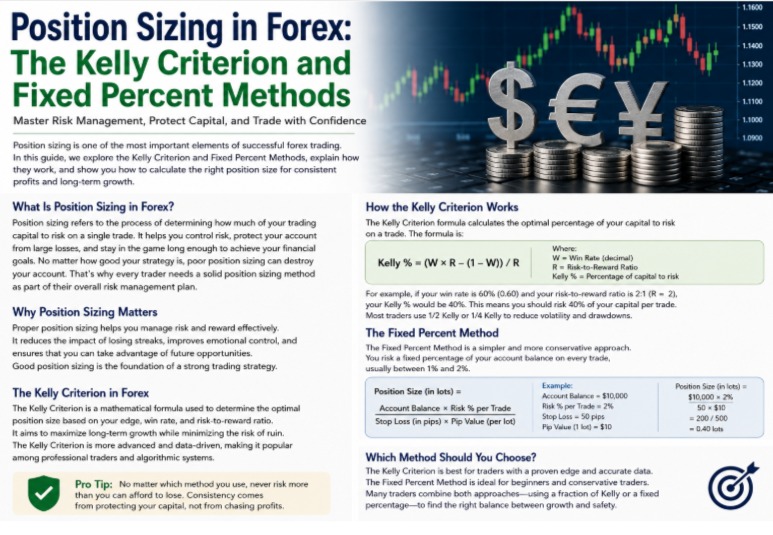
The Kelly criterion forex model is a mathematical formula used to determine the optimal percentage of capital to risk per trade. The formula considers:
- Probability of winning
- Probability of losing
- Risk-to-reward ratio
The goal of the Kelly criterion forex strategy is to maximize long-term account growth while minimizing the risk of ruin.
Many professional traders use the Kelly criterion forex method as part of their advanced forex risk management strategy because it helps optimize capital allocation.
How the Kelly Criterion Works
The Kelly criterion forex formula calculates the ideal trade size based on expected returns and win probability. Traders who understand their strategy statistics can use this model to improve forex position sizing decisions.
The formula typically requires:
- Win percentage
- Average profit
- Average loss
Although the Kelly criterion forex method can increase account growth, it may also lead to higher volatility if used aggressively. This is why many traders apply only a fraction of the full Kelly percentage.
Understanding how to calculate position size in forex becomes especially important when using advanced formulas like the Kelly model.
Advantages of the Kelly Criterion Forex Method
The Kelly criterion forex approach offers several benefits for traders seeking long-term growth.
One major advantage is that the model adjusts risk exposure according to strategy performance. Stronger trading systems may justify larger position sizes under the Kelly criterion forex method.
Another advantage is improved capital efficiency. Since the model is mathematically optimized, it helps traders maximize expected returns while maintaining structured forex position sizing.
The Kelly criterion forex strategy also supports disciplined trading because decisions are based on data rather than emotions.
Limitations of the Kelly Criterion Forex Method
Despite its benefits, the Kelly criterion forex model also has disadvantages.
One challenge is that the formula relies heavily on accurate trading statistics. If traders overestimate their win rate or expected returns, the Kelly criterion forex calculation may recommend excessive risk exposure.
Another limitation is increased account volatility. Aggressive forex position sizing can create larger drawdowns during losing streaks.
Because of these risks, many traders combine the Kelly criterion forex approach with a more conservative forex risk management strategy.
The Fixed Percent Position Sizing Method

What Is the Fixed Percent Method?
The fixed percent strategy is one of the most popular approaches to forex position sizing. Under this method, traders risk a fixed percentage of their account balance on each trade.
Most traders risk between 1% and 2% per trade as part of their forex risk management strategy. This method is simple, consistent, and widely recommended for beginners.
Unlike the Kelly criterion forex formula, the fixed percent approach does not require advanced mathematical calculations or performance analysis.
Why Traders Prefer the Fixed Percent Method
One reason traders prefer the fixed percent method is simplicity. Traders only need to calculate a small percentage of their account balance before entering trades.
This approach also helps traders learn how to calculate position size in forex more easily. Since the risk percentage remains fixed, traders can maintain consistent risk exposure across different market conditions.
The fixed percent method supports emotional stability because losses remain predictable. This makes it an effective forex risk management strategy for retail traders.
Many professionals combine fixed percentage rules with broader forex position sizing techniques to improve long-term consistency.
How to Calculate Position Size in Forex
Basic Position Size Formula
Understanding how to calculate position size in forex is essential for effective risk management.
The basic formula includes:
- Account balance
- Risk percentage
- Stop-loss distance
- Pip value
Learning how to calculate position size in forex helps traders determine the correct lot size for each trade while maintaining controlled risk exposure.
Example of Position Size Calculation
Suppose a trader has:
- Account balance: $10,000
- Risk per trade: 2%
- Stop loss: 50 pips
The trader first calculates the maximum acceptable loss. In this example, 2% of the account equals $200.
After calculating pip value, the trader determines the correct lot size based on the stop-loss distance. This process demonstrates how to calculate position size in forex effectively.
Traders who master how to calculate position size in forex are better equipped to maintain consistent forex position sizing practices.
Comparing Kelly Criterion Forex and Fixed Percent Methods
Risk Exposure Differences
The Kelly criterion forex approach is more aggressive because it attempts to maximize growth mathematically. In contrast, the fixed percent strategy focuses more on stability and capital preservation.
Traders using the Kelly criterion forex model may experience higher volatility compared to those using conservative forex position sizing techniques.
Suitability for Different Traders
The fixed percent method is generally better for beginners because it simplifies how to calculate position size in forex and reduces emotional pressure.
Experienced traders with strong statistical knowledge may benefit more from the Kelly criterion forex model as part of a broader forex risk management strategy.
Both methods can improve forex position sizing when applied correctly and consistently.
Building a Strong Forex Risk Management Strategy

Importance of Discipline
A successful forex risk management strategy requires discipline and consistency. Traders must follow position sizing rules regardless of emotions or market conditions.
Proper forex position sizing helps traders survive losing streaks while protecting capital for future opportunities.
The Kelly criterion forex model and fixed percent method both support disciplined trading when used responsibly.
Combining Multiple Risk Management Tools
Many traders combine several techniques to strengthen their forex risk management strategy.
These techniques may include:
- Stop-loss orders
- Risk-reward ratios
- Position sizing models
- Diversification
Understanding how to calculate position size in forex remains one of the most important skills within any risk management system.
Conclusion
Successful trading depends heavily on risk management and disciplined decision-making. Proper forex position sizing helps traders protect capital, control emotions, and achieve long-term consistency in the market.
The Kelly criterion forex method offers a mathematically optimized approach for maximizing account growth, while the fixed percent method provides simplicity and stability. Both strategies can play an important role in a professional forex risk management strategy.
Traders who understand how to calculate position size in forex can reduce unnecessary risks and improve trading discipline. Whether using the Kelly criterion forex approach or fixed percentage rules, the goal remains the same: protecting capital while growing the account steadily over time.
Ultimately, mastering forex position sizing is one of the most important steps toward becoming a consistently profitable forex trader.