

Quick Summary
Have you also closed a trade too early, and then the price continued in your favor? Very painful, right? This happens when you have no idea about when to exit a trade. You’re not alone in watching your winning trade turn into a loss. This is where partial close trading can be a game-changer for your trading. Today, with the help of this guide, you’ll learn:
- What is partial close trading
- How does it work step-by-step
- Pros and cons of partial close trading
- Best partial close trading strategies
- Common mistakes and pro tips
What is partial close trading, and why is it so powerful?
Partial close trading is a professional position management strategy. Here, traders close a portion of an open position to secure profits and allow the remaining portion to stay active in the market. In this strategy, you close everything and let everything run, instead of choosing between them.
Why is it so powerful?
- It locked in profits
- Freedom to ride bigger moves
- Reduced emotional pressure
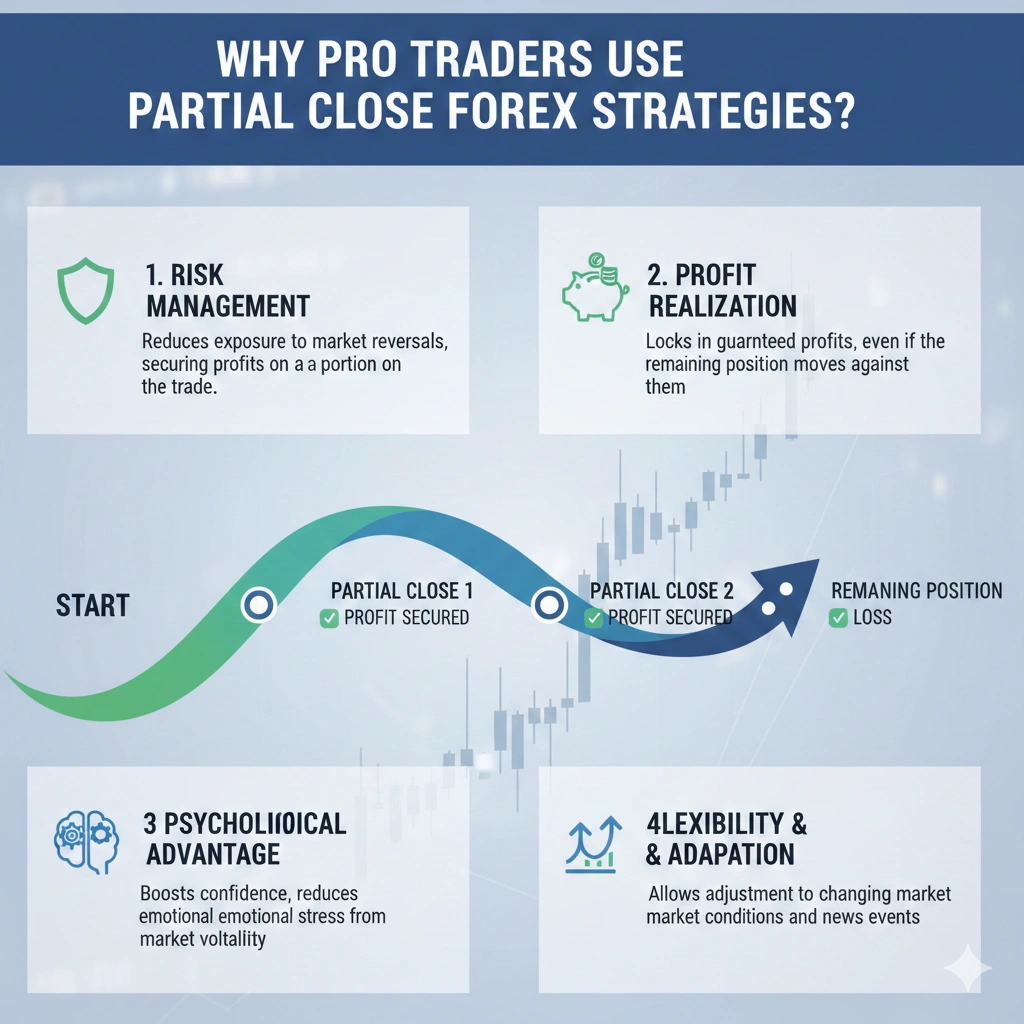
Why do professional traders use partial close forex strategies?
Are you also relying on luck? Always rely on capital protection, probability, and consistency, just like professional traders. This is the reason that partial close forex strategies are a core part of professional trading systems. Let’s look at some reasons:
- They understand that markets don’t move in straight lines
- They convert floating profits into real balance growth
- They build sustainable, predictable growth
- They trade with emotional control
- They protect capital before chasing bigger moves
So, to become a professional trader, follow these strategies because professionals don’t trade without them.
How does partial close trading work step-by-step?
Here’s a structured plan and rule-based process for how you can use partial close trading effectively:
- Step 1: Plan your trade before entry
- Step 2: Enter with full position size
- Step 3: Wait for the price to reach your first target
- Step 4: Close a portion of your position
- Step 5: Adjust your stop loss
- Step 6: Let the remaining position run
- Step 7: Exit remaining trade at final target or stop
By following these steps, you can secure early profits, stay in the trend longer, and build smoother equity growth.
When should you close partial positions in trading?
What do you think is more important? Knowing how much you close or when to close a partial close. If you’re a professional, you also follow structure-based, price-based, and risk-based rules.
Here are the powerful and proven moments to use partial close trading. Let’s break it down:
- When the price reaches your first profit target
- At major support and resistance zones
- When the market structure shows weakening momentum
- When your trade becomes emotionally heavy
- During high-impact news or session transitions
- When your trade reaches 1R or 2R risk-reward levels
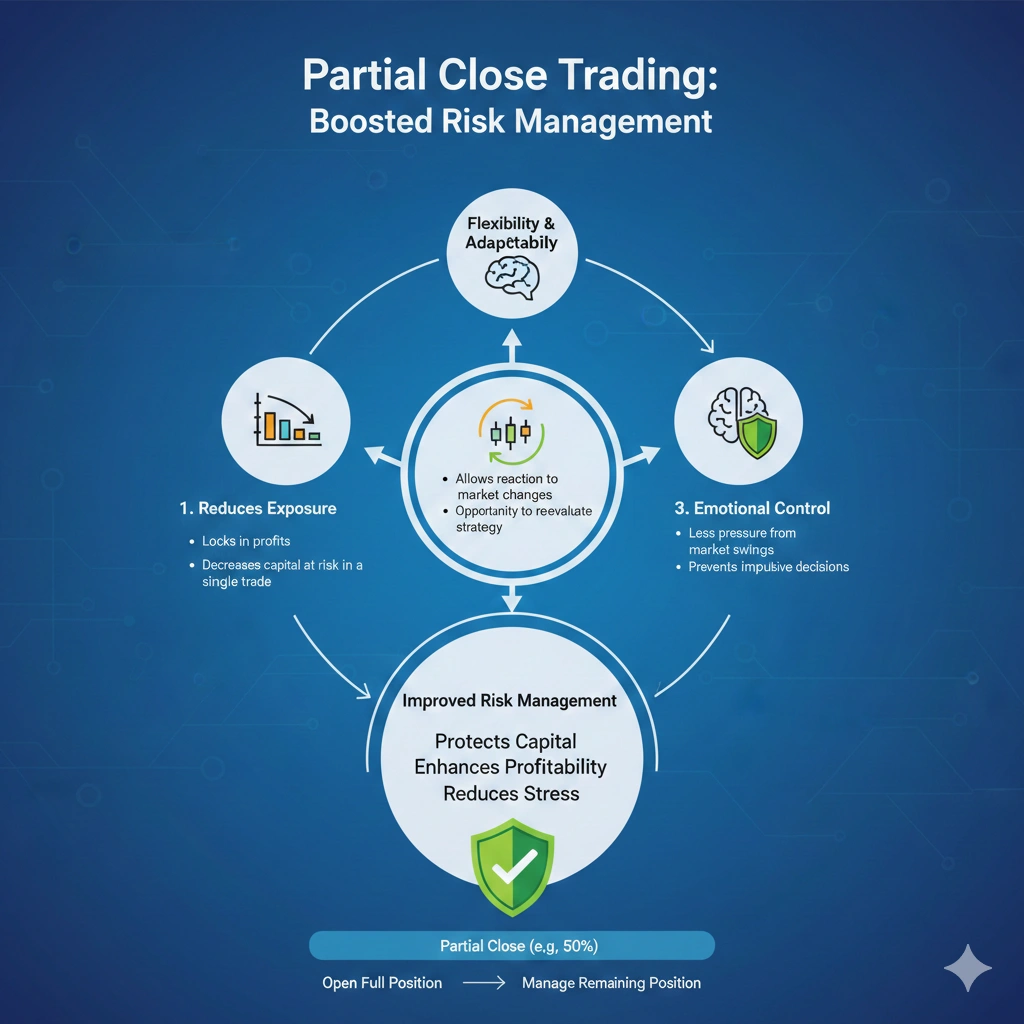
How does partial close trading improve risk management?
Partial close trading allows you to reduce market exposure while still keeping profit potential alive and improves the risk management.
- Convert open profits into realized profits
- Lock in a portion of your profits
- Imporves risk-to-reward ratio
- Fear of loss decreases that reduce overtrading.
What is the best partial close trading formula for lot size?
Here is the basic position sizing formula that ensures your every trade risks the same percentage of your account.
Formula:
Total Lot Size = Account Risk (%)* Account Balance
Stop Loss (pips) * Pip Value
What are the best partial close trading strategies?
Below are the most effective strategies that can help you to secure your profit without destroying your reward-to-risk ratio.
- Strategy 1: The 50-50 partial close method
- Strategy 2: Break-even lock strategy
- Strategy 3: The scale-out ladder strategy
- Strategy 4: ATR-Based volatility partial close
- Strategy 5: Time-based partial close strategy
- Strategy 6: Trailing stop + Partial Take-Profit Strategy
How much should you close in partial close trading?
It totally depends on the style of your trading and the timeframe and market volatility. Follow structured scaling-out execution rules to secure your profits early. Here’s a practical table:
| Trading Style | TP 1 Partial Close | TP 3 Partial Close | TP 3 Partial Close |
| Scalping | 50-70% | 10-20% | 20-30% |
| Intraday | 30-50% | 20-30% | 20-40% |
| Swing Trading | 20-40% | 20-30% | 30-40% |
| Position Trading | 10-30% | 20-30% | 40-60% |
What mistakes do traders make with partial close forex?
- Closing partial positions too early without structure
- Not moving stop loss after partial profit
- Using partial closure emotionally instead of strategically
- Overcomplicating the exit plan
- Not backtesting partial close strategies
- Forgetting the spread and commission impact
- Closing too much of the position
What are the pros and cons of partial close trading?
| Pros | Cons |
| Locks in profits early | Reduce the maximum profit on individual trades |
| Improves account consistency | Increased trading costs |
| Allows big winners to grow | Not ideal for every strategy |
| Strengthens risk management | Need backtesting and optimization |
| Reduces emotional pressure | Requires strict rules to work |
What pro trader tips improve partial close trading?
To improve your trade results and refine your scaling-out execution, here are some pro trader tips for you:
- Always partial close at structure, not feelings
- Always move the stop loss after a partial close
- Keep your first partial close small enough to let big winners grow
- Trail only the runner instead of the whole trade
- Backtest partial close models
- Use R-Multiples, not random targets
- Track net RR after fees
- Reduce position size during news
- Journal partial close result
Is partial close trading good for beginners?
Yes, it is absolutely beneficial even if you’re a beginner. It helps you by:
- Building your confidence
- Improves consistency
- Reduces emotional stress
- Teaches professional trade management
- Protects capital

Frequently Asked Questions (FAQs)
1. Is a partial closing of a trade profitable?
Yes, it is highly profitable because it reduces emotional mistakes and improves profit consistency, which makes long-term profitability more achievable.
2. Can partial close be used in crypto trading?
Yes, in the crypto market, partial close trading is extremely effective. If you close partial positions at key levels, you can lock in your profits early while reducing drawdowns and emotional stress.
3. Does partial close reduce overall profits?
No, it does not reduce overall profits, but it actually improves long-term profitability. It leads you to better risk-reward efficiency and smoother equity growth.
4. Is partial close trading suitable for scalping?
Yes, it is suitable for scalping strategies because scalpers often use 50-70% partial closes to secure quick profits while leaving a smaller lot size to benefit from extended momentum.
5. Can I automate partial close trading?
Yes, you can automate partial close trading by using expert advisors, TradingView, and trade management bots.
Final Thoughts
In this fast-moving market, success hinges on how well you manage your trades, which leads to winning. Many traders focus on indicators, entries, and signals, but you should have an idea about trade management, which is where real money is made. Partial close trading allows you to reduce risk, lock in profits, and mentally calm down during sudden volatility or pullbacks.
If you’re a beginner, then you should use it for your safety and consistency. It extracts profit from the market and turns your trading into a structured business rather than an emotional gamble. Join InsightfulTrade today to trade with confidence instead of guesswork with their proven strategies and real-market examples. Start today!
Author: Arihant Jain
Trading Experience: 5+ Years
Arihant Jain is a financial markets analyst and trading educator with expertise in Forex, indices, crypto, and risk-managed trading systems. His insights are based on real trading experience, data-driven analysis, and transparent market understanding. All content is reviewed for accuracy and aligns with Google’s EEAT guidelines.
Risk Disclaimer:
Trading involves substantial risk. All information is for educational purposes only and should not be taken as financial advice. Always do your own research.
Last Updated: 12 January 2026

