Introduction
Have you ever questioned yourself about the danger of handling numerous trading accounts? Most traders believe that having multiple accounts can assist them in diversifying strategies, hedging positions, or maximizing gains. However, the reality is that it is not only a clever idea to juggle between accounts, but there is also a sober multiple trading accounts risk that you cannot disregard. Unexpected margin calls due to being overexposed in volatile markets such as EURUSD or US30 make it easy to fall over your head.
And in case you are considering whether it is legal or not, yes, you can find a lot of accounts that trade legality, which depends on the broker and the country. We will unravel the risks, the rules, and the strategies in real life in this guide so that you can trade even smarter but not riskier, regardless of having more than one account.
What Are Multiple Trading Accounts?
Multiple trading account arrangement is the setup whereby a trader has more than one account, either with the same broker or with different brokers. Traders often do this to
- Strategies of tests without jeopardizing their principal account.
- Apply various leverage values to various trades.
- Position hedge accounts to minimize risk.
- Separate short-term trades and long-term investments.
Example: John has a EURUSD scalping account and a US30 swing trading account; a large movement in a given market would not wipe out all of his trades.
Why Do Traders Use Multiple Accounts?
The multiple accounts traders take on multiple trading account risks and diversify trading strategies.
- Control risk: you have one loss, and you are not wiped out.
- Strategy of tests: Experiment with new things.
- Grab broker privileges: reduced spreads, enhanced execution.
- Be active: When one of the brokers fails, the other continues trading.
Hint: It is best not to go overboard; too many accounts will confuse and create margin issues.
What Are the Risks of Multiple Trading Accounts?
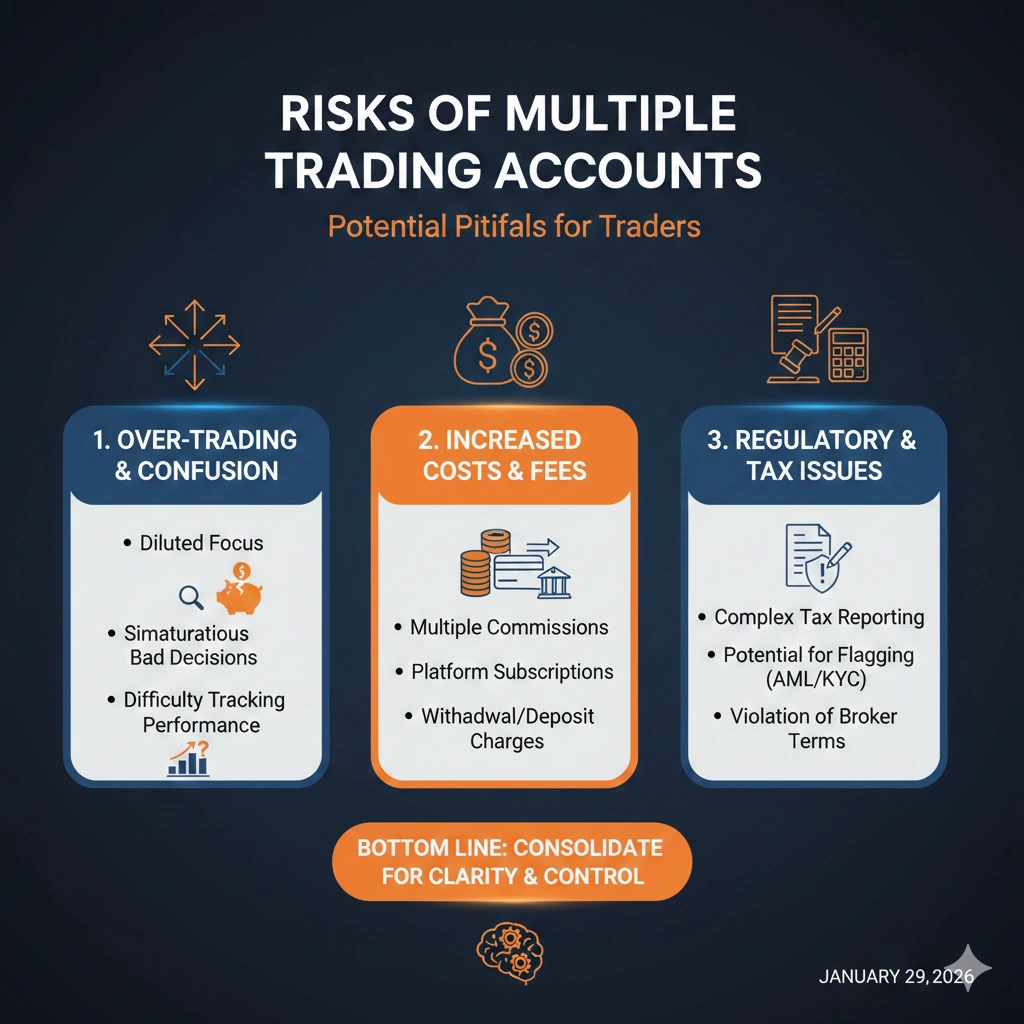
Using multiple accounts has a real risk of multiple trading accounts in use:
| Risk | Example |
| Overexposure | Same EURUSD trade in 3 accounts |
| Margin call | Leveraged US30 trade triggers a margin call |
| Confusion | Hard to track trades |
| Extra fees | Multiple account commission |
| Legal issues | Some brokers don’t allow multiple accounts |
Advice: It can be a good idea to use multiple accounts, though pledging to keep a close watch on them so as to avoid huge losses.
Is Many Accounts Trading Legality a Concern?
Yes, it can be. Depending on your country and your broker, the legality of many accounts trading will vary:
- US Brokers: There is a single account in most cases.
- EU Brokers: It is not uncommon to allow multiple accounts when the accounts are disclosed.
- Asia & Oceania: There are different rules; some do not allow account hedging.
Hint: Never forget to read the rules of your broker, or you may be suspended or even lose your money. Trade within the rules is also safe and legal.
How Can Traders Mitigate Risk When Using Multiple Accounts?
The management of multiple trading account risk is easier than it sounds:
- Each account needs to be approached differently.
- Maintain low leverage so that the EURUSD or US30 margin call will not occur.
- Record trades within a risk book.
- Follow the values of pipes and lot sizes.
Quick Example:
| Instrument | Standard lot | Pip value | Example Risk ($10/pip) |
| EURUSD | 1 lot | 10 USD | 100 pips = $1,000 |
| GBPJPY | 1 lot | 12 USD | 50 pips = $600 |
| US30 CFD | 1 lot | 1 USD | 200 pips = $200 |
Tip: Keep an eye on every account to minimize multiple trading accounts.
Can Multiple Accounts Lead to Overtrading?
Absolutely! More than one account may give the traders the temptation to open the same trades in more than one account, thus increasing the number of trading accounts.
Pro Tip: Have a daily trading limit on each account so that you do not overtrade and maintain your risk within control, especially with EURUSD or US30, which are volatile instruments.
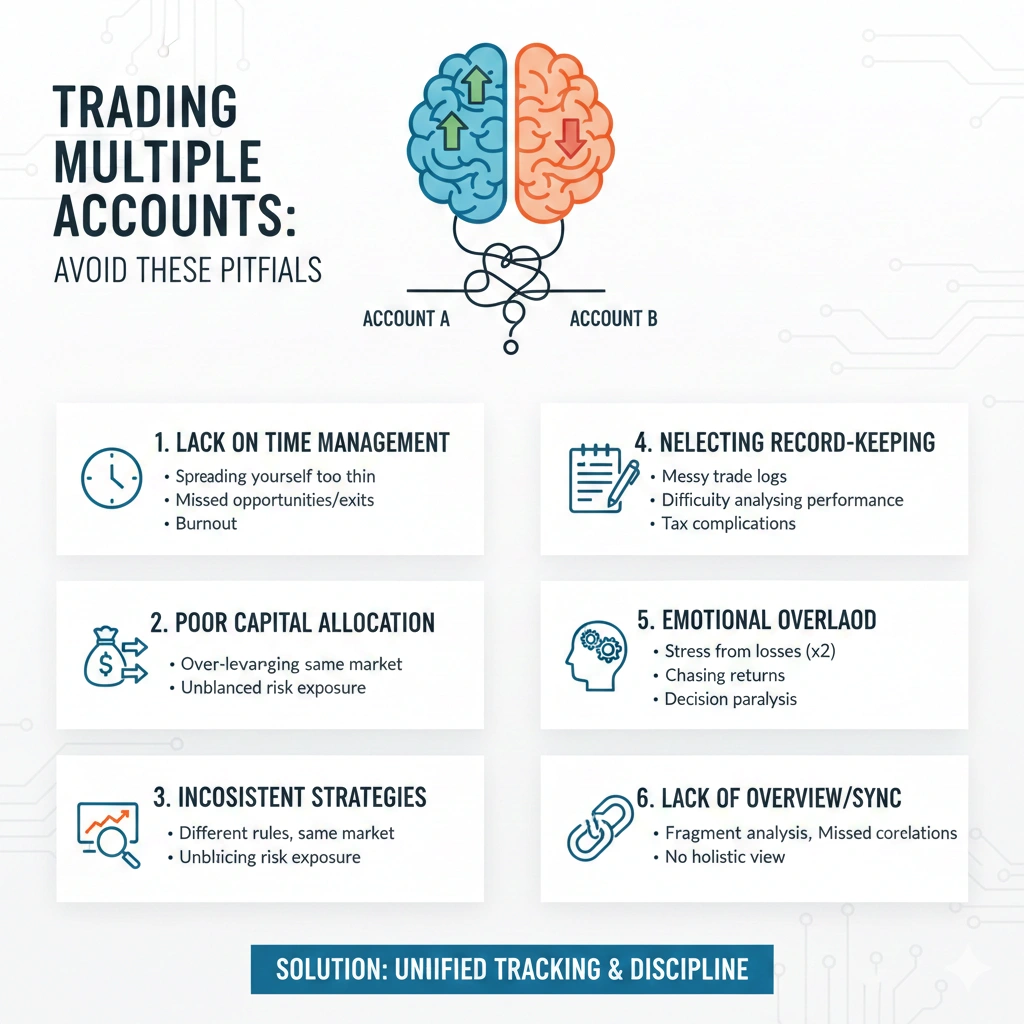
What Are Common Mistakes Traders Make With Multiple Accounts?
Simple errors are known to often occur among traders and expose several trading accounts to danger:
- Violation of broker restrictions – not all brokers permit two or more accounts.
- Confusion of risk levels – it is a mistake to treat all accounts the same way.
- Excessive leverage consumption – large trades in EURUSD or US30 can play out.
- Failure to monitor performance- when it comes to handling multiple accounts, it is easy to lose track.
Real Case Scenario: A trader took 3 accounts with 4 trades of EURUSD. The entire account margin calls resulted in over 5,000 losses caused by a sudden 150-pip move.
How Does Risk Management Differ With Multiple Accounts?
Multiple trading accounts risk implies that you must monitor total exposure.
- Single account: Risk is simple to deal with.
- Several accounts: Sum up account risks.
Quick Formula:
Total Risk = Risk Account 1 + Risk Account 2 + etc.
Hint: It is always necessary to compute the overall risk before trading EURUSD or US30.
Are There Any Advantages of Using Multiple Accounts?
Yes! Surprisingly, multiple trading accounts can be used to mitigate the multiple trading accounts risk in some cases.
- Separate strategies: Keep scalping trades and swing trades in different accounts.
- Safely test brokers: Test various brokers and do not put all your money at risk.
- Avoid unproductive time: When one of the brokers fails at peak action, the other account will continue trading for you.
- Apply leverage wisely: Various accounts enable you to control the leverage levels of various strategies.
Which Instruments Are Riskier With Multiple Accounts?
- High-leveraged CFDs such as US30 or NAS100 may blow up several accounts in a short time should the market move rapidly.
- Unstable forex currencies like the GBPJPY or EURGBP have the ability to cause large volatility that adds overall exposure across accounts.
- The low-liquidity exotic pairs are not easy since the price discrepancies, or slippage, may strike all accounts simultaneously.
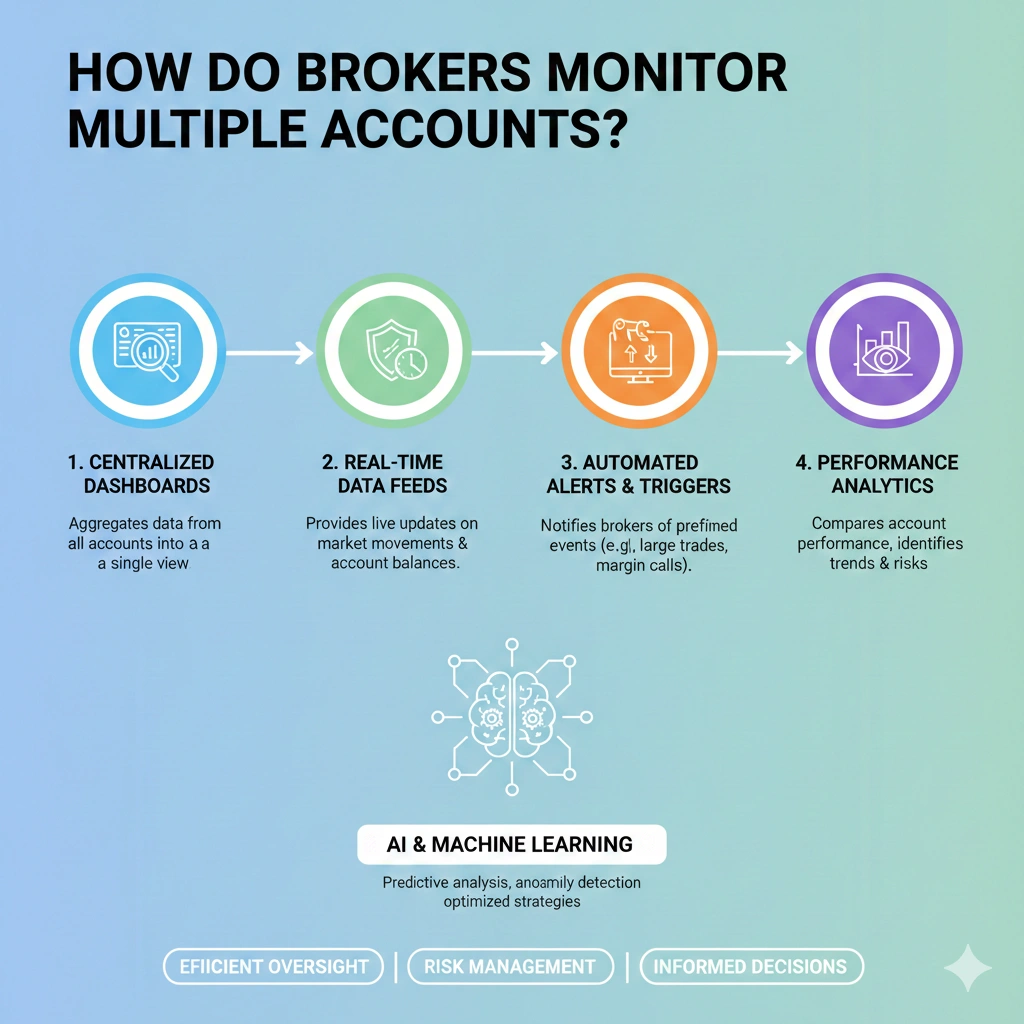
How Do Brokers Monitor Multiple Accounts?
Brokers do not underestimate the risk of trading accounts and follow the activity in a variety of ways:
- IP Tracking: They will be able to know whether there are several accounts being used by the same location.
- KYC Checking: The personal data is used to verify that you are not opening secret accounts with the brokers.
- Pattern of order: The trading patterns in more than one account may cause concerns.
How Do You Track Performance Across Multiple Accounts?
The risk of multi-trading accounts is all about tracking the performance of the accounts.
- Trading journal or Excel.
- Gains/losses on track, drawdown, and ROI.
- Compare comparison tactics between accounts.
Example:
| Account | Instrument | Gain/loss |
| 1 | EURUSD | +$500 |
| 2 | US30 CFD | +$300 |
| 3 | GBPJPY | +$200 |
Tips: A performance review is the way to control your multiple trading accounts’ risk.
FAQs
Q1: Is having multiple trading accounts illegal?
Not always. It relies on the regulatory policies of brokers and local regulations. It is permitted by some brokers and prohibited by others.
Q2: Can multiple accounts reduce risk?
Yes, but in the event of diversifying strategies, a lot of it may be risky.
Q3: How many trading accounts are safe?
Most traders are normally 2 or 3; this makes the situation more complicated and prone to error.
Q4: Can brokers detect multiple accounts?
Yes, brokers apply IP tracking, KYC, and trading pattern analysis.
Q5: Should beginners open multiple accounts?
Not. The beginners must initially trade on a single account to learn the trading discipline and risk management.
Conclusion
Trading through several trading accounts might be effective, provided that caution is taken, but there is also a real multiple trading accounts risk. Overexposure and margin calls are just a few of the outcomes of dealing with multiple accounts. It would be advised to choose several accounts and handle them diligently, strategically, and properly tracked. Always verify numerous accounts that are legal to trade and the rules of brokers, and be in control of leverage.
Divesting strategies, tracking performance, and keeping an eye on multiple trading accounts’ risk will allow you to trade wiser, minimize losses, and have several accounts serve, rather than work, on your behalf. Keep in mind an increase in accounts will not translate into an increase in profit unless risk is managed prudently.
Ready to minimize multiple trading accounts’ risk and trade smarter? Join InsightfulTrade today for expert strategies, tips, and tools to manage multiple accounts confidently and boost your trading success!
Author: Arihant Jain
Trading Experience: 5+ Years
Arihant Jain is a financial markets analyst and trading educator with expertise in Forex, indices, crypto, and risk-managed trading systems. His insights are based on real trading experience, data-driven analysis, and transparent market understanding. All content is reviewed for accuracy and aligns with Google’s EEAT guidelines.
Risk Disclaimer:
Trading involves substantial risk. All information is for educational purposes only and should not be taken as financial advice. Always do your own research.
Last Updated: 29 January 2026