Introduction
The Morning Star Candlestick Strategy is one of the most trusted bullish reversal techniques in technical analysis. Forex traders, stock market investors, and cryptocurrency traders frequently use this strategy to identify potential buying opportunities after a prolonged downtrend. Unlike lagging technical indicators that react after the market has already moved, the Morning Star pattern provides an early indication that selling pressure may be weakening and buyers are beginning to regain control. Because it is based entirely on price action, the strategy is easy to understand and can be applied across different financial markets and trading styles.
Price action reflects the ongoing battle between buyers and sellers. During a downtrend, sellers dominate the market and push prices lower. However, no trend continues forever. Eventually, selling momentum begins to slow, buyers enter the market, and the balance of power starts to change. The morning star pattern captures this transition through a three-candlestick formation that signals the possibility of a bullish reversal. Traders who understand this pattern can identify high-probability entry opportunities before a new uptrend becomes obvious.
The Morning Star Candlestick Strategy is suitable for beginners because of its simple structure, while experienced traders value it for its accuracy when combined with support and resistance, trendlines, and volume analysis. Whether you are a day trader or a swing trader, learning this strategy can improve your ability to identify market reversals and make more confident trading decisions.
What Is the Morning Star Candlestick Strategy?
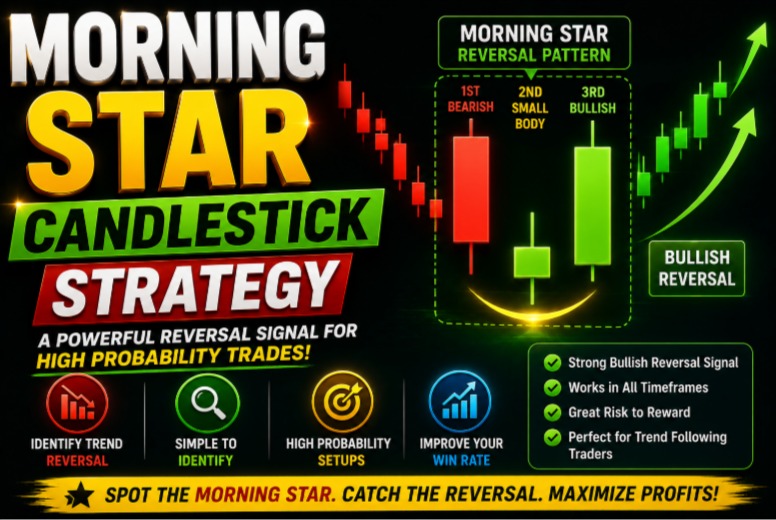
The Morning Star Candlestick Strategy is a price action trading method that uses a three-candle formation to identify potential bullish reversals after a bearish trend. The first candle is a strong bearish candle that confirms the existing downtrend. The second candle is small, showing indecision and weakening selling pressure. The third candle is a strong bullish candle that closes well into the body of the first candle, confirming that buyers have taken control.
The strategy works because it reflects a gradual shift in market sentiment. Instead of relying on indicators to predict future prices, traders simply observe how buyers and sellers behave over three consecutive candles. This makes the strategy objective and suitable for different market conditions.
Professional traders often combine the Morning Star Candlestick Strategy with trend analysis and support levels to improve the quality of trading signals. The pattern becomes even more reliable when it forms after a prolonged decline near significant technical zones.
Understanding the Morning Star Candlestick
The morning star candlestick formation consists of three candles that represent changing market psychology. The first candle reflects strong bearish momentum, indicating that sellers remain in control. The second candle is much smaller, suggesting that selling pressure is fading and the market is entering a period of indecision. The final bullish candle confirms that buyers have successfully reversed market sentiment.
Every morning star candlestick tells a story about the balance of supply and demand. During the first candle, sellers dominate the market. The second candle reflects hesitation as selling pressure begins to weaken. By the third candle, buyers enter aggressively, pushing prices higher and signaling the possibility of a trend reversal.
Although the morning star candlestick appears regularly on price charts, its effectiveness depends on where it forms. Patterns that develop near important support levels or after extended downtrends generally produce stronger trading opportunities than those appearing in random market conditions.
Identifying a Bullish Candlestick Pattern
A bullish candlestick pattern indicates that buyers are gaining strength after a period of selling pressure. The Morning Star is considered one of the most reliable bullish reversal formations because it provides confirmation through multiple candles instead of relying on a single candlestick.
The reliability of a bullish candlestick pattern increases when it appears after an extended decline or near significant support levels. Traders often use additional confirmation from moving averages, trendlines, or momentum indicators before entering a trade.
Every bullish candlestick pattern should be evaluated within the context of the overall market trend. Strong bullish signals that align with higher timeframe support generally offer better trading opportunities than patterns appearing in sideways markets.
Using the Morning Star Trading Strategy
The morning star trading strategy begins by identifying a clear downtrend followed by the Morning Star formation. Traders wait for the third bullish candle to close before considering an entry, ensuring that buyers have confirmed the reversal.
A successful morning star trading strategy includes proper stop-loss placement below the lowest point of the pattern. This protects trading capital if the market unexpectedly continues lower. Profit targets are usually determined using nearby resistance levels or favorable risk-to-reward ratios.
Professional traders understand that the morning star trading strategy performs best when combined with market structure analysis rather than being traded as an isolated candlestick pattern.
Why Reversal Candlestick Patterns Are Effective
Every reversal candlestick pattern reflects changing market psychology. Instead of attempting to predict market direction, traders observe actual buying and selling behavior. This provides a more reliable understanding of market sentiment than relying solely on technical indicators.
A reversal candlestick pattern becomes particularly valuable during periods of high market volatility because it often signals the beginning of a new trend before indicators respond. Traders who recognize these formations early can often achieve better entry prices and improved risk-to-reward ratios.
Combining a reversal candlestick pattern with support and resistance analysis significantly increases the probability of identifying successful trading opportunities.
Entry and Exit Rules
The best way to trade the Morning Star Candlestick Strategy is to wait until the third candle closes and confirms the reversal. Entering before confirmation increases the risk of false signals because sellers may still regain control.
Stop-loss orders are typically placed below the lowest point of the Morning Star formation. Profit targets should be based on nearby resistance levels or predetermined risk-to-reward ratios. Maintaining consistent trade management helps traders remain disciplined regardless of market conditions.
Best Timeframes
The Morning Star Candlestick Strategy works on nearly every timeframe. Scalpers may identify the pattern on lower timeframes, while swing traders often prefer the four-hour and daily charts because they generally produce stronger and more reliable reversal signals.
Higher timeframes usually reflect institutional activity more accurately, making Morning Star formations more dependable for long-term trading decisions.
Risk Management
No candlestick pattern guarantees success, making risk management essential. Professional traders risk only a small percentage of their account balance on each trade and avoid increasing position size based on emotions or previous results.
Waiting patiently for high-quality Morning Star formations and following consistent trading rules improves long-term profitability while reducing unnecessary losses.
Common Mistakes
One common mistake is trading every Morning Star pattern without considering the overall market trend. Another mistake is entering before the third candle confirms the reversal. Ignoring support and resistance levels or failing to use proper stop-loss placement can also reduce the effectiveness of the strategy.
Successful traders understand that patience, discipline, and proper market analysis are just as important as recognizing the pattern itself.
Conclusion
The Morning Star Candlestick Strategy is one of the most dependable price action techniques for identifying bullish reversals in the forex market. By understanding the morning star candlestick, recognizing a bullish candlestick pattern, applying an effective morning star trading strategy, and confirming signals with a reversal candlestick pattern, traders can improve their timing and decision-making. While no strategy wins every trade, combining this approach with proper risk management, market structure analysis, and patience can significantly improve consistency and long-term trading performance.
FAQ
What is the Morning Star Candlestick Strategy?
The Morning Star Candlestick Strategy is a price action trading method that uses a three-candle bullish reversal formation to identify potential buying opportunities after a downtrend.
What is a morning star candlestick?
A morning star candlestick is a three-candle formation consisting of a strong bearish candle, a small indecision candle, and a strong bullish candle that confirms a possible market reversal.
Why is the Morning Star considered a bullish candlestick pattern?
The bullish candlestick pattern signals that buyers have regained control after sellers dominated the market, increasing the probability of an upward price movement.
How does the morning star trading strategy work?
The morning star trading strategy waits for the complete three-candle formation before entering a buy trade, with confirmation provided by the final bullish candle and proper risk management.
What is a reversal candlestick pattern?
A reversal candlestick pattern is a price action formation that indicates the existing trend may be ending and a new trend could begin, helping traders identify potential market turning points.
Which timeframe is best for the Morning Star Candlestick Strategy?
The Morning Star Candlestick Strategy can be used on all timeframes, but many traders prefer the four-hour and daily charts because they generally provide stronger and more reliable reversal signals.