

Quick Summary
Deciding between market order vs limit order execution is a very important part of trading success that traders often forget. Many traders are obsessed with using indicators and chart patterns; your order choice directly affects your fill price, slippage, and final profits. In a market order, your order gets filled at the available price, while in limit orders, you have to set a particular price for your entry. In this blog, you will learn how the order types work, and you might be able to select the one that suits your trading style and helps you achieve your goals.
Key Insights at a Glance
| Factor | Market Orders | Limit Orders | Execution Impact |
| Speed | Immediate | Conditional | Timing vs price trade-off |
| Price Control | Low | High | Slippage risk difference |
| Fill Certainty | High | Not guaranteed | Missed trade possibility |
| Volatility Sensitivity | High | Moderate | Execution variability |
| Liquidity Impact | Strong | Controlled | Order book interaction |
| Strategy Fit | Momentum | Precision entries | Performance alignment |
Why Market Order vs Limit Order Execution Matters
For a successful trade performance, you need more than the ability to predict the next move. How your trade fills in the market can impact how profitable your trade is.
Your decision on market order vs limit order can affect your:
- Your entry accuracy
- Trading fees
- Risk level
- Strategic trust
- Your confidence
Your winning trade can turn into a losing one if your entry isn’t correct.
Understanding Market Orders Execution
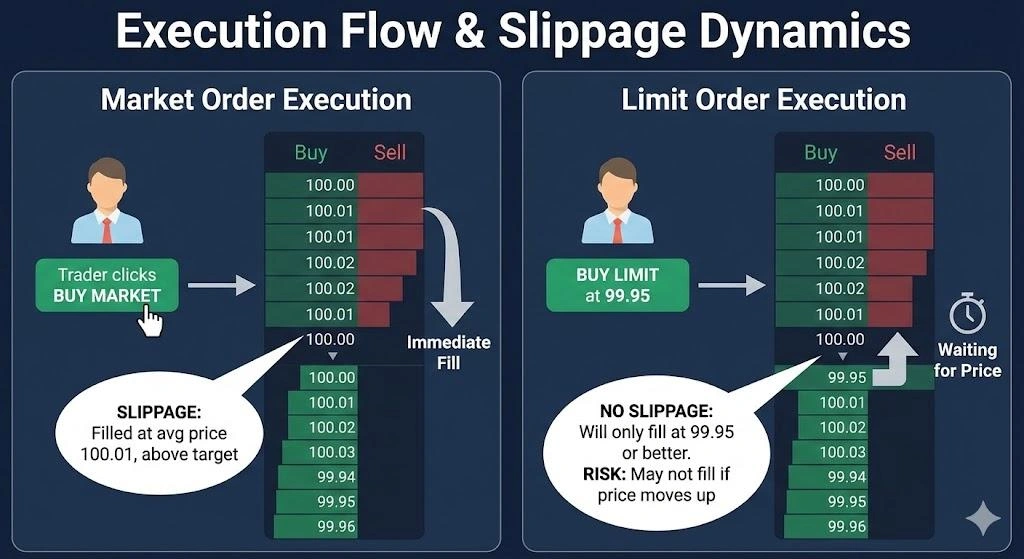
In market orders your trades get executed the moment you hit the go button at the best available price.
Advantages
- You get quick entry or exit
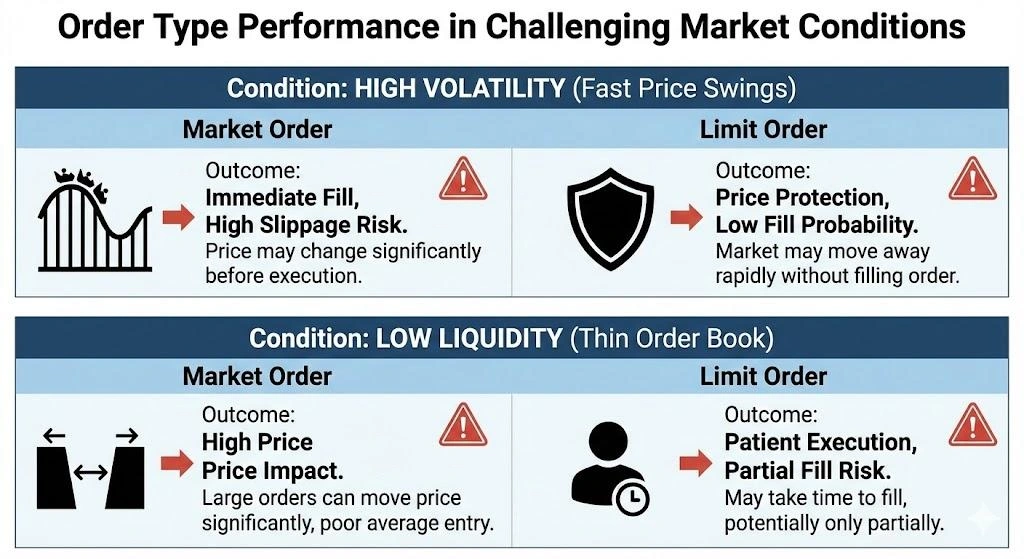
- Good for volatile markets
- Increases the chance of orders fills
Risks
- Slippage can hit
- Worse pricing during low liquidity
- High spreads
Between market orders and limit orders, the market orders ensure you get your trade.
Understanding Limit Orders Execution
In limit orders your trade gets hit only at your selected price.
Advantages
- Better control over price
- Reduce the slippage chance
- Better cost management
Risks
- Partial fills
- Missed trades
- Delayed execution
The limit orders ensure your trade gets safe entry in the market.
Core Difference: Speed vs Control
The decision of order type depends on your priority, whether it’s speed or control:
- Market orders prioritize complete entry
- Limit orders prioritize the selected price.
And your strategy helps you decide what matters more for your trade.
Slippage and Execution Risk
Slippage happens when your entry price doesn’t match with your target.
Market orders are more exposed because:
- They consume available liquidity
- They accept current market pricing
Limit orders cut down the slippage but might leave you with unfilled orders.
You should judge your order performance by tracking actual slippage data over many trades.
Psychological Factors in Order Selection
Emotions often influence our choices like
- In FOMO we prefer market orders
- For a targeted price use limit orders
- Overconfidence leads to rush into trade
Controlling your emotions helps you stay disciplined with your trade execution.
Position Size and Order Type Interaction
Big trades increase the challenges in trading.
For example:
- Small market orders get filled very easily
- While larger ones often move price
In limit orders you can handle large sizes better, but you need more patience.
Partial Fills and Execution Complexity
Limit orders sometimes fill partially when liquidity is insufficient.
This creates:
- Uneven position exposure
- Multiple execution prices
- Additional transaction management
Market order vs limit order execution analysis should include partial fill behavior.
Algorithmic and Institutional Perspectives
Big banks and traders often combine both order types.
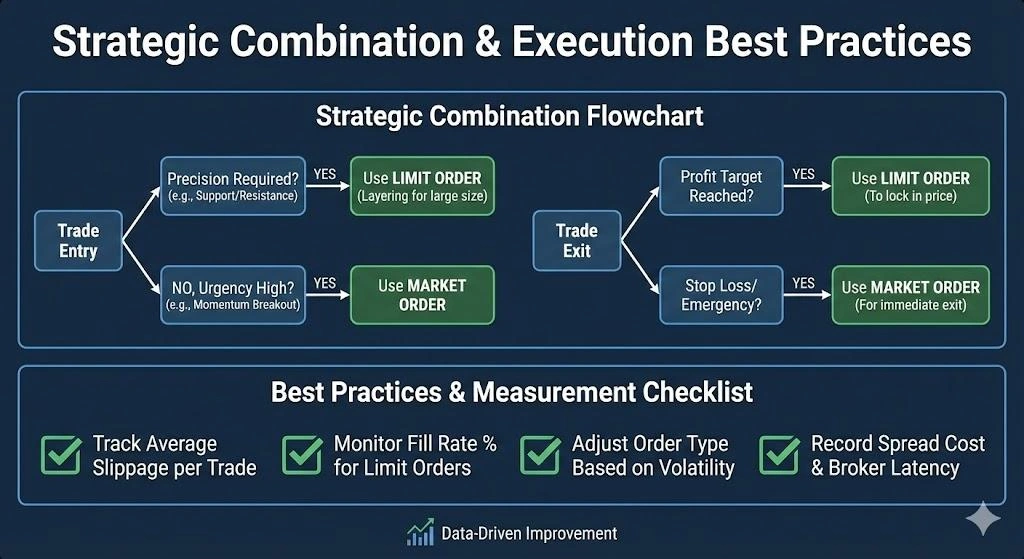
- They use limit orders for entry
- And market orders for urgent exits
- They split large orders into small parts to manage well
This mindset can help you improve performance by taking it as a core part of your strategy.
Measuring Order Type Performance
To see how each order type performs, you should analyze:
- How slippage hits your trades
- Fill rate percentage
- Spread cost
- Speed of complete fill
These data can help you select the market order vs limit order.
Technology’s Role in Execution Quality
There are factors apart from market conditions that can affect your choice for order types:
- Your broker’s server
- Your internet connection
- How stable your trading apps stay
- How quickly your order get sent
Even a great strategy can fail if the system falls apart.
Combining Market and Limit Orders Strategically
Smart ways you can handle your trades are
- Entering a trade with the limit but exiting at market price
- Entering in at the market but setting a limit for the profit
- Staking multiple limit orders in layer
Using both of them together can help you get better results as the market mood shifts.
If you place a market order during high-impact news and the price jumps from 1.1000 to 1.1005, your order fills 5 pips higher. That’s slippage.
When Market Orders Are Appropriate
You can use market orders when:
- Momentum is strong
- Getting into a trade fast is the priority
- The market is deep and active
- The risk of missing trade is high
When Limit Orders Are Appropriate
It’s more preferred to use limit orders when:
- You want a particular price.
- The market is a bit silent.
- Price moves are steady, not jumping around.
- Your strategy depends on a specific price level.
Why Execution Awareness? Improves Consistency
Traders who are able to get the market order vs limit order execution develop:
- Have more realistic expectations
- Better control over their costs
- A less emotional mindset
- Stronger reliability in their strategies
Execution isn’t just an extra step; in fact, it’s a part of your strategy that is really crucial.
Conclusion: Market order vs limit order execution
To end with, this blog with InsightfulTrade is here to help you choose the best order type that suits your strategy and help you achieve your goals. Selecting between a market order vs limit order is a very crucial part of trading. Market orders offer you speed and guaranteed execution, but they also leave the door open to higher cost and slippage. On the order side, a limit order gives you control, but there are also chances of incomplete orders. Traders who track their execution data and change their order types to the current market are the ones who build true long-term consistency.
FAQs: Market order vs limit order execution
1. What is the main difference in market order vs limit order execution?
A market order basically means buy at any price; a limit order means you have total control over the price your trade gets executed at.
2. Which order type has better performance?
There’s no one in particular. It totally depends on the market situation, how much money is flowing, and what your strategy requires at the moment.
3. Can tools help analyze execution quality?
Yes, tools that help you track slippage, spreads, and liquidity can be really helpful to choose the perfect order type for yourself.
4. Do Indian traders need execution records for compliance?
Yes, every trader needs to maintain records to stay on the good side of the law and be ready for any sudden audit.
5. Is one order type always better than the other?
No, both are different and have different advantages that show out based on the situations and your goals.
Author: Kumkum Chandak
Experience: 3+ Years in Trading Research & Market Content Strategy
Kumkum Chandak is a trading content strategist and market research writer who specializes in simplifying technical analysis, trading tools, and strategy-driven educational content. Her work is optimized for EEAT, accuracy, and user intent, ensuring every article delivers practical insights for traders of all levels.
Risk Disclaimer:
All content is strictly educational and not financial advice. Trading involves substantial risk. Always perform your own analysis or consult a professional advisor.
Last Updated: 17 February 2026

