Introduction
Interest rate decisions are very important, and it highly influences the global financial markets. When a central bank like federal reserves or ECB introduces some changes to the interest rate, the market reacts to them immediately then whether it’s forex, indices, bonds, and commodities. The interest rate is not a tiny change, it changes the flow of capital, changes how the investors feel and changes everyone’s expectation for the next year. For you, understanding the interest rate impact is important to handle the market volatility and grab high-end opportunities.
Why Interest Rates Matter in Financial Markets
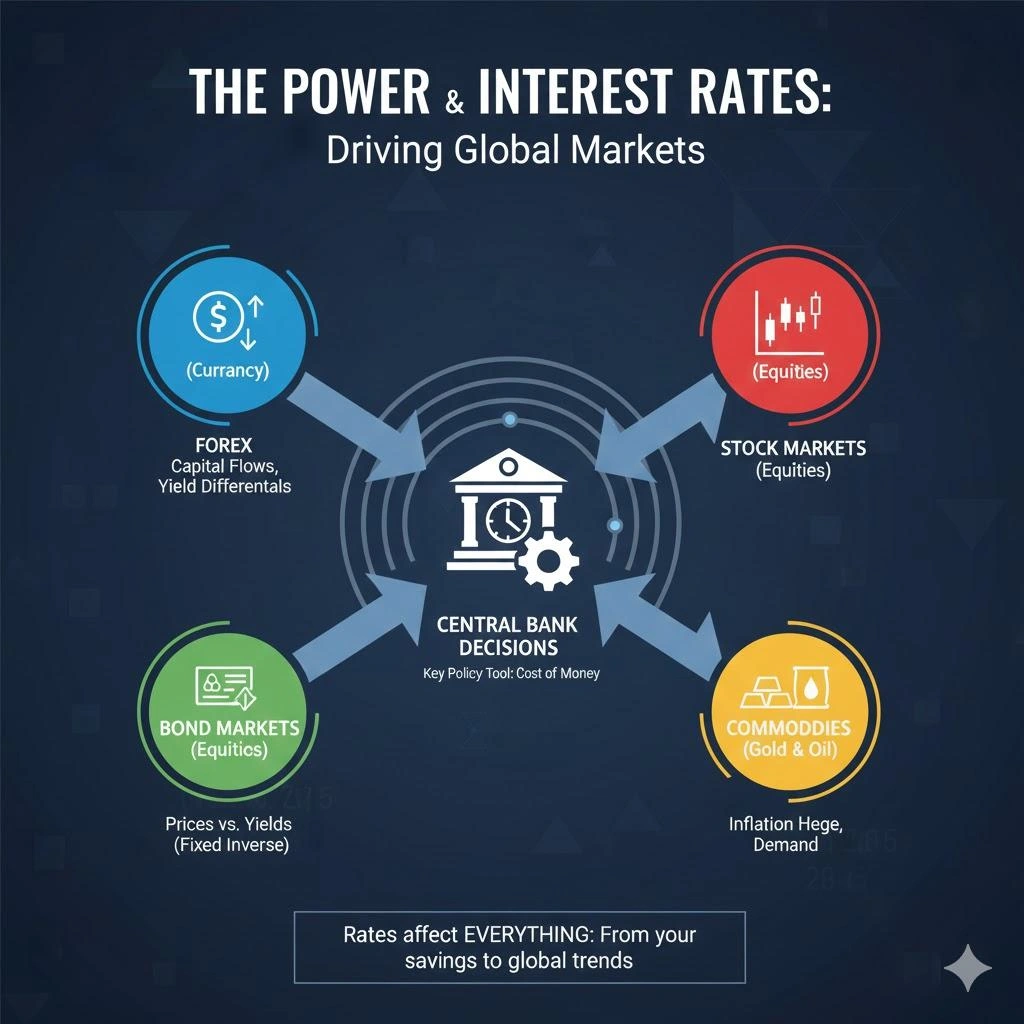
Interest rates represent the cost of money in an economy. When central banks change the rates, it causes people to change their habits related to their borrowings, spending, saving, and investment behavior. This is why the interest rate impact is felt across nearly every asset class.
Key reasons interest rates matter include:
- Interest rates determine the amount you would be getting on your savings and fixed-income instruments
- It decides how much a corporate and regular people will be paying, influencing their profitability and demand
- On the basis of interest rates, investors decide which currency to invest in.
Because of this, interest rates act as a foundation for market valuation and trend formation.
The Role of Central Banks in Interest Rate Decisions
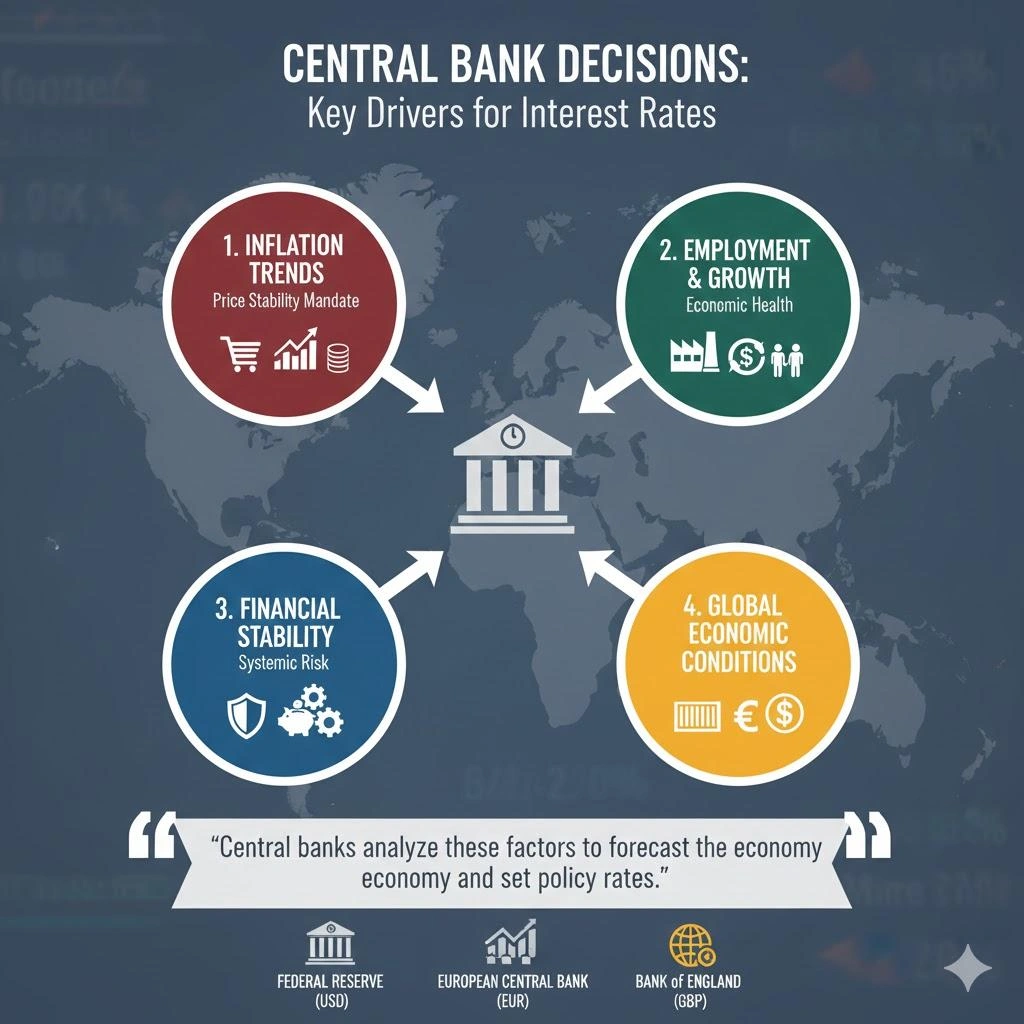
The major role of the Central bank is to maintain price stability, control inflation and support economic growth. Institutions such as the Federal Reserve, European Central Bank, Bank of England, and others use interest rates as their primary policy tool. In central bank decisions trading, markets attempt to anticipate not only the decision itself but also the future policy path.
Central banks adjust rates based on:
- Cost of living
- Jobs and economic growth
- Financial stability concerns
- Global economic conditions
These are the factors that affects the central bank’s decision on interest rates.
Interest Rate Impact on Forex Markets
The forex market is the most sensitive to interest rate decisions because currencies are directly tied to yield differentials. Investors want big returns with the least amount of risk, so when a country offers higher interest rates than another, then the investors move their capital to the higher-yielding currency. This creates a clear forex rate impact driven by monetary policy divergence.
How Rate Hikes Affect Currencies
When a central bank raises interest rates:
- They make the currency more attractive for investors
- Investors buy that currency to take advantage of higher yields
- Demand for the currency cause increase in price
How Rate Cuts Affect Currencies
When rates are cut:
- Lower rates weaken the currency
- Investors pull out their money for better options
- Low rates can lead to increase in prices (Inflation)
Forex traders closely analyze these dynamics in central bank decisions trading.
Interest Rate Expectations vs Actual Decisions
Markets are forward-looking, which means prices often move before the actual rate decision. Like in many cases due to expectations of investors, the price already shifts even before the actual announcement.
Important aspects include:
- Markets pricing through futures and options
- The hints that Central bank provides in their reports
- Economic data leading up to the decision
If a rate decision is as per your expectations, then the market reacts to it calmly. If it surprises, volatility increases significantly.
Interest Rate Impact on Stock Markets
Interest rates influence stock markets through multiple channels. Higher rates increase borrowing costs for companies and reduce future cash flow valuations. On the other hand, lower rates make it easy for companies to make profits..
Key stock market effects include:
- Growth stocks like tech companies take big hit when the rates rise
- A rate cut means less risk leading to more investments
- On announcement of rate cuts, investors look for better deals apart from the equity market.
Bond Markets and Interest Rate Sensitivity
Bond markets react directly to interest rate changes. Bonds and interest rates have an inverse relation – if one goes up, other has to go down. The basic rule remains: rate hikes crush bond prices, while rate cuts breathe life back into them.
Key points include:
- Long-term bonds are lot more sensitive to rate changes then a short-term bond
- Yield curve tells us if the investors are feeling optimistic or they’re preparing for recession
- Bond market spots trend and risk before the stock market does.
Interest Rate Impact on Commodities
Interest rates also influence commodities, particularly gold and oil. Higher interest rates tend to pressure gold prices due to higher opportunity costs, while lower rates often support them.
Commodity effects include:
- Gold reacts inversely to the interest rates
- Oil reacts to the rates more indirectly.
- Commodity currencies affected by both rates and demand
Risk Sentiment and Interest Rate Decisions
Interest rate decisions play a major role in shaping global risk sentiment. When banks raise the rate the traders get nervous and pull their money out, while the rate cut leads to the opposite.
Key risk sentiment reactions include:
- Strengthening of safe-haven assets during rate hikes
- Increased volatility during policy uncertainty
- Shifts in capital toward defensive positions
How Traders Use Interest Rate Decisions in Market Analysis
Professional traders don’t just watch charts; they analyze deep into both fundamental and technical frameworks. Rather than trading headlines alone, they evaluate context, expectations, and follow-through.
A structured trading approach includes:
- Tracking central bank calendars and speeches
- Analyzing inflation and employment trends
- Comparing policy divergence between economies
- Aligning interest rate analysis with technical levels
This disciplined method improves consistency in central bank decisions trading.
Common Mistakes Traders Make Around Rate Decisions
Despite their importance, interest rate events are often misused by traders.
Common mistakes include:
- Trading immediately during announcements without a plan
- Ignoring market expectations and positioning
- Overleveraging due to high volatility
- Focusing only on the rate number instead of guidance
Avoiding these mistakes allows traders to manage better.
Short-Term vs Long-Term Interest Rate Impact
The effect of interest rate decisions varies by timeframe.
- Short-term: Volatility spikes and rapid price movements
- Medium-term: Trend formation based on policy direction
- Long-term: Structural shifts in capital flows and growth
Understanding timeframe alignment is essential for managing forex rate impact effectively.
Current Market Perspective on Interest Rates
In current market conditions, traders closely monitor:
- Inflation persistence
- Labor market strength
- Central bank credibility
- Global policy divergence
These factors ensure that the interest rate impact remains one of the most important drivers of market behavior.
Conclusion
The interest rate impact on financial markets cannot be taken lightly. One single decision on interest rate by the central bank can change everything from currencies, bonds, and commodities to the overall risk sentiment. By digging into how central bank policies work you give yourself a powerful framework for interpreting market movements. Instead of reacting to it emotionally, use it to anticipate trends, manage risk, and trade with confidence in an ever-changing market environment.
For further queries, visit InsightfulTrade’s website. They are here to help with the financial market with their incredibly researched content and expert traders who will guide you and help you gain confidence with tricky concepts of the market.
FAQs
- What is the impact of interest rate on trading?
It refers to how changes in interest rates influence financial markets and asset prices. - Why do forex markets react strongly to interest rates?
Because currencies are directly affected by yield differentials and capital flows. - Are rate hikes always bullish for a currency?
Not always; market expectations and economic context matter. - How should beginners trade around rate decisions?
By focusing on post-announcement trends rather than immediate volatility. - Do interest rates affect all markets equally?
No, the impact varies across forex, stocks, bonds, and commodities.
Author: Kumkum Chandak
Experience: 3+ Years in Trading Research & Market Content Strategy
Kumkum Chandak is a trading content strategist and market research writer who specializes in simplifying technical analysis, trading tools, and strategy-driven educational content. Her work is optimized for EEAT, accuracy, and user intent, ensuring every article delivers practical insights for traders of all levels.
Risk Disclaimer:
All content is strictly educational and not financial advice. Trading involves substantial risk. Always perform your own analysis or consult a professional advisor.
Last Updated: 19 December 2025