Introduction
The Inside Bar Forex Trading Strategy is one of the most popular price action trading methods used by forex traders to identify high-probability trading opportunities. Unlike strategies that rely on multiple technical indicators, this method focuses entirely on candlestick formations and market structure. The simplicity of the strategy makes it suitable for beginners, while its effectiveness has made it a favorite among experienced traders. By understanding how price behaves during periods of consolidation, traders can prepare for potential breakouts and improve their trade timing.
Financial markets constantly alternate between periods of high volatility and low volatility. During strong trends, buyers or sellers dominate the market, pushing prices aggressively in one direction. However, these trends rarely continue without pauses. The inside bar strategy helps traders recognize these pauses, which often occur before another significant move. Instead of chasing the market, traders patiently wait for confirmation before entering a position, making the strategy both disciplined and objective.
Another reason the Inside Bar Forex Trading Strategy remains widely used is its versatility. It works across multiple currency pairs, trading sessions, and timeframes, allowing traders to adapt it to their preferred trading style. Whether you are a scalper looking for short-term opportunities or a swing trader aiming to capture larger market movements, understanding the inside bar strategy can help you make more informed trading decisions while reducing emotional trading.
What Is the Inside Bar Forex Trading Strategy?
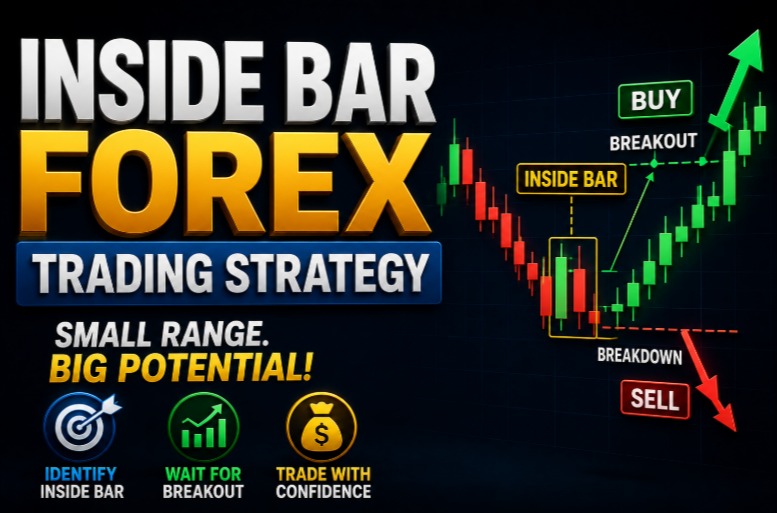
The Inside Bar Forex Trading Strategy is a price action technique based on a specific candlestick formation known as the inside bar. An inside bar forms when the entire range of the current candle remains within the high and low of the previous candle, often called the mother bar. This pattern represents a temporary period of market consolidation where buying and selling pressure become balanced before the market decides its next direction.
The concept behind the strategy is straightforward. Rather than predicting whether the market will rise or fall, traders simply identify the inside bar and wait for price to break above or below the mother bar. Once a confirmed breakout occurs, traders enter in the direction of the move with predefined risk management rules. This disciplined approach allows traders to follow market momentum instead of making emotional decisions based on speculation.
The Inside Bar Forex Trading Strategy is effective because it reflects the natural rhythm of financial markets. Markets expand, consolidate, and expand again. By focusing on these cycles, traders can identify high-quality trading opportunities while avoiding unnecessary trades during uncertain market conditions.
Understanding the Inside Bar Pattern
The inside bar pattern is one of the easiest candlestick formations to identify. The high of the inside bar must remain below the high of the mother bar, while the low of the inside bar must remain above the low of the mother bar. This smaller candle reflects reduced volatility and temporary indecision between buyers and sellers.
Every inside bar pattern tells a story about market psychology. After a strong bullish or bearish movement, traders often pause to evaluate the next direction. During this period, institutions may be accumulating or distributing positions while retail traders hesitate to enter new trades. This creates a narrow trading range that eventually leads to increased volatility once one side gains control.
Not every inside bar pattern leads to a successful trade. The surrounding market context plays an important role in determining whether the breakout is likely to continue. Patterns that appear during strong trends generally produce more reliable signals than those forming in sideways markets. Traders who combine the pattern with support and resistance levels, trend analysis, and volume often achieve better results.
Why the Inside Bar Forex Trading Strategy Works
The Inside Bar Forex Trading Strategy works because it aligns with the natural behavior of the forex market. Price rarely moves continuously in one direction without periods of consolidation. These pauses allow traders to take profits, institutions to adjust positions, and new participants to enter the market. Once this consolidation ends, momentum often returns with significant strength.
The inside bar strategy also removes much of the uncertainty associated with trading. Instead of entering randomly, traders wait for confirmation that buyers or sellers have taken control. This confirmation reduces the likelihood of false entries and encourages disciplined decision-making.
Institutional traders contribute significantly to the success of this strategy. Large financial institutions cannot execute massive orders instantly without affecting market prices. As a result, they often build positions during consolidation phases. When enough liquidity becomes available, price breaks out of the range, creating opportunities for traders who have patiently waited for confirmation.
How to Identify a Price Action Inside Bar
A price action inside bar is identified by observing candlestick formations without relying on technical indicators. Traders simply compare the current candle with the previous candle to determine whether it fits the inside bar criteria. If the entire candle remains within the mother bar’s range, it qualifies as an inside bar.
The strength of price action inside bar analysis lies in its simplicity. Traders focus entirely on what the market is communicating through price movement rather than interpreting lagging indicators. This approach allows them to react more quickly to changing market conditions while maintaining a clear understanding of market structure.
Experienced traders rarely evaluate a price action inside bar in isolation. They also consider the overall trend, nearby support and resistance levels, higher timeframe direction, and market volatility before deciding whether to trade the breakout.
Creating an Effective Inside Bar Trading Setup
A successful inside bar trading setup begins with identifying the prevailing market trend. Trading inside bars that align with the dominant trend generally increases the probability of success because momentum already favors one direction. Once an inside bar forms, traders prepare entry orders beyond the mother bar’s high and low while waiting for price confirmation.
Every inside bar trading setup should include clearly defined stop-loss and take-profit levels before entering the market. Risk management should never be an afterthought. Professional traders determine their potential loss before considering potential profits, ensuring that every trade fits within their overall trading plan.
The quality of an inside bar trading setup improves significantly when the pattern appears near important technical levels. Inside bars forming after pullbacks within strong trends often produce better breakout opportunities than patterns developing during random market fluctuations.
Entry and Exit Rules
Entering a trade too early is one of the most common mistakes traders make. Instead of buying or selling immediately after identifying an inside bar, experienced traders wait for a confirmed breakout beyond the mother bar. Confirmation usually comes from a strong candle close outside the established range, indicating that momentum supports the breakout.
Exit strategies should remain consistent and objective. Some traders use fixed risk-to-reward ratios such as 1:2 or 1:3, while others trail their stop loss behind market structure to capture larger trends. Regardless of the method used, successful trading depends on following predetermined exit rules rather than making emotional decisions during live market conditions.
Best Timeframes for the Strategy
The Inside Bar Forex Trading Strategy can be applied across multiple timeframes, making it suitable for various trading styles. Lower timeframes such as the 15-minute and 30-minute charts provide more trading opportunities but often generate more false signals due to market noise. Higher timeframes like the four-hour and daily charts generally produce stronger setups because they reflect broader market sentiment and institutional activity.
Swing traders frequently prefer daily inside bars because these formations often lead to substantial price movements lasting several days. Day traders, on the other hand, may focus on hourly charts where they can capitalize on intraday volatility while still benefiting from the reliability of the pattern.
Risk Management
Even the best trading strategy cannot eliminate losses entirely. Proper risk management ensures that losing trades remain small while profitable trades contribute to long-term account growth. Many professional traders risk only one to two percent of their trading capital on a single position, allowing them to withstand periods of consecutive losses without significant damage.
Patience also forms an important part of risk management. Traders should avoid forcing trades simply because they want market exposure. Waiting for high-quality inside bar formations often results in fewer trades but significantly better overall performance.
Common Mistakes to Avoid
Many traders assume that every inside bar guarantees a breakout, but this is far from true. One of the biggest mistakes is ignoring the overall market trend and trading every formation regardless of context. Another common error is entering before the breakout is confirmed, increasing the likelihood of being trapped by false moves.
Poor risk management, oversized positions, and emotional decision-making also reduce the effectiveness of the strategy. Traders who consistently follow predefined rules and remain patient are more likely to achieve long-term success than those who constantly chase the market.
Conclusion
The Inside Bar Forex Trading Strategy remains one of the most reliable price action techniques for identifying potential breakout opportunities in the forex market. By understanding the inside bar pattern, waiting for a confirmed inside bar breakout, analyzing price action inside bar behavior, and following a disciplined inside bar trading setup, traders can improve both their entry timing and overall consistency. Although no trading strategy guarantees success, combining this approach with sound risk management, trend analysis, and patience can significantly increase the probability of making profitable trading decisions. Like every successful trading method, long-term profitability depends not on finding perfect trades but on consistently applying a well-tested strategy with discipline.
FAQ
What is the Inside Bar Forex Trading Strategy?
The Inside Bar Forex Trading Strategy is a price action trading method that uses inside bar formations to identify potential breakout opportunities after periods of market consolidation.
What is an inside bar pattern?
An inside bar pattern is a candlestick formation where the entire range of one candle remains within the high and low of the previous candle, indicating reduced market volatility and temporary indecision.
What is an inside bar breakout?
An inside bar breakout occurs when price moves above the mother bar’s high or below its low after an inside bar forms. Traders often use this breakout as confirmation to enter a trade in the direction of momentum.
How does price action inside bar analysis improve trading?
Price action inside bar analysis helps traders understand market behavior without relying on lagging indicators. It allows traders to focus on actual buying and selling activity, improving trade timing and decision-making.
What makes an effective inside bar trading setup?
A successful inside bar trading setup includes identifying the prevailing trend, waiting for breakout confirmation, placing a logical stop loss, and maintaining disciplined risk management throughout the trade.
Which timeframe works best for the Inside Bar Forex Trading Strategy?
The Inside Bar Forex Trading Strategy works on all timeframes, but many traders prefer the four-hour and daily charts because they generally produce stronger, more reliable signals with less market noise.