If you’re looking to learn how to trade GBP/USD, it’s important to note that it’s one of the most traded and volatile currency pairs on the forex market. Here, in our guide on how to trade gbp usd pair, we’ll explain basic strategies like trend, breakout, and range trading so that you can trade GBP/USD more clearly, systematically, and confidently in the live market.
Key takeaway
- GBP/USD is volatile: be timely.
- Economic factors matter: Interest rates, inflation, GDP, and jobs affect price.
- Use strategies such as trend, breakout, and range trading; they work well.
- Manage risk: Always use stop-loss and proper position sizing.
- Best times: London and New York are best for trading
What is GBP/USD?
GBP/USD, or “Cable,” as it is also called, is a major forex pair comprising the British Pound and the US Dollar. It is a highly popular forex trading pair.
It’s called ‘Cable’ after the telegraph cables that connected London and New York.
GBP/USD is very volatile and liquid and responds to major economic announcements such as interest rates (BoE and Fed), inflation, and GDP growth.
Why trade GBP/USD?
GBP/USD presents significant trading opportunities due to its liquidity, volatility, and technical characteristics, making it a very popular forex pair.
Volume and liquidity: Low spreads and quick execution, particularly in London and New York.
Volatility: Large moves on significant news such as Bank of England (BoE) and Fed interest rate announcements.
Data correlation: Responds to UK and US economic data like inflation, GDP growth, and unemployment.
Technical characteristics: Good support and resistance levels and chart patterns.
Historical data does not ensure future results, and GBP/USD can fluctuate based on global economic and political events.
Risks of trading GBP/USD in forex
When trading GBP/USD, traders need to consider the risks.
High volatility: Price movements can lead to higher profits or losses.
Risk of currency correlation: Affected by other markets such as EUR/USD and USD/JPY.
Gaps: Gaps during weekends or overnight may result in losses.
Risk management techniques (stop-loss and take-profit) are required when trading GBP/USD.
What influences the GBP/USD rate?

GBP/USD (British pound to US dollar) is affected by interest rates, economic indicators, politics, and market sentiment.
Interest rates (BoE & Fed): Interest rates set by the Bank of England (BoE) and the US Federal Reserve (Fed) have a strong influence on GBP/USD movements as they decide where to place their money.
Economic data: Major reports such as inflation (CPI), GDP, and jobs reports from the US and UK provide frequent volatility.
Political events: Elections, policy changes, or political risk in the UK or US can have negative or positive effects on the pound or dollar.
Market sentiment: In times of uncertainty, investors seek safe-haven USD, which can lead to a decline in the GBP/USD pair.
How to trade GBP/USD pair
Trading GBP/USD CFDs is easy and can be done in a few steps.
- Create an account: Register and verify your account.
- Choose GBP/USD: Pick the GBP/USD CFD from the list.
- Configure trade: Specify trade volume, leverage, and risk management (stop-loss).
- Use a demo account: Practice with virtual funds before going live.
- Place trade: Buy if you think GBP/USD will increase, sell if you think it will decrease.
- Track trade: Follow the trade with charts, indicators, and real-time data.
We also provide real-time analysis, alerts, risk management, and 24-hour support to assist in trading GBP/USD.
What are some top GBP/USD trading strategies?

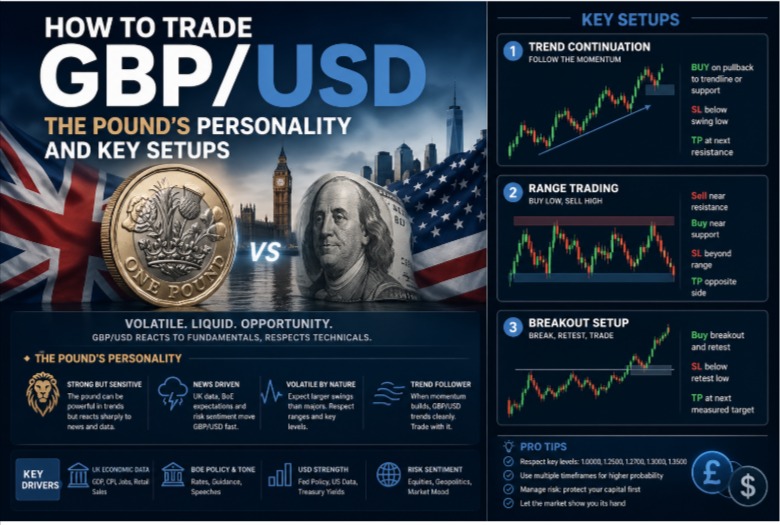
The key to trading GBP/USD is to develop strategies based on market scenarios and timing.
Trend trading:
Use indicators to determine the GBP/USD trend and trade with the trend for higher highs or lower lows.
Breakout trading:
Trade based on price breaking through key levels of support or resistance to make strong moves.
Range trading:
Trade support and resistance in low-volatility ranges.
Macro trading:
Hold longer-term positions on UK vs. US economic and interest rate dynamics.
What time frame should I use for GBP/USD trades?
The time frame for trading GBP/USD depends on the trading strategy:
Scalpers: Trade on 1-5 minute charts, looking for short-term fluctuations.
Day Traders: Trade on 15-minute to hourly charts, capturing price movements within a day.
Swing Traders: Focus on 4-hour to daily charts and trades based on longer-term trends.
Longer time frames can be easier for new traders as they offer more time to analyze and make trading decisions. And more experienced traders may use different time frames to gain a more comprehensive view of market movements.
Common Mistakes Traders Make When Trading GBP/USD
When trading GBP/USD, it’s as important to not make mistakes as to spot opportunities. GBP/USD is a fast and volatile pair that can cause large losses.
A frequent error is trading during news that causes erratic price movements.
Another is failing to consider news events, particularly those from the BoE and Fed, which have a significant influence on GBP/USD.
Other mistakes include trading without confirming the trend and placing stop-loss orders incorrectly.
Risk Management in GBP/USD Trading
Risk management is vital when learning how to trade GBP/USD, as it’s volatile.
- Only risk 1-2% of your account per trade.
- Use a stop-loss to limit losses.
- Don’t use excessive leverage.
- Be cautious during news events.
When trading GBP/USD, it’s better to preserve your capital than to take every opportunity.
Conclusion
Knowing how to trade GBP/USD is all about analyzing market factors, developing strategy, and risk management. By learning how to trade gbp usd pair, in a disciplined way, taking into account the sessions, news events, and price action, you can better manage the volatility and make more systematic trading decisions in a real trading environment.
How to trade GBP/USD with InsightfulTrade can help you develop better forex trading strategies with expert tips and insights.
FAQs
- Is GBP/USD good for beginners?
GBP/USD is suitable for beginners because it’s highly liquid and has low spreads, but it can be very volatile during UK and US news. Beginners should trade simple strategies, use technical analysis, and manage risk.
- What is the best time of the day to trade GBP/USD?
The best time to trade GBP/USD is the London-New York overlap (12pm-4pm UTC in the summer and 1pm-5pm UTC in the winter). These hours have the greatest liquidity, tightest spreads, and high volatility, making it a good time for short-term and day trading strategies, but they can be affected by market news.
- What is the average spread on GBP/USD?
GBP/USD CFD spreads depend on market factors, broker pricing, and liquidity. They tend to be narrow during peak hours but may increase during low liquidity or news events. It’s important to check spreads in real time before trading.
- How is GBP/USD affected by interest rate decisions?
GBP/USD reacts to BoE and Fed. A hawkish BoE is good for the GBP, and a hawkish Fed is good for the USD. These are closely watched by traders.
- Why is GBP/USD so volatile?
It is highly sensitive to UK and US economic indicators, interest rates, and global market conditions, which leads to volatility.
Author: Arihant Jain
Trading Experience: 5+ Years
Arihant Jain is a financial markets analyst and trading educator with expertise in Forex, indices, crypto, and risk-managed trading systems. His insights are based on real trading experience, data-driven analysis, and transparent market understanding. All content is reviewed for accuracy and aligns with Google’s EEAT guidelines.
Risk Disclaimer:
Trading involves substantial risk. All information is for educational purposes only and should not be taken as financial advice. Always do your own research.