
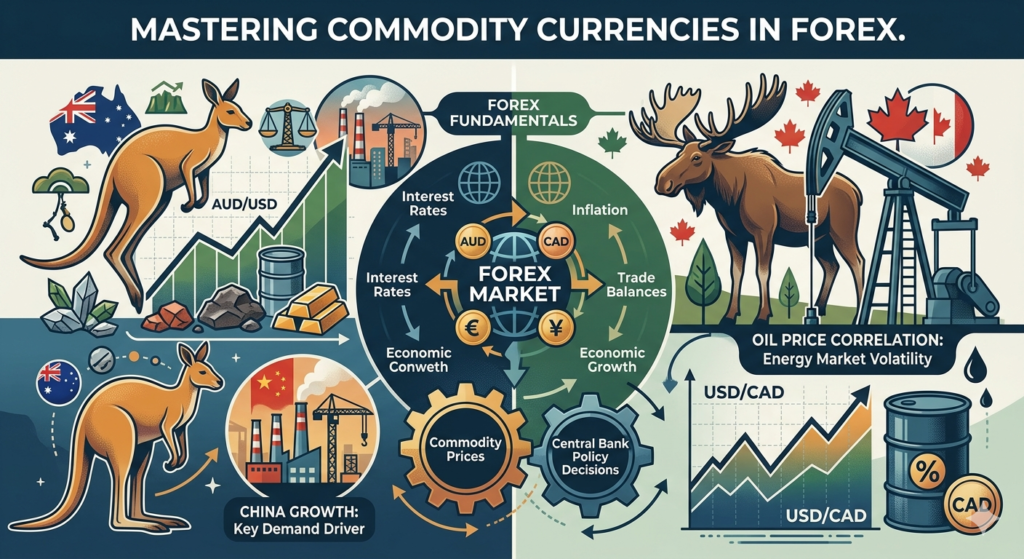

Commodity currencies play a crucial role in the global forex market. Unlike currencies that are driven primarily by manufacturing or service-based economies, commodity-linked currencies are heavily influenced by the prices of natural resources such as oil, gold, natural gas, iron ore, and agricultural products. For forex traders, understanding these relationships can unlock significant opportunities and provide valuable insights into broader market trends.
A successful commodity currency strategy requires understanding AUD/USD analysis, performing effective USD/CAD trading assessments, monitoring the oil price correlation with currencies, and incorporating strong forex fundamentals into trading decisions. By mastering these concepts, traders can identify high-probability opportunities in some of the most dynamic currency pairs in the forex market.
This comprehensive guide explores how commodity currencies behave, what drives their movements, and how traders can develop effective strategies for long-term success.
Understanding Commodity Currencies in Forex Markets
Commodity currencies are currencies whose economies rely heavily on natural resource exports.
Countries rich in oil, metals, minerals, and agricultural products often experience currency movements closely tied to commodity prices.
The foundation of any successful commodity currency strategy begins with understanding how resource markets influence exchange rates.
When commodity prices rise, exporting nations generally experience stronger trade balances, increased investment, and improved economic growth.
These developments frequently strengthen their currencies.
Understanding these relationships allows traders to build more effective forex fundamentals and identify emerging market opportunities.
Commodity currencies often provide early signals regarding broader economic trends.
Why Commodity Currency Strategy Matters
Many major forex trends originate from changes in global commodity markets.
A well-designed commodity currency strategy helps traders anticipate currency movements before they become obvious to the broader market.
Because commodity prices reflect supply, demand, and economic growth expectations, they often influence investor sentiment.
A successful commodity currency strategy combines market analysis, economic research, and risk management.
Traders who understand commodity-driven market relationships can often identify opportunities that traditional technical analysis alone may overlook.
This approach is particularly valuable during periods of significant economic change.
AUD/USD Analysis and Commodity Markets
Among all commodity-linked currencies, the Australian Dollar is one of the most popular.
Australia is a major exporter of iron ore, coal, gold, and other natural resources.
As a result, AUD/USD analysis frequently involves evaluating commodity demand and global economic conditions.
Strong commodity prices often support Australian export revenues and contribute to currency strength.
Effective AUD/USD analysis includes monitoring Chinese economic growth because China is Australia’s largest trading partner.
Changes in Chinese industrial demand frequently influence Australian exports and currency performance.
Many professional traders rely heavily on AUD/USD analysis when evaluating global commodity trends.
Why China Matters in AUD/USD Analysis
China’s economy plays a critical role in determining Australian export demand.
Infrastructure projects, manufacturing growth, and industrial production influence commodity consumption.
A thorough AUD/USD analysis often includes reviewing Chinese GDP data, manufacturing surveys, and trade reports.
Strong Chinese growth frequently supports Australian exports and strengthens the Australian Dollar.
Conversely, economic slowdowns may weaken demand for commodities and negatively impact currency performance.
Understanding this relationship enhances the effectiveness of any commodity currency strategy.
Global demand conditions remain a key factor in Australian Dollar valuation.
USD/CAD Trading and Oil Prices
The Canadian Dollar is another major commodity-linked currency.
Canada is one of the world’s largest oil exporters, making energy markets a critical component of USD/CAD trading.
Because oil exports contribute significantly to Canada’s economy, fluctuations in crude oil prices often influence currency performance.
Successful USD/CAD trading requires monitoring oil market trends, economic indicators, and central bank policy decisions.
When oil prices rise, the Canadian Dollar often strengthens.
When energy prices decline, the currency may weaken.
Understanding these relationships improves forecasting accuracy and trade selection.
Oil Price Correlation and Currency Markets
The relationship between oil prices and currencies is known as oil price correlation.
This concept is particularly important for commodity-exporting nations.
A strong oil price correlation often exists between crude oil and the Canadian Dollar.
As oil prices increase, export revenues rise, potentially strengthening the currency.
Traders who understand oil price correlation can identify opportunities before major currency movements occur.
Monitoring supply disruptions, geopolitical developments, and OPEC decisions can improve market awareness.
Many institutional traders incorporate oil price correlation analysis into broader macroeconomic frameworks.
Forex Fundamentals and Commodity Trading
Strong forex fundamentals are essential for successful commodity currency trading.
While technical indicators provide valuable information, understanding economic drivers offers deeper market insight.
Key forex fundamentals include:
Interest rates.
Inflation.
Employment data.
Trade balances.
Commodity prices.
Economic growth.
These factors often influence currency demand and long-term market trends.
Combining technical analysis with forex fundamentals improves decision-making and risk management.
Professional traders frequently use both approaches together.
Commodity Currency Strategy and Central Bank Policies
Central bank decisions significantly influence commodity-linked currencies.
Interest rate changes affect capital flows and investor sentiment.
A comprehensive commodity currency strategy includes monitoring central bank announcements and policy expectations.
For example, decisions by the Reserve Bank of Australia and the Bank of Canada frequently affect AUD/USD analysis and USD/CAD trading opportunities.
Understanding how policymakers respond to inflation and economic growth improves market forecasting.
Monetary policy remains one of the most powerful drivers of currency trends.
AUD/USD Analysis During Commodity Booms
Commodity booms often create strong opportunities in AUD/USD.
Periods of rising demand for metals and minerals frequently support Australian economic growth.
Effective AUD/USD analysis involves evaluating both domestic and international economic conditions.
Strong export demand can attract foreign investment and strengthen the Australian Dollar.
Many traders focus on commodity cycles because they often generate sustained market trends.
Understanding commodity-driven growth improves trading performance and market awareness.
USD/CAD Trading During Energy Market Volatility
Energy market volatility often creates significant opportunities for USD/CAD trading.
Changes in crude oil supply, geopolitical events, and economic forecasts can trigger large currency movements.
A disciplined USD/CAD trading approach includes monitoring energy inventories, production reports, and global demand expectations.
Combining oil market research with forex fundamentals provides a stronger foundation for trading decisions.
Risk management becomes especially important during volatile periods.
Preparation and discipline remain key elements of successful trading.
Oil Price Correlation and Risk Management
While oil price correlation provides valuable insight, traders should avoid relying exclusively on commodity prices.
Currencies are influenced by multiple factors simultaneously.
Interest rates, economic growth, inflation, and investor sentiment all affect exchange rates.
A balanced commodity currency strategy integrates oil price correlation with broader forex fundamentals.
This comprehensive approach reduces the risk of oversimplifying market analysis.
Professional traders often combine commodity research with technical confirmation signals.
Forex Fundamentals and Global Economic Growth
Global economic growth plays a major role in commodity currency performance.
Strong growth often increases demand for energy, metals, and raw materials.
This environment supports commodity-exporting economies and strengthens related currencies.
Understanding these forex fundamentals helps traders identify long-term trends.
Many successful traders incorporate global economic forecasts into their analysis.
Monitoring growth expectations can improve trade selection and forecasting accuracy.
High-Volume Related Keywords for Commodity Currency Trading
In addition to the primary keywords, traders frequently search for:
Commodity currency pairs
Australian dollar forecast
Canadian dollar analysis
Oil and forex trading
Commodity market trends
Resource-driven currencies
Forex economic analysis
Commodity cycle trading
Currency correlation strategy
Global demand forex trading
These related keywords complement commodity currency strategy, AUD/USD analysis, USD/CAD trading, oil price correlation, and forex fundamentals while helping traders develop a broader understanding of commodity-driven forex opportunities.
Common Mistakes Traders Make With Commodity Currencies
Many traders focus exclusively on chart patterns while ignoring forex fundamentals.
Others underestimate the importance of oil price correlation when trading commodity-linked currencies.
Some traders conduct incomplete AUD/USD analysis by overlooking Chinese economic data.
Others fail to incorporate energy market developments into USD/CAD trading decisions.
Successful traders combine multiple forms of analysis and maintain disciplined risk management practices.
A comprehensive approach often leads to more consistent results.
Conclusion
Commodity currencies provide unique opportunities for forex traders because they are directly influenced by global resource markets. Understanding commodity currency strategy principles, conducting thorough AUD/USD analysis, performing detailed USD/CAD trading research, monitoring oil price correlation, and applying strong forex fundamentals can help traders identify profitable opportunities and navigate changing market conditions.
As global demand for commodities continues to evolve, commodity-linked currencies will remain an important part of the forex landscape. Traders who understand these relationships can gain valuable insights and improve their ability to capitalize on market trends.
Frequently Asked Questions
What is a commodity currency strategy?
A commodity currency strategy focuses on trading currencies that are heavily influenced by commodity prices and resource exports.
Why is AUD/USD analysis important?
AUD/USD analysis helps traders understand how commodity demand, Chinese economic growth, and Australian economic conditions influence the Australian Dollar.
What factors affect USD/CAD trading?
USD/CAD trading is heavily influenced by oil prices, economic indicators, central bank policies, and broader market sentiment.
What is oil price correlation?
Oil price correlation refers to the relationship between crude oil prices and currencies, particularly those of major energy-exporting countries.
Why are forex fundamentals important?
Forex fundamentals help traders understand the economic forces driving currency movements, including growth, inflation, trade balances, and interest rates.
Which commodity currencies are most popular?
The Australian Dollar, Canadian Dollar, New Zealand Dollar, and Norwegian Krone are among the most widely traded commodity-linked currencies.
How can traders improve commodity currency trading?
Traders can improve results by strengthening AUD/USD analysis, monitoring oil price correlation, conducting detailed USD/CAD trading research, and focusing on strong forex fundamentals.