
Quick Summary
In the era of the rapid rise of online platforms for trading, forex trading scams have become more sophisticated in 2026. It is because traders like you started trusting fake trading apps, Telegram tips, unregulated brokers, and other schemes. In this guide, we’ll learn
- What is the Forex scam India?
- Is Forex trading legal or not
- Common mistakes made by you
- Real examples of forex trading vs scams
- How to verify a forex broker
What Is a Forex Scam India?
Any fraudulent activity that misleads you into any kind of illegal currency trading schemes. It can be any individuals, apps, mentors, websites, or social media that can trap you with false promises of guaranteed profits. They can pressure you to deposit more funds by showing some fake screenshots of profits.
In short, Forex scam India is an activity that promises you returns, avoids Indian regulations, and also hides broker registration and is generally considered a scam.
Is Forex Trading Legal in India, or Is It a Scam?
If you trade in legal form, forex trading is legal in India. Now let’s check how to identify forex scam with what is allowed and what is not.
| Allowed | Not Allowed |
| INR-based pairs | Non-INR pairs through foreign brokers |
| SEBI-regulated brokers | Unregistered offshore apps |
| Exchanges like NSE, BSE | Telegram signal groups |
Pro tip: Always follow the form that is allowed to avoid scams and for safe trading.
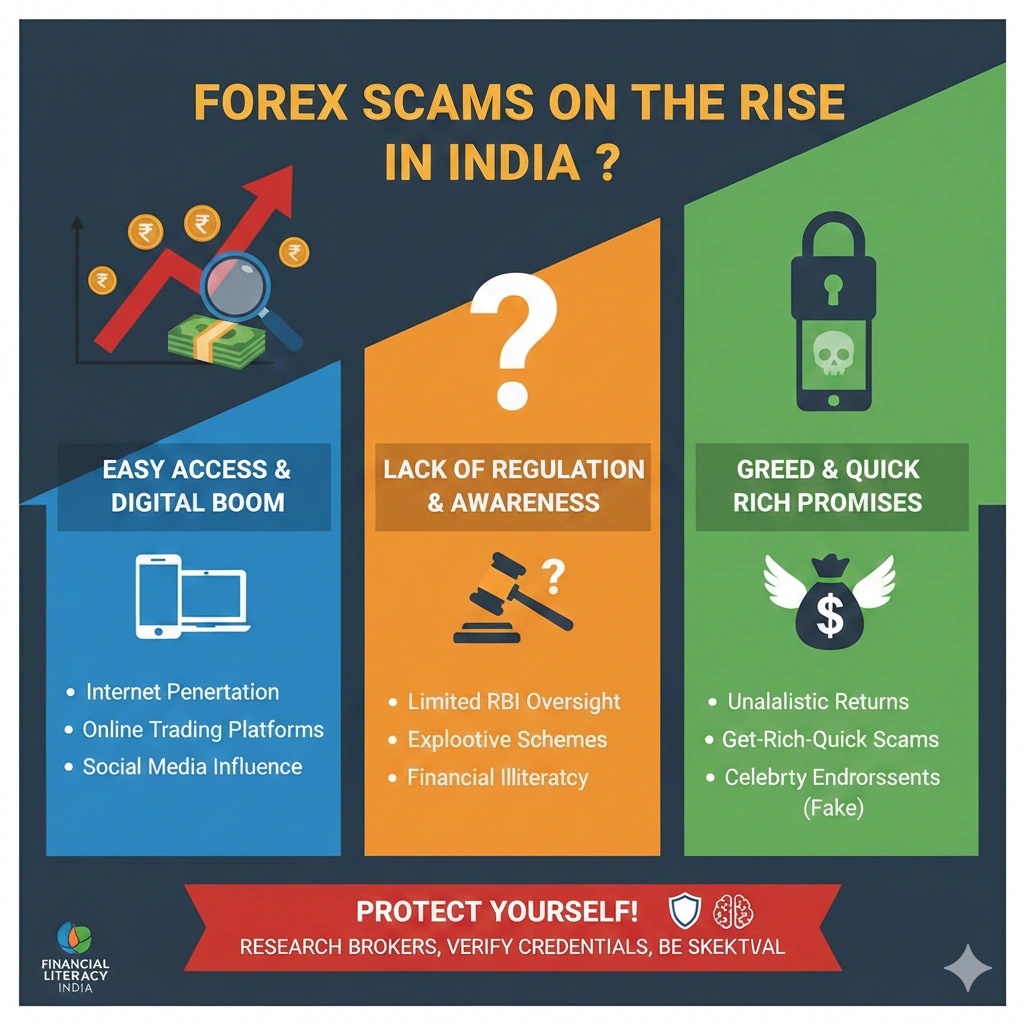
Why Are Forex Scams Increasing Rapidly in India?
There are several reasons behind the rapid increment of forex scam India. Some of them are given below:
- Growing interest in online income
- Scams look attractive with social media hype.
- Not aware of regulations
- Limited enforcement against offshore entities
- High-leverage temptation
- Easy access to fraud tools
How to identify Forex scam India?
- Not Registered in SEBI
- Guaranteed returns
- Unknown or offshore brokers
- Blocked withdrawals
- Pressure Tactics
- Request for personal documents
- Whatsapp or Telegram signal groups
If you’re also facing such things, make yourself aware that it can be a scam. If it looks too perfect or too easy, then it is not forex; it is a scam.
How to Verify a Forex Broker in India?
Do not deposit even a single penny before verifying your broker and ensuring that he is safe and legal or not. Here’s how you can verify correctly and avoid forex scam India:
- Visit the official website of SEBI and search the name of the broker in the registered broker list.
- The broker must be a member of NSE, BSE, or MCX.
- Verify allowed currency pairs, which are USD/INR, EUR/INR, GBP/INR, and JPY/INR.
- Read the policies, compliance details, and customer support on their website.
- Check Indian banking channels that deposits and withdrawals must be through your own banking account.
How Can Indian Traders Trade Forex Safely and Legally?
By following the things given below, you can trade legally and safely. Let’s see what these are:
- Check the fake brokers list India.
- Trade only on Indian exchanges
- Keep proper records
- Avoid offshore brokers
- Use your own bank account
- Follow Indian Tax rules
- Learn risk management
- Trade only INR-based pairs
What Does SEBI Say About Forex Trading Scams in India?
SEBI always warns you to not easily believe fake apps, social media, and misleading messages that offer guaranteed profits and easy returns. Here are some points about what SEBI says about forex scam India.
- Warns against unregistered platforms
- Verify registration before investing
- Beware of fake communications & impersonators.
- No assured returns or special accounts
How Do Forex Scammers Trap Beginners Psychologically?
Scammers target the trader with weakness such as
- Fear of missing out
- Greed or fast money-making
- Lack of patience
- Overconfidence

Pip, Lot Size & Profit Reality Check
EUR/USD Pip Value Example
| Lot Size | Pip Value |
| 0.01 (Micro) | $0.10 |
| 0.10 (Mini) | $1 |
| 1.00 (Standard) | $10 |
What Are Common Mistakes Traders Make That Lead to Scams?
- Trust in Guaranteed Profits
If someone is genuine and not a scammer, then he’ll not make fake promises of fixed or risk-free returns.
- Avoid Regulation
Make it easy for scammers, and they can create problems for you by falling into forex scams in India. If you avoid regulation, your money has no legal protection.
- Share Personal Documents
Don’t share your personal details and documents because they can use them for fake loans, illegal accounts, or money laundering and can cause legal problems for you.
- Lack of Proper Knowledge
If you’re trading without basic education, it can be one of the mistakes and can be advantageous for scammers.
- Believe in Influencers & Testimonials
One of the mistakes can be if you are influenced by an influencer’s luxury lifestyle, cars, or screenshots of profits. Avoid it because these can be paid promotions or edited results.
Can You Recover Money Lost in a Forex Scam India?
Yes, it is possible to recover your lost money in a scam by immediately following these steps:
- Contact your bank and file a fraud complaint immediately.
- Save all proof such as screenshots of chats, website, brokers, etc.
- You can also report on the Cybercrime Portal with all details.
- Take action quickly that increases the chance of freezing the fraud accounts.
- File an FIR at your local police station.
Formula Used in Real Forex Trading
Profit/Loss Formula:
Pips * Lot Size * Pip Value = Profit/Loss
As an illustration:
- 50 pips * 0.10 lot * $1 = $50
If he’s a real trader, he’ll explain formulas. If he’s not explaining, he is a scammer.
Pros & Cons of Forex Trading in India (Reality Table)
| Pros | Cons |
| High Liquidity | Legal Restrictions |
| Flexible timing | High risk |
| Skill-based | Emotional pressure |
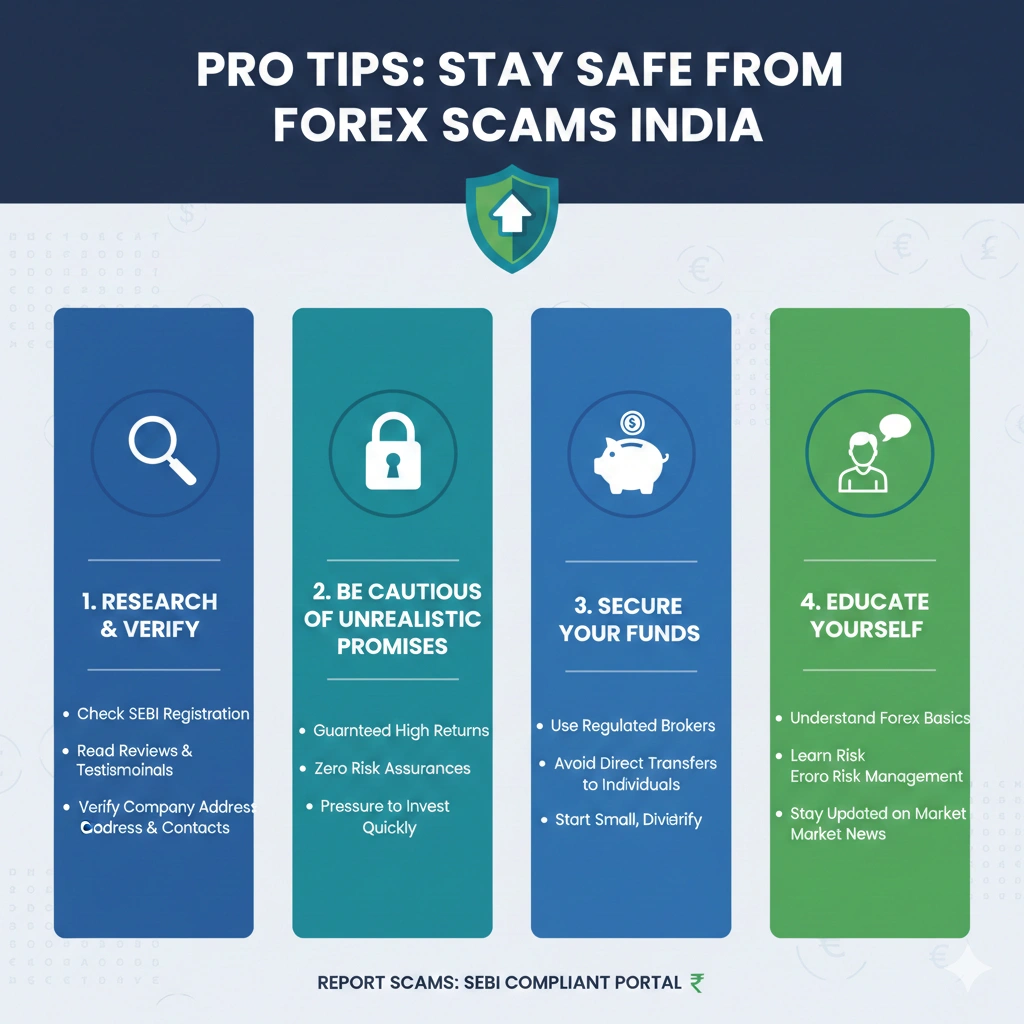
Pro Tips to Stay Safe from Forex Scam India
Here are some tips that you should follow to stay safe in forex trading. Let’s see together.
- Stay away from unregulated brokers
- Avoid fake promises that guarantees profit
- Trade with brokers who are SEBI-registered
- Use verified channels for payments
- Don’t share your PAN, Aadhar, bank details, or any OTP.
- Don’t believe in Whatsapp & Telegram Signal Groups
Frequently Asked Questions (FAQs)
1. Is forex trading a scam in India?
No, forex itself is not a scam, but many fake apps and unregulated brokers misuse the forex label to run illegal schemes for their profit and lead to Forex Scam India.
2. Are Telegram forex signals legal in India?
No, these signals are not illegal themselves, but if you use them to trade through unregulated brokers, it can be illegal or risky.
3. Can I trade EUR/USD legally in India?
If you’re an Indian retail trader, in that case you are not legally permitted to trade EUR/USD through unregulated brokers because it is not allowed by the RBI.
4. Why do people lose money in forex?
The reason for losing money can be overtrading, improper risk management, and falling for scams. Without discipline, your trading can turn into gambling rather than a professional skill.
5. Are guaranteed returns possible in forex?
No, returns are not guaranteed because they are driven by market sentiments and global economic events that make price movement unpredictable. So, don’t focus on unrealistic profit guarantees.
Final Thoughts: Is Forex Worth the Risk in India?
At the end of this guide, Forex Scam India, now you’ve got that forex trading is not a lottery; it is a professional skill. Don’t get trapped easily with fake promises such as zero money, fixed profits, and easy money. Be aware if someone is asking you to deposit money and manipulates you. Once you’re trapped in, you’ll think that forex itself is a scam.
So now, you get it that most scams happen when you believe social media blindly without any inquiry. To avoid forex scam India, treat forex like a profession and trade smart because forex is not a shortcut to overnight wealth.
Don’t let scammers steal the money that you earned. Stay informed and visit InsightfulTrade for legal broker guidance, scam alerts, and beginner-friendly education. Start making smart decisions with safety today!
Author: Arihant Jain
Trading Experience: 5+ Years
Arihant Jain is a financial markets analyst and trading educator with expertise in Forex, indices, crypto, and risk-managed trading systems. His insights are based on real trading experience, data-driven analysis, and transparent market understanding. All content is reviewed for accuracy and aligns with Google’s EEAT guidelines.
Risk Disclaimer:
Trading involves substantial risk. All information is for educational purposes only and should not be taken as financial advice. Always do your own research.
Last Updated: 27 December 2025