
Introduction
When you have stared at a price chart and then wondered where the market will next pull back or bounce, it is most likely that the Fibonacci trading strategy is one of the simplest ones to begin with. Traders are fond of it, as it provides distinct levels; it is applicable in Forex, indices, and crypto, and it also works well in conjunction with other techniques such as trendlines or support and resistance. How to put your Fib levels in the right place or experiment with more complicated tools such as Fib confluence trading. These tools assist you in making them look like price may respond, not like it must respond.
Consider Fibonacci to be a map. You do not have to guess about entries and exits and can plan pullback trades using retracements such as 38.2%, 50%, or 61.8% and map realistic targets using extensions such as 127.2 or 161.8. We will take it step by step in this guide to help you begin using Fibonacci levels with confidence.
What is the Fibonacci trading strategy—and can it actually work for you?
In case you are attempting to make sense of market reversals and probable resistance points, the Fibonacci trading strategy is among the simplest instruments to begin testing out. As soon as you memorize the technique of drawing Fib levels, you will begin to see the frequency with which the price reacts.
When you take a step for the Fib confluence trading, such as placing two or more Fibs of different wings or time frames on top of each other.
What is a Fibonacci retracement, and how is it calculated?
Under the Fibonacci trading strategy, level calculation is simple as long as one knows how to draw Fib levels using a clean swing high and low. It is merely retracements = High – (high-low) × Fib ratio.
In a typical example, in the EURUSD, the 61.8% replacement can be a very important area of Fibonacci confluence trading since it is often matched to support or resistance.
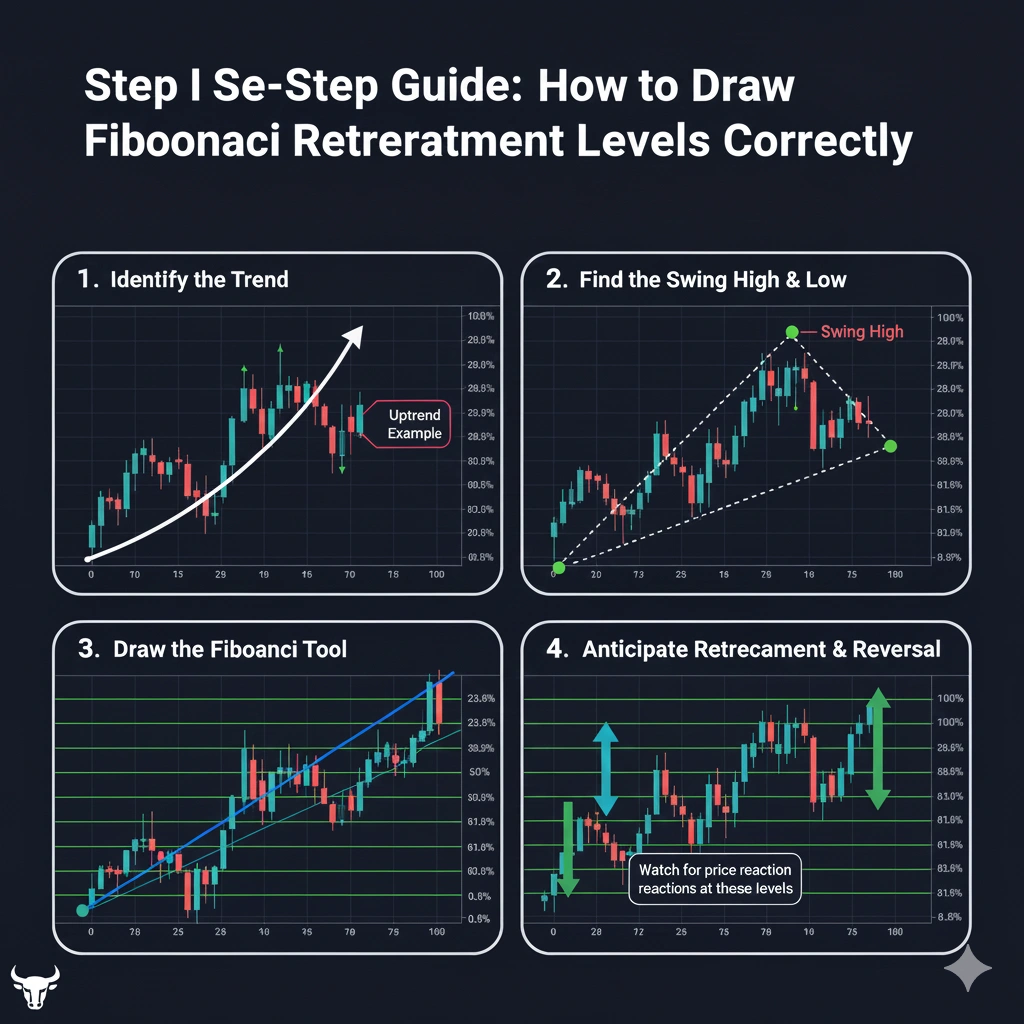
How do you draw fib levels correctly—step-by-step?
- The Fibonacci trading strategy begins with the identification of a swing high and swing low on a chart.
- Your platform will automatically highlight such key areas as 38.2%, 50%, and 61.8% as soon as you have mastered the art of drawing Fib levels.
- The levels assist in identifying possible pullbacks, bounce zones, or continuation areas of a trend.
What is Fibonacci confluence trading, and why does it matter?
Fib confluence & strategy
Trading with the Fibonacci trading becomes easier when a number of Fib lines coincide to produce powerful zones.
Drawing clean fib levels
Being able to bring the levels of fibers to the surface of clear swings makes it easy to spot confluence.
Power of confluence trading
Fib confluence trading eliminates guesswork and defines areas of high probability of entry.
Which timeframes work best with a Fibonacci trading strategy?
- The Fibonacci trading strategy can be used on any time frame, although the cleaner swings are more effective.
- Swing trades prefer to use daily charts and 4h charts since Fib reactions are more accurate.
- The 1H to 15m charts are ideal for intraday traders who decide to have rapid setups yet with sound structure.
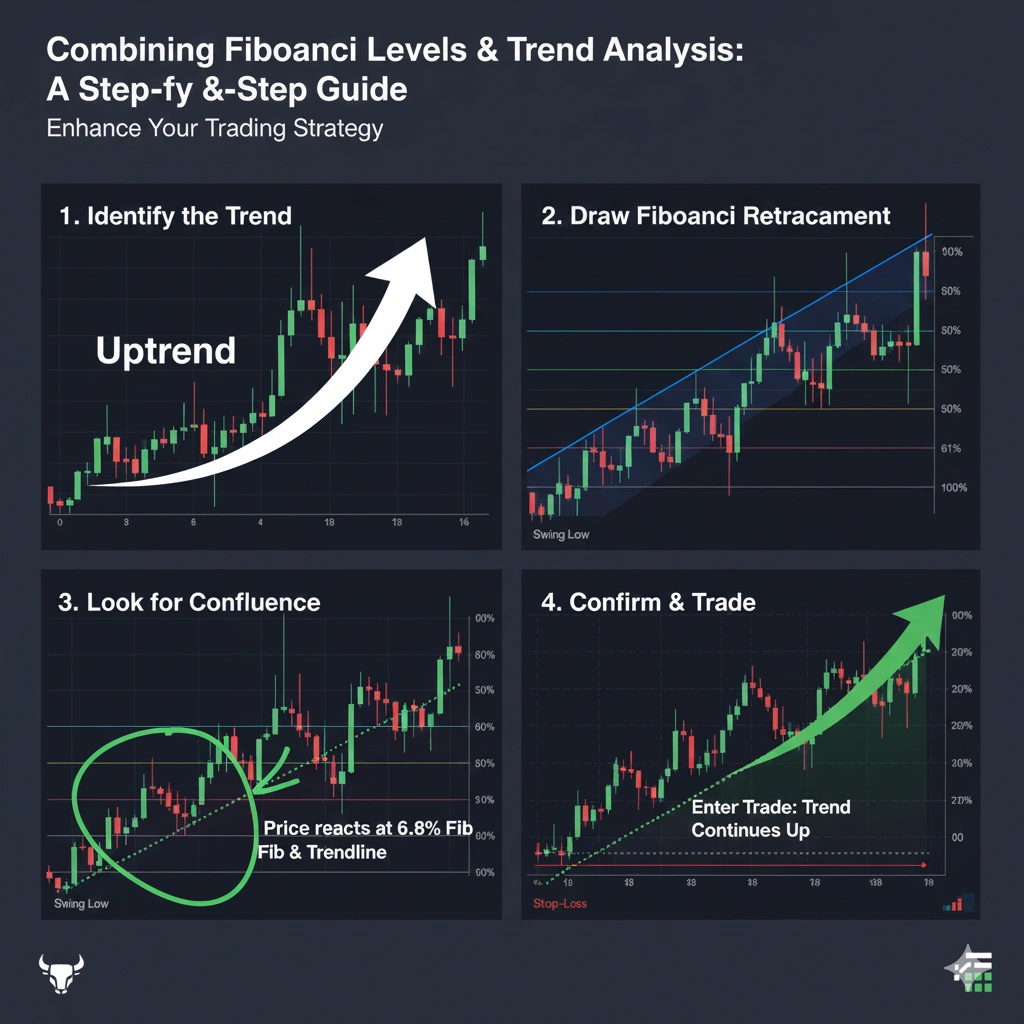
How can I combine Fibonacci levels with trend analysis?
- The first step is to determine the trend: uptrend = higher highs and higher lows; downtrend = lower highs and lower lows.
- A better chance is to enter trades at or around 38.2 to 61.8% retracements on the trend direction.
- Established profit objectives based on Fibonacci expense, such as 127.2% or 161.8%.
How do you use Fibonacci extensions to set targets?
The Fibonacci trading plan has extensions that assist in determining profit goals. To take the case of EURUSD, when it changes by 1 point with the value of 1.1000 to 1.1200, the extension of it is 127.2%, approximately 1.1254
These targets are more credible with an understanding of how to draw Fib levels and the identification of Fib confluence trading zones.
How does the Fibonacci trading strategy work on EURUSD?
Example: EURUSD (1H chart)
- Swing low—1.0840, swing high—1.1000 (move = 160 pips)
- 61.8% retracement – 1.0901
- Trade idea—buy near 1.0900
- Stop loss—1.0870 (30 pips)
- Target – 1.1000 or 127.2% Extension
What pip and lot size tables should a trader use with Fibonacci entries?
| Instrument | Micro lot (0.01) | Mini lot (0.1) | Standard lot (1.0) |
| EURUSD | $0.10/pip | $1/pip | $10/pip |
| USDJPY | $0.09/pip | $0.9/pip | $9/pip |
| US$30 | $0.10/point | $1/point | $10/point |
Use these values together with your Fibonacci trading strategy and Fibonacci confluence trading zones in order to control risk.
What are the pros and cons of Fibonacci trading?
| Pros | Cons |
| Easy to draw and understand | Subjective relies on the selection of Swing |
| Trades in instruments such as EURUSD and the US30 | The weaker in the tumultuous or lateral market |
| Bonds with trends and fib confluence trading | Excessive use may result in confirmation bias. |
| Risk management and/or entry/exit planning assistance | Not to be used separately should be confirmed. |
How do you build a step-by-step Fibonacci trading plan?
Identify the trend
Trade with the trend, but not against it. Check the higher time frame.
Drop clean Fibonacci levels.
Identifying a definite high and a definite low is important to know how to draw fib levels.
Look for price reaction.
Relative attention on 38.2 – 61.8 retractions and candlestick confirmations.
Calculate position size/set stop.
ATR, or pip risk, is used to calculate the lot size and put your stop past the key structure.
What are the common mistakes traders make with Fibonacci tools?
- Choosing imprecise swing points, the eyes or loss are unclear, and therefore fib level cannot be considered reliable.
- Nevertheless, it is not a prediction; it is a tool, and that is why the trend should be ignored.
- Poor position sizing or overleveraging of position—even a perfect setup can go wrong.
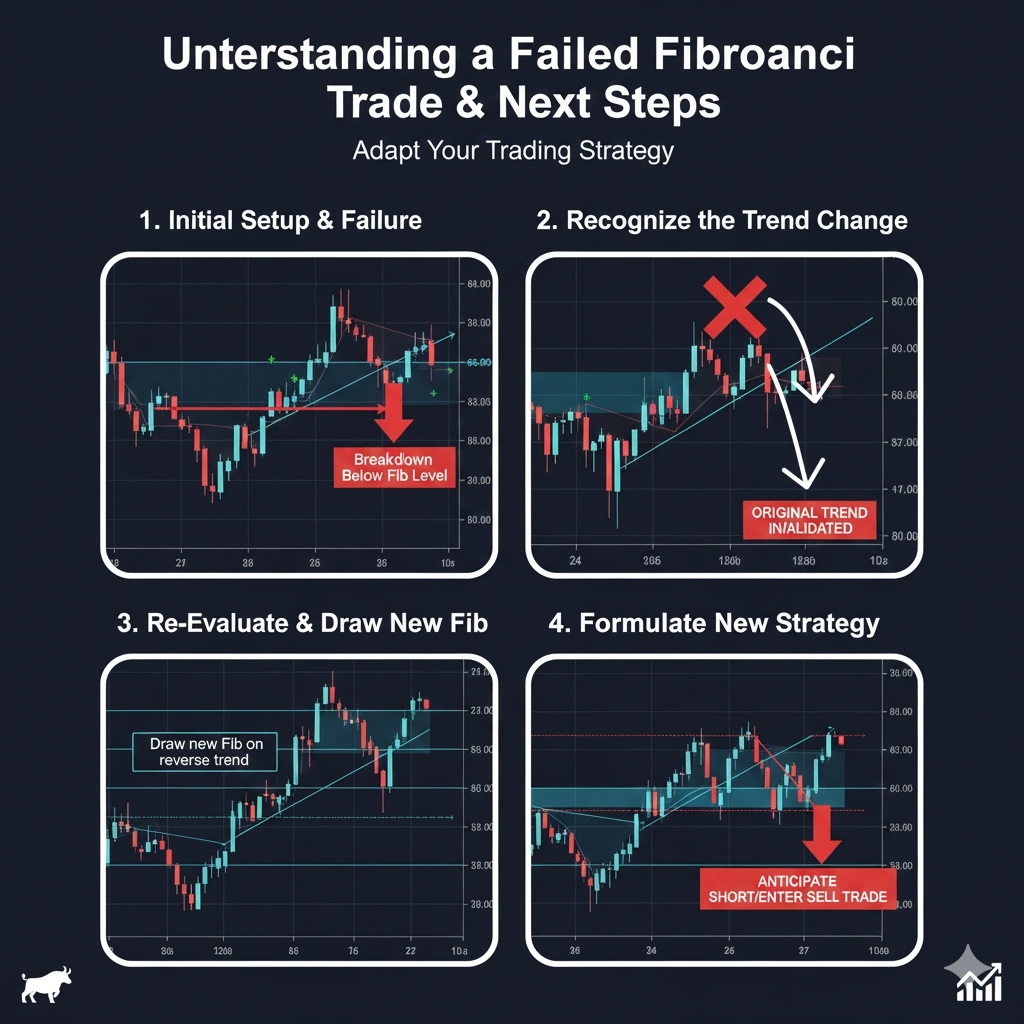
How do you interpret a failed FIB trade—and what should you do?
When a Fibonacci trading strategy does not work, accept the loss and never follow it. Look to see whether your swing points were accurate and whether or not your Fib confluence trading plan was solid.
Record the notes on how to draw Fib levels, keep a journal, and refine your rules to make more favorable trades in the future.
Can Fibonacci work on every market—FX, indices, and commodities?
Yes—Fibonacci ratios are mathematical and broad in application. But reliability varies.
FX: normally responsive because it is more liquid
Indices (US30): trend movement is good, but economic news volatility can be a problem.
Commodities: increase in noise of fundamental drivers; mix with fundamentals.
What is the difference between Fibonacci retracement and Fibonacci extension?
Fibonacci Extension
The Fibonacci Extension reveals the location where the price could go once the trend has been followed. It is primarily applied to profit goals such as 127.2% or 161.8%, and it works well with FIB conference trading to have a higher level of confidence.
Fibonacci Retracement
Fibonacci retracement is applied in identifying pullback areas within a trend. Once they figure out how to draw Fib levels, traders who employ the Fibonacci trading strategy see instances of entries based on the 38.2%, 50%, and 61.8% markets.
FAQs
- What is Fibonacci trading?
It is a trading approach that employs the Fibonacci retracement degrees to locate drawbacks, entrances, and targets in trend markets.
- How to draw fibs?
To identify potential reversal areas, you draw Fibonacci levels between a clear swing high and swing low (or the reverse), drawing them between these levels.
- What is fib confluence?
When several levels of fibers, support/resistance, or indicators are aligned, the setup becomes stronger.
- Do FIB levels always work?
No, they do well in the trending markets. In choppy markets, Fib levels are not very accurate.
- Which markets use Fibonacci?
The Fibonacci trading strategy can be applied to forex pairs, gold, crypto, the US30 index, and others.
Conclusion
To sum everything up, the Fibonacci trading strategy is something that is so powerful when you finally know how to use it correctly. It is all about being able to see through, being able to wait, and being able to discipline oneself—everything to do with knowing how to draw fib levels the right way and knowing where to find smart fib confluences trading zones. Fib numbers are not magic numbers; they just assist in interpreting the market structure and locating rational changes of pullback where price trends respond.
Fibonacci, combined with trend direction, good swing points, and risk management, will make it a good guide and not another indicator in your chart. Losses will occur, but with clean structures and even rules in place. Fib trading will provide you with high-probability entries on pairs such as EURUSD, gold, or even US30.
Unlock the power of Fibonacci in your trading! Join InsightfulTrade to master precision entries, trend reversals, and profit targets with expert guidance. Start refining your strategy today—trade smarter.
Author: Arihant Jain
Trading Experience: 5+ Years
Arihant Jain is a financial markets analyst and trading educator with expertise in Forex, indices, crypto, and risk-managed trading systems. His insights are based on real trading experience, data-driven analysis, and transparent market understanding. All content is reviewed for accuracy and aligns with Google’s EEAT guidelines.
Risk Disclaimer:
Trading involves substantial risk. All information is for educational purposes only and should not be taken as financial advice. Always do your own research.
Last Updated: 4 December 2025