
It’s easy for traders to get obsessed with indicators and charts, but sometimes the result depends more on how your order actually gets filled than on your market prediction. Especially when you’re dealing with the execution speed in a low liquidity market. In such a market, even a perfect setup can be disappointing because of low liquidity, execution challenges, and constant risk of slippage. That’s why it’s important for you to learn why this happens and how to stay in control to boost your overall performance.
Execution speed in low liquidity markets refers to how efficiently your order gets filled when the order book is thin. In these conditions, slower execution increases slippage and widens trading costs. Managing timing, size, and order type becomes critical for performance.
Quick Summary
| Aspect | Key Insight |
| Core Focus | Execution speed in low liquidity markets |
| Main Risk | Slippage risk trading increases significantly |
| Market Type | After-hours, exotic pairs, small-cap instruments |
| Core Problem | Orders fill at worse prices due to thin liquidity |
| Practical Goal | Improve low liquidity execution through structure and timing |
| Compliance Note | Accurate records are critical during volatile fills |
Understanding Liquidity: The Foundation of Execution
Before addressing execution speed in low liquidity markets, it is important to understand what liquidity represents.
What Is Liquidity?
The times when you are easily able to enter or exit a trade without causing any massive price swing are called liquidity.
High liquidity:
- Tight bid-ask spreads
- Faster order matching
- Minimal price disruption
Low liquidity:
- Wider spreads
- Fewer counterparties
- Greater price impact
And when the market is running low, how fast your order gets executed becomes a massive factor in whether you will win or lose.
In thin markets, the order book has fewer limit orders stacked at each price level. When your order size is larger than the available volume at the best bid or ask, it starts consuming the next price levels. This is why even small delays or large orders can push your average entry away from your intended price.
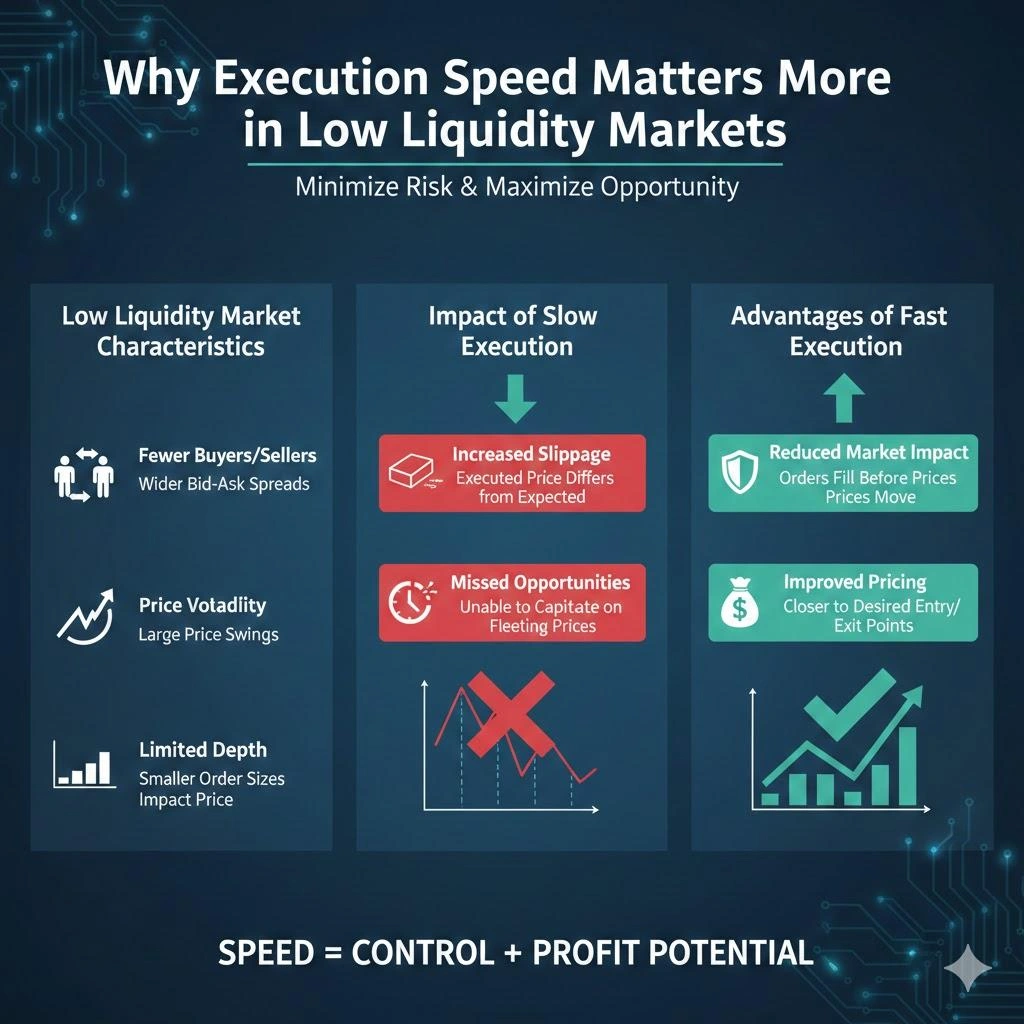
Why Execution Speed Matters More in Low Liquidity Markets
When the market liquidity is high, a little delay in order is not a big deal. However, in thin markets:
- Price levels vanish instantly
- The depth of available traits is shallow
- Orders get partially filled
This is the impact of low liquidity execution.
The Core Problem
A trader places a market order expecting a specific price. Due to thin order book depth, the order “walks the book,” filling at progressively worse prices.
This difference is known as slippage.
Slippage Risk Trading: The Hidden Performance Drain
Missing out on the price you wanted is a bit annoying, but in reality it can turn a winning trade into a losing one.
Why Slippage Increases in Low Liquidity
- Fewer traders available
- Prices adjust too rapidly
- Order size gets too big for the market
- News-related volatility
This explains that if your order is slow or poorly structured in this thin market, you’re more likely to get hit by bad prices that can eat your profits.

Low Liquidity Execution in Different Asset Classes
1. Forex Exotic Pairs
Exotic pairs usually see much:
- Less action
- Widen spreads
- A high chance of slippage
In these cases, fast execution isn’t enough unless you’re also disciplined about your position size.
2. Small-Cap Stocks
Small-cap stocks are very sensitive to order flow.
Example:
- If you place a large market order when there aren’t any shares available, the price can suddenly spike just to find liquidity to fill your order.
This shows when the market is running low, it just doesn’t affect your orders, but it can actually warp the price structure itself.
3. After-Hours Index Futures
During non-peak sessions:
- Liquidity falls
- Big banks aren’t much active
- Unpredictable price jumps
That’s why fast execution becomes critical to stop slippage from eating away your profits.
Example: A trader places a 3-lot EUR/INR market order during late Asian hours. The visible spread shows 2 pips, but due to shallow depth, the final fill averages 6 pips worse. The extra cost directly reduces the reward-to-risk ratio.
Why Market Orders Become Dangerous in Thin Conditions
Your speed is more important than the price; especially in a low-liquidity market, this trade-off becomes more dangerous.
What Happens Internally
- Your order search for best price available
- If there isn’t enough volume, your order might get filled at bad prices
- Your average price ends up being much higher or lower than you expected
Understanding this mechanism is the key to deciding whether a market order is actually worth the risk when the market is thin.
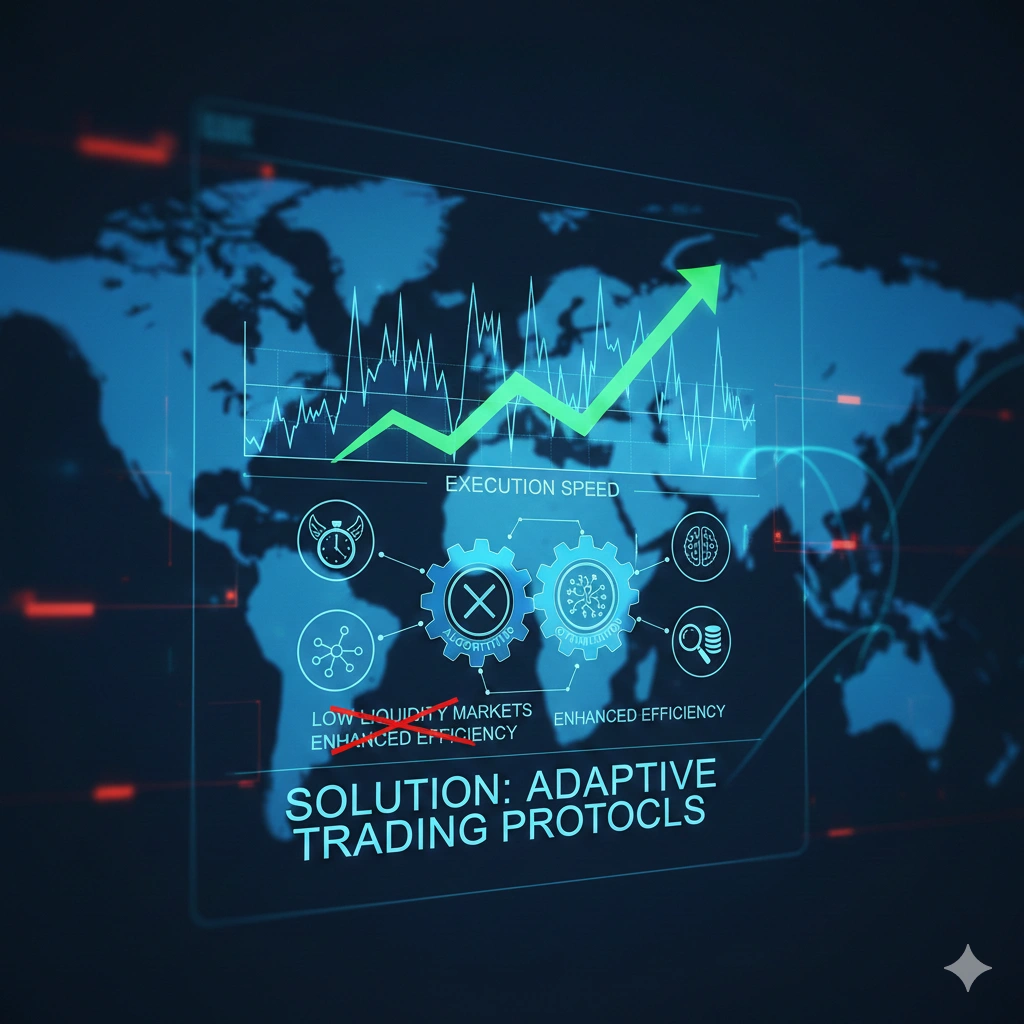
Solution: Improving Execution Speed in Low Liquidity Markets
1. Use Limit Orders Strategically
Limit orders:
- Control entry price
- Reduce slippage
- Improve cost certainty
This might not work; your order may not get filled. It’s a choice between getting the desired price or execution certainty.
2. Adjust Position Size
Big orders when the market is quiet can leave an impact and push prices against you.
Reducing size:
- Help keep the order book stable
- Get smoother fills in thin market
- Minimizes slippage risk trading
3. Trade During Liquidity Clusters
Liquidity often improves during:
- Session overlaps
- Market open periods
- Institutional participation windows
Avoiding trading when the market is running is the best way to get faster, better fills in low liquidity markets.
Measuring Execution Performance
To improve, traders must track:
- Expected vs actual entry price
- Spread at time of execution
- Fill time
- Order size vs available liquidity
This all will help you improve low liquidity execution.
Regional Considerations: India
Indian traders often face a quiet market when they are trading:
- Global forex pairs
- US indices at off-peak hours
- After-market equity trades
Knowing fashion timing and broker infrastructure can help you improve your execution speed in low liquidity markets.
Regional Considerations: Vietnam
As a Vietnam trader trading global instruments, you’ll face the similar challenges:
- Thinner liquidity between sessions
- High risks of price slippage
- Exposure to slippage risk trading
That’s why picking a specific trading session will boost your results.
Compliance and Documentation: Execution Speed in Low Liquidity Markets
From a legal view, it’s important to record price gaps accurately.
Key documentation elements:
- Timestamp of order
- Requested price
- Executed price
- Market condition
To crack all the audits and win broker disputes, keep track of all your trading records.
Common Mistakes in Low Liquidity Execution
- Trading with big position size
- Blindling hitting the orders
- Ignoring the gaps widening
- Trading during news spikes
- Thinking that speed can solve liquidity gaps
Avoiding these mistakes can help execute your trade with speed even in a thin market without needing any complex tools.
Conclusion: Execution Speed in Low Liquidity Markets
When the market is running on low liquidity, execution speed isn’t just about having the fastest tech; it’s about being a smart participant. Problems usually arise when your trade size, timing, and the market’s depth aren’t in sync. It leads to the risk of trade slippage, which can eat away your returns, even if your strategy is perfect. Connect with Insightful Trade; they can improve your results, help you analyze the trading session, use the right order types, and keep your position size in check.
FAQs: Execution Speed in Low Liquidity Markets
1. Why does execution speed in low liquidity markets matter so much?
When there are few buyers and sellers, the price jumps more easily. This causes slippage that can eat up your profit.
2. Can faster brokers eliminate slippage risk trading?
They can reduce the technical delays, but they can’t force someone to take the other side of your trade if no one is there.
3. Are limit orders better in low liquidity execution?
They can help you get your desired entry price, but there’s no guarantee of the order getting completed. You can avoid the slippage, but the risk of missing the move is still there.
4. How can Indian traders manage low liquidity conditions?
The best way is to trade when the major market sessions overlap, use a smaller position size, and keep a close eye on spread.
5. Is documenting slippage important for compliance?
Definitely keeping track of your records helps you pass an audit and gives you solid proof if you ever need to settle a dispute with your broker.
Author: Kumkum Chandak
Experience: 3+ Years in Trading Research & Market Content Strategy
Kumkum Chandak is a trading content strategist and market research writer who specializes in simplifying technical analysis, trading tools, and strategy-driven educational content. Her work is optimized for EEAT, accuracy, and user intent, ensuring every article delivers practical insights for traders of all levels.
Risk Disclaimer:
All content is strictly educational and not financial advice. Trading involves substantial risk. Always perform your own analysis or consult a professional advisor.
Last Updated: 12 February 2026

