The forex market is highly sensitive to geopolitical developments, and one of the strongest triggers of market uncertainty is economic sanctions. Understanding economic sanctions forex relationships is essential because sanctions can instantly affect currency values, investor confidence, trade flows, and global financial stability. In today’s interconnected economy, governments increasingly use sanctions as political and economic tools, making their impact on forex markets more significant than ever.
The rise of sanctions currency impact analysis has become a major part of modern forex trading. Traders carefully monitor sanctions imposed on countries, banks, industries, and political entities because these actions directly influence currency demand and market sentiment. In many cases, sanctions create sharp market reactions that lead to massive price swings across major and emerging currencies.
At the same time, growing geopolitical tensions have increased the importance of geopolitical trading risk management. Forex traders now face rapid market movements triggered by political conflicts, diplomatic disputes, and economic restrictions. Understanding how sanctions influence currencies can help traders better navigate volatility and protect capital during uncertain market conditions.
Understanding Economic Sanctions Forex Market Reactions
The relationship between economic sanctions forex markets begins with the impact sanctions have on international trade and economic confidence. Economic sanctions are restrictions imposed by governments or international organizations to pressure countries politically or economically. These measures can include trade bans, asset freezes, financial restrictions, or limitations on exports and imports.
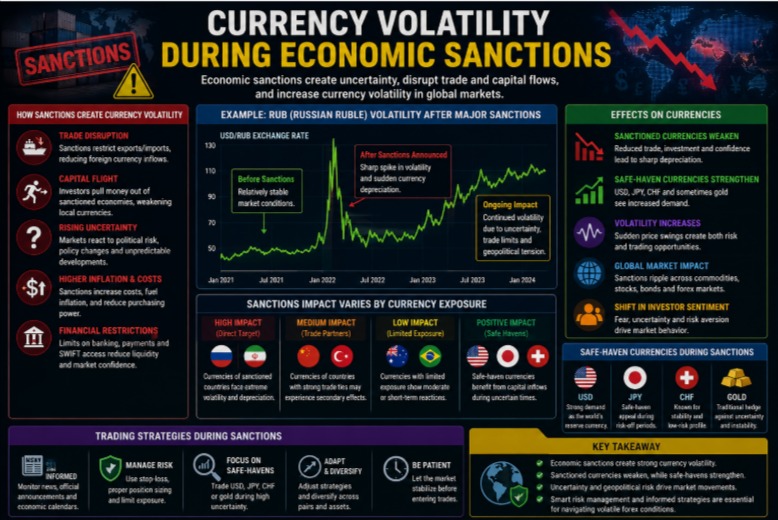
Whenever sanctions are introduced, the economic sanctions forex market reacts immediately because traders anticipate slower economic growth, reduced foreign investment, and weaker trade performance. Currency markets often experience sharp volatility as investors move capital away from affected economies.
The role of sanctions currency impact becomes particularly important when sanctions target major economies or critical industries such as energy, banking, or technology. Restrictions on exports or international payments can weaken a country’s currency by reducing demand and investor confidence.
At the same time, sanctions increase geopolitical trading risk because traders must quickly adapt to changing political conditions and unpredictable market reactions. News related to sanctions can create sudden price spikes and increased uncertainty across global forex markets.
How Sanctions Currency Impact Global Forex Markets
The concept of sanctions currency impact is closely tied to investor psychology and global economic stability. When sanctions are announced, investors often fear economic slowdowns, trade disruptions, and reduced business activity. This fear causes traders to rapidly adjust positions in currency markets.
For example, sanctions targeting major exporters can weaken local currencies because reduced trade activity decreases foreign currency inflows. This is one of the clearest examples of how economic sanctions forex markets react to geopolitical decisions.
In many cases, the sanctions currency impact extends beyond the targeted country. Neighboring economies, trading partners, and global commodity markets may also experience disruptions. Forex traders closely monitor these broader economic effects when analyzing currency movements.
The increase in geopolitical trading risk during sanction periods often causes investors to move capital into safe-haven currencies such as the US Dollar, Swiss Franc, or Japanese Yen. These currencies generally strengthen during global uncertainty because they are considered more stable.
The interconnected nature of financial markets means that sanctions imposed on one country can influence currency values worldwide. This makes understanding economic sanctions forex dynamics essential for traders operating in global markets.
Geopolitical Trading Risk and Currency Volatility
One of the biggest consequences of sanctions is rising geopolitical trading risk. Political uncertainty increases market fear and creates highly volatile trading conditions. Forex traders must constantly monitor global news because even small geopolitical developments can trigger major currency fluctuations.
The relationship between economic sanctions forex activity and volatility becomes especially visible during international conflicts. Military tensions, diplomatic disputes, and economic restrictions often lead to rapid market reactions as investors seek safer assets.
The effect of sanctions currency impact is particularly strong in emerging markets because developing economies often rely heavily on foreign trade and investment. Sanctions can weaken local currencies significantly, increasing inflation and economic instability.
Periods of high geopolitical trading risk also affect trader behavior. Many traders reduce leverage, avoid risky positions, and focus on safer currencies during uncertain market conditions. This shift in market sentiment contributes to additional volatility in the forex market.
For professional traders, understanding how sanctions influence market psychology is critical for managing risk and identifying trading opportunities.
Safe-Haven Currencies During Economic Sanctions Forex Conditions

Safe-haven currencies play a major role during periods of economic sanctions forex volatility. Investors often move funds into currencies associated with economic stability and strong financial systems.
The US Dollar is one of the primary safe-haven assets during sanction-related uncertainty. The connection between the Dollar and sanctions currency impact is particularly important because global trade and financial transactions are heavily dependent on the US financial system.
The Japanese Yen and Swiss Franc also benefit during periods of heightened geopolitical trading risk. Investors typically seek these currencies when uncertainty increases because of their historical stability and lower exposure to geopolitical conflicts.
The rise in safe-haven demand often strengthens these currencies significantly, creating major shifts in forex market trends. Traders who understand economic sanctions forex dynamics can use these movements to identify profitable trading opportunities.
Gold is another important safe-haven asset frequently monitored alongside forex markets during sanction periods and geopolitical crises.
How Central Banks Respond to Sanctions Currency Impact
Central banks play a critical role in managing the effects of sanctions currency impact on national economies. During periods of sanctions-related instability, central banks may introduce emergency monetary policies to support financial systems and stabilize currencies.
The connection between central bank policy and economic sanctions forex markets becomes especially important during prolonged geopolitical conflicts. Interest rate changes, currency interventions, and liquidity measures can all influence currency strength.
Increased geopolitical trading risk may force central banks to lower interest rates or provide stimulus programs to support economic growth. However, such measures can sometimes weaken the local currency further if investors lose confidence in economic stability.
Forex traders carefully monitor central bank statements because policy decisions often influence long-term currency trends during sanctions-related crises.
Forex Trading Strategies During Geopolitical Trading Risk
Successful traders develop specific strategies for navigating geopolitical trading risk environments. During sanctions-related volatility, many traders focus on risk management and capital preservation.
In economic sanctions forex conditions, traders often reduce leverage to avoid excessive exposure to unpredictable market swings. Stop-loss orders and position sizing become essential tools for controlling risk.
The role of sanctions currency impact analysis is also critical when selecting currency pairs. Traders frequently focus on safe-haven currencies or avoid currencies directly affected by sanctions and geopolitical instability.
News trading strategies are common during sanction periods because forex markets react quickly to breaking developments. Traders monitor government announcements, diplomatic negotiations, and economic reports to anticipate potential currency movements.
Technical analysis remains useful, but geopolitical events can quickly override chart patterns. This is why traders combine technical indicators with fundamental and geopolitical analysis during periods of heightened geopolitical trading risk.
The Future of Economic Sanctions Forex Trading
The future of economic sanctions forex trading will likely become even more complex as geopolitical tensions continue increasing globally. Economic sanctions are increasingly used as strategic tools in international relations, affecting trade, energy markets, and financial systems.
The growing importance of sanctions currency impact analysis reflects the evolving relationship between politics and financial markets. Forex traders must now understand both economic fundamentals and geopolitical developments to navigate modern markets effectively.
As global uncertainty rises, geopolitical trading risk may continue driving higher market volatility. Conflicts involving trade, energy resources, technology, and international alliances could create new forex trading opportunities and challenges.
Technology and real-time news access have also accelerated market reactions, making sanctions-related trading more fast-paced and unpredictable than ever before.
Conclusion
Economic sanctions have become one of the most influential forces shaping modern forex markets. The relationship between economic sanctions forex conditions and currency volatility highlights how geopolitical events directly affect investor confidence and global financial stability.
The growing role of sanctions currency impact analysis shows why traders must closely monitor international developments, political tensions, and economic restrictions. Sanctions can weaken currencies, disrupt trade, and create significant market volatility across global forex markets.
At the same time, rising geopolitical trading risk creates both opportunities and dangers for traders. Those who understand market psychology, safe-haven flows, and geopolitical developments can better manage uncertainty and adapt to rapidly changing conditions.
In today’s interconnected financial world, mastering the impact of sanctions on forex markets is essential for successful currency trading.
FAQs
What is economic sanctions forex trading?
Economic sanctions forex trading refers to analyzing how government-imposed sanctions affect currency markets, investor sentiment, and forex trading opportunities.
How does sanctions currency impact affect currencies?
The sanctions currency impact can weaken currencies by reducing trade, lowering foreign investment, increasing uncertainty, and damaging economic confidence.
Why is geopolitical trading risk important in forex?
Geopolitical trading risk is important because wars, sanctions, political conflicts, and diplomatic tensions can create sudden and unpredictable currency movements.
Which currencies perform best during sanctions-related crises?
Safe-haven currencies like the US Dollar, Japanese Yen, and Swiss Franc often perform well during periods of economic sanctions forex volatility because investors seek stability.
How can traders manage geopolitical trading risk?
Traders can manage geopolitical trading risk by reducing leverage, using stop-loss orders, diversifying positions, and closely monitoring global political and economic news.