
China is the world’s second-largest economy—and one of the biggest drivers of global growth. The Chinese market has a huge impact on the financial markets of all the continents. Whether it’s India, the US, or the UK, they all react to data almost instantly. From stock markets and commodities to currencies and bonds, the China impact global markets is undeniable. We all know how the data drives market force. You can’t ignore China if you want to predict the market moves.
In this blog, we’ll discuss how ups and downs in China’s market influence the global sentiment, why the Shanghai market matters to you, and how you can use it to stay one step ahead.

Why Chinese Economic Data Matters for Global Markets
Economic data from China plays a key role because of the country’s:
- Massive manufacturing output
- Dominant role in global trade
- Large consumer base
- Influence on commodity demand
- Integration in global supply chains
As a result, any shift in China’s economic indicators can trigger ripple effects across global financial markets. This phenomenon is widely known as the China economic data effect.
Some of the most influential Chinese indicators include:
- GDP Growth Rate
- Manufacturing PMI
- Industrial Production
- Trade Surplus / Export-Import Data
- Retail Sales
- Inflation (CPI & PPI)
It’s pretty simple to understand that good numbers mean that the global market tends to breathe relief and buy, and when they are bad, it means panic selling is coming.
The Shanghai Index Influence on Global Markets
The Shanghai Composite Index (SSE) is China’s primary stock market index. Because the Chinese market opens when the West is still sleeping, it gives us the first clue on how the market is gonna be for the rest of the trading day, especially during economic uncertainty.
How the Shanghai Index Influences Global Markets
- Asian markets (Nikkei, Hang Seng, KOSPI) often follow SSE trends due to regional economic ties.
- European indices (DAX, FTSE, STOXX) As they heavily rely on exporting goods to China. If SSE looks weak, then the European market often takes a hit. .
- US markets (S&P 500, Dow Jones, Nasdaq) closely watch the Chinese market for clues on consumer demand, tech-sector regulations, or geopolitical developments.
- Commodity-heavy markets (Australia, Canada, Brazil) depend heavily on China’s appetite for metals and energy.
If you want to just predict how the market day is going to be globally, you should start watching Chinese markets closely.
Real Examples of China’s Impact on Global Indices
1. COVID-19 Pandemic Data Shock (2020)
The news of factory shutdowns and the cessation of production in China during COVID from China caused the global markets to crash. The S&P 500 dropped around 30%, crude oil prices fell sharply, and Asian markets saw massive sell-offs.
2. China’s Manufacturing Slowdown (2023–2024)
Weak PMI data triggered global fears over slowing global demand. European markets (especially Germany’s DAX) reacted negatively due to reduced Chinese imports of machinery and automobiles.
3. Tech Sector Regulatory Crackdowns
When China imposed regulations on tech giants like Alibaba and Tencent, global tech stocks felt the pressure—affecting NASDAQ and related tech-linked ETFs worldwide.
These are the proof that global markets track China’s economic pulse very closely.

Key Chinese Indicators and Their Global Impact
1. GDP Growth Rate
China’s GDP results influence global expectations for economic expansion.
- Strong GDP → boosts global indices (especially commodities, industrial stocks, and Asian markets).
- Weak GDP → triggers global sell-offs amid fears of global recession.
2. Manufacturing PMI
A PMI below 50 indicates contraction.
Impact:
- Hurts export-driven markets (EU, Japan).
- Reduces commodity demand → affects oil, iron ore, and copper prices.
- Global indices experience defensive-sector rotation.
3. Trade Balance Reports
China is the world’s largest exporter.
- Reduced exports → weaker supply chain activity globally.
- Reduced imports → signal weak domestic demand, affecting global manufacturing.
4. Industrial Production
A drop in industrial output shakes investor sentiment across emerging and developed markets.
5. Inflation Data: CPI & PPI
- Chinese deflation risks affect worldwide demand for goods.
- High PPI impacts global prices for raw materials.
Understanding these indicators will help you anticipate global market reactions more effectively.
The Ripple Effect: How China Impact Global Markets
1. Commodity Markets
China is the biggest consumer of:
- Oil
- Copper
- Iron ore
- Coal
Lower demand → commodity prices drop → commodity-linked indices fall.
2. Currencies
Chinese data affects major currency pairs:
- AUD/USD and NZD/USD drop when China weakens (due to export reliance)
- USD/CNH spikes during uncertainty
- Safe-haven assets like JPY and USD surge
3. Global Supply Chains
Weak Chinese manufacturing signals disruptions, influencing:
- Automobiles
- Electronics
- Semiconductors
This affects global corporate earnings and stock prices.
4. Investor Sentiment
The global investment community closely watches China’s data to gauge risk appetite.
The Exception to the Rule: Understanding Market Decoupling
While the “China ripple effect” is a powerful force, expert traders know that correlations are not permanent. There are periods of market decoupling, where global indices move in the opposite direction of Chinese data.
This often happens due to:
- Capital Flight: When Chinese data is weak, global investors may pull money out of Asian markets and invest it into “safe havens” like US Treasuries or US mega-cap tech stocks. In this scenario, a drop in the Shanghai Index can actually fuel a rally in the S&P 500.
- The Distraction Factor: Sometimes, local news is just louder. Look at the 2023–2024 AI boom. The US Nasdaq was breaking records thanks to the AI craze, completely ignoring the property crisis and economic slowdown happening in China at the same time.
From this you learn that it’s not always necessary for the China market and global markets to be related to each other. Sometimes it could be just the fundamentals of a country affecting its market; no need for other global markets to have an impact on it.
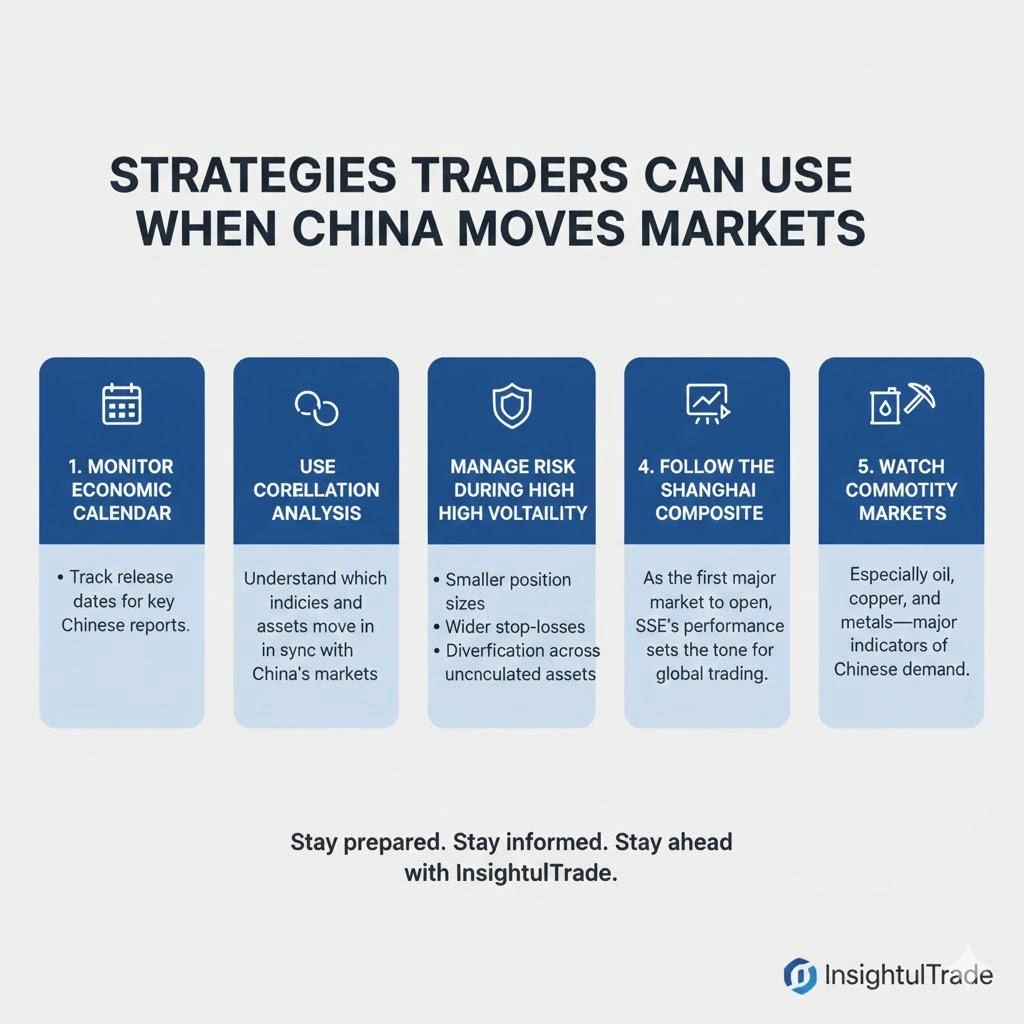
Strategies Traders Can Use When China Moves Markets
1. Monitor Economic Calendar
Traders should track release dates for key Chinese reports.
2. Use Correlation Analysis
Understand which indices and assets move in sync with China’s markets.
3. Manage Risk During High Volatility
- Smaller position sizes
- Wider stop-losses
- Diversification across uncorrelated assets
4. Follow the Shanghai Composite
As the first major market to open each day, SSE’s performance sets the tone for global trading.
5. Watch Commodity Markets
Especially oil, copper, and metals—major indicators of Chinese demand.
Conclusion: China Impact Global Markets
The global financial system has experienced growing involvement from China in its operations. China impact global markets through its influence on stock indices and commodities as well as its effects on currency markets and bond markets.
The Shanghai index movement and new economic data releases enable you as a trader to predict global market trends with better accuracy through their continuous market information updates.
For further information, visit Insightful Trade; they deliver market research and expert commentary, which will help you understand Chinese market influence on worldwide trading markets at both entry and expert levels.
Stay prepared. Stay informed. And stay ahead with InsightfulTrade.
FAQs: China Impact Global Markets
Q1. How does Chinese economic data affect global indices?
It influences global investor sentiment, commodity demand, and the performance of interconnected markets, especially in Asia, Europe, and the US.
Q2. Which Chinese indicators matter most for global markets?
Key indicators include GDP, PMI, industrial production, trade data, CPI, and PPI.
Q3. Why does the Shanghai Index influence other markets?
Because it reflects China’s economic health, commodity sentiment, and market expectations and serves as an early signal for global markets.
Q4. How does weak Chinese data affect commodities?
Lower industrial demand pushes commodity prices down, affecting commodity-heavy markets like Australia, Canada, and Brazil.
Q5. How can traders use Chinese data in strategy?
By tracking economic releases, managing risk management, and monitoring the correlation between China and global stocks.
Author: Kumkum Chandak
Experience: 3+ Years in Trading Research & Market Content Strategy
Kumkum Chandak is a trading content strategist and market research writer who specializes in simplifying technical analysis, trading tools, and strategy-driven educational content. Her work is optimized for EEAT, accuracy, and user intent, ensuring every article delivers practical insights for traders of all levels.
Risk Disclaimer:
All content is strictly educational and not financial advice. Trading involves substantial risk. Always perform your own analysis or consult a professional advisor.
Last Updated: 16 December 2025