Quick Summary
A broker’s handle to handle HFT is the actual way to decide whether your strategy will work in live markets. Often traders assume that strategies are failing when in reality it’s their broker’s execution rules that are getting in the way. HFT is incredibly demanding when it comes to speed, getting orders accepted, and keeping the platform stable. Understanding how your broker handles all this will help you decide if they can keep up with your trading style, especially when the trading rules are so strict in India.
Overview Table
| Factor | Weak Broker HFT Handling | Strong Broker HFT Handling |
| Order Acceptance | Frequent rejections | Consistent acceptance |
| Execution Speed | Inconsistent | Predictable |
| Broker Execution Rules | Opaque | Transparent |
| Slippage Control | Poor | Measured |
| Platform Stability | Degrades under load | Stable under bursts |
| Compliance Readiness | Low | High |
The Core Problem: Why HFT Strategies Break in Live Trading
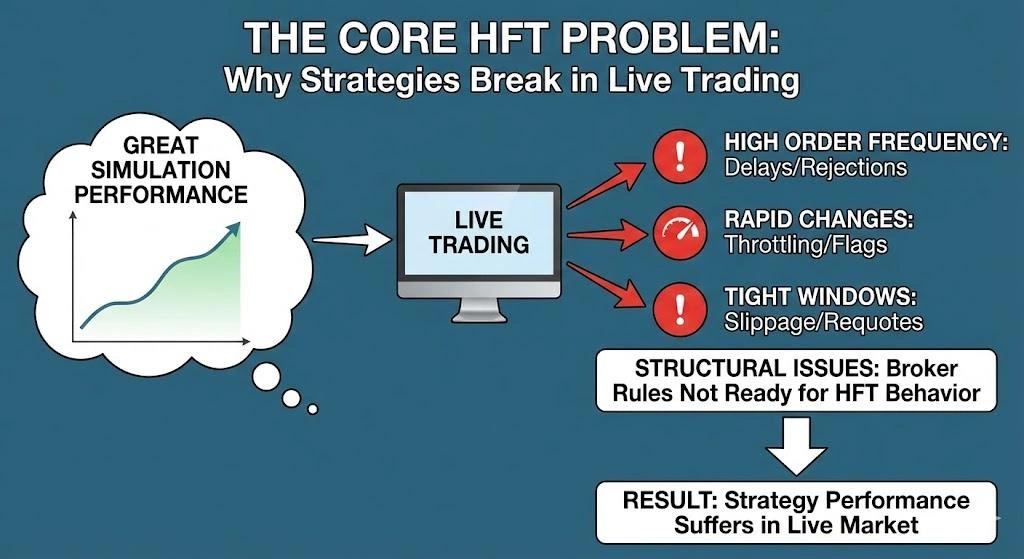
HFT strategies often look great in backtests, but they struggle when you go live. For which traders often blame things like:
- Over-optimizing
- Market randomness
- Shifting volatility
While those are important, what really matters is how they handle HFT.
Why This Is a Structural Problem
HFT strategies generate:
- High-frequency order
- Rapid changes and cancellation
- Tiny entry and exit windows
- Sensitivity to milliseconds
If your broker’s system is not built for this much intensity, then your performance is going to suffer no matter how good your strategy is.
What Is Broker HFT Handling?
Broker HFT handling is simply how a broker’s tech, policies, and rules deal with high-frequency trading. It includes things like
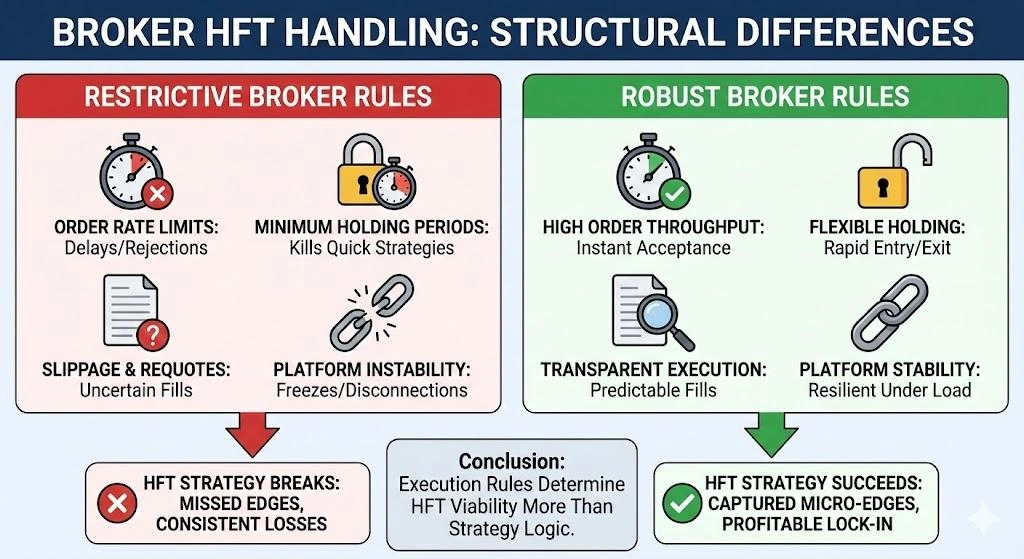
- Order rate limits
- Minimum holding times for each trade
- How they handle price jumps and re-quotes
- How they monitor your trade and whether they slow-down your speed
It’s not about whether they allow HFT, it’s about how the broker actually processes it on a daily basis.
Why Broker Execution Rules Matter More Than Strategy Logic
A strategy is just a nice idea; the execution is what actually makes it possible.
- Slippage: High costs and bad fills will eat your profit margin alive.
- Margin Rules: If you get a forced liquidation, it doesn’t matter how good your strategy was.
- Routing: Lag and poor order handling can completely ruin your timing.
- Compliance: Basic rules like FIFO and hedging restricts your moves.
Think of execution as the floor, if it breaks your whole strategy is going down with it.
Common Broker Execution Rules That Affect HFT
1. Order Rate Limits
Some brokers put a limit to the number of orders that you can place every second.
Why it matters:
The HFT system needs to be able to fire off and cancel orders almost instantly to work properly.
2. Minimum Holding Periods
Some brokers don’t like it when you get in or out of a trade more often, like in a matter of seconds and might restrict it.
Why it matters:
This completely kills the whole point of high frequency strategy.
3. Slippage and Requote Policies
The broker’s rule decides if your order is filled right away or if they have to check back because with you.
Why it matters:
HFT strategies can’t handle any kind of uncertainty when it comes to getting their trades filled.
Broker HFT Handling vs Broker Marketing Claims
Plenty of brokers claim that they are HFT-friendly, but their actual rules often say otherwise.
Things to watch out for:
- The might slow down your orders without telling you
- Hidden risk filters that can block your trades
- An actual person to check your trades after you’ve placed them
You can’t just trust ads, the only way to see how a broker really handles HFT is to read their policy papers and watch their actual performance in a live market.
Platform Stability and Broker HFT Handling
High-frequency trading puts a lot more pressure on platforms than manual trading ever would. If a broker can’t handle it, you will start seeing:
- Platform freezes when things get busy
- There are delays in the broker answering your orders
- You keep getting disconnected when the market sets wild
These problems are from the broker’s side, not an issue with your own internet connection.
Broker HFT Handling in the Indian Context
Indian Market Structure
Indian markets feature:
- A huge number of individual traders
- Everything is done through regulated exchanges
- The government (SEBI) keeps a close eye on everything
This means that how a broker handles your order is closely monitored.
Tools to Evaluate Broker HFT Handling
You can figure out your broker’s rules by looking at:
- Your order execution records
- Reports of how often trades are rejected or slipped
- Using tools to track any lag
- Broker policy documents
Why Some Brokers Discourage HFT
A lot of people think brokers are just out there to get traders, but usually that’s not the case. In reality:
- High-frequency trading puts a massive stress on their tech
- The government and regulators watch them more often
- Managing risk becomes complicated
Basically, brokers with older or weaker tech have to set stricter rules just to keep their own system from crashing and to cover their own backs.
Broker HFT Handling and Risk Management
Good broker HFT handling means:
- It increases the probability of order completion
- You have way more control over slippage
- Your trades stay stable when the market is wild
This doesn’t just help in improving your performance, but also make your overall risk management much more reliable.
Common Trader Mistakes
- Assuming that every broker handles HFT similarly
- Not bothering to check the broker’s execution rules
- Only testing your HFT strategy on a demo account
- Blaming your strategy when the real problem is trades execution
- Forgetting about the legal and compliance side of things
Professional traders treat broker selection as one of the most important decisions.
Institutional Perspective on Broker HFT Handling
Here’s how big players select their brokers based on:
- How consistent their execution is.
- How transparent they are about how orders are handled
- Whether they follow all the necessary rules and regulations
- How tough and reliable their infrastructure is.
This checklist can be really beneficial for you while selecting your own broker.
Conclusion
How a broker handles high-frequency trading is a huge deal, but most people totally miss it. No matter how good your strategy is, it can’t beat a broker with a slow restrictive, or unstable platform or order mismanagement. HFT makes even the smallest flaws stand out, so picking the right broker and knowing their rules is absolutely vital.
By understanding broker HFT handling and evaluating a broker’s rules as carefully as you do your own strategy, you are finally thinking like a pro. Sites like InsightfulTrade focus on this execution-first approach, helping traders understand that their tech and infrastructure are as important as your trading strategies.
FAQs
1. What tools help analyze how a broker handles HFT?
You’ll want to look at execution records and latency trackers. and reports on any rejected orders. It’s also a good idea to read the broker’s policy.
2. Are all brokers suitable for HFT trading?
Definitely not, many brokers have strict rules that can easily hinder or even block high-frequency trading behaviour.
3. Is broker HFT handling relevant for Indian traders?
Absolutely, because of SEBI’s regulations and market surveillance, the way a broker handles your orders is incredibly important.
4. Can poor broker HFT handling be mistaken for strategy failure?
Yes, many times. Many high-frequency strategies fail because of the broker’s execution, not because the strategy itself was wrong.
Author: Kumkum Chandak
Experience: 3+ Years in Trading Research & Market Content Strategy
Kumkum Chandak is a trading content strategist and market research writer who specializes in simplifying technical analysis, trading tools, and strategy-driven educational content. Her work is optimized for EEAT, accuracy, and user intent, ensuring every article delivers practical insights for traders of all levels.
Risk Disclaimer:
All content is strictly educational and not financial advice. Trading involves substantial risk. Always perform your own analysis or consult a professional advisor.
Last Updated: 17 January 2026