
Introduction to Breakout Trading in Forex
The forex market is known for its constant price fluctuations, rapid movements, and periods of intense volatility. While some traders prefer range-bound conditions, others actively seek explosive price movements that can generate significant profit opportunities. One of the most effective ways to capitalize on these market conditions is by implementing a well-defined breakout trading strategy.
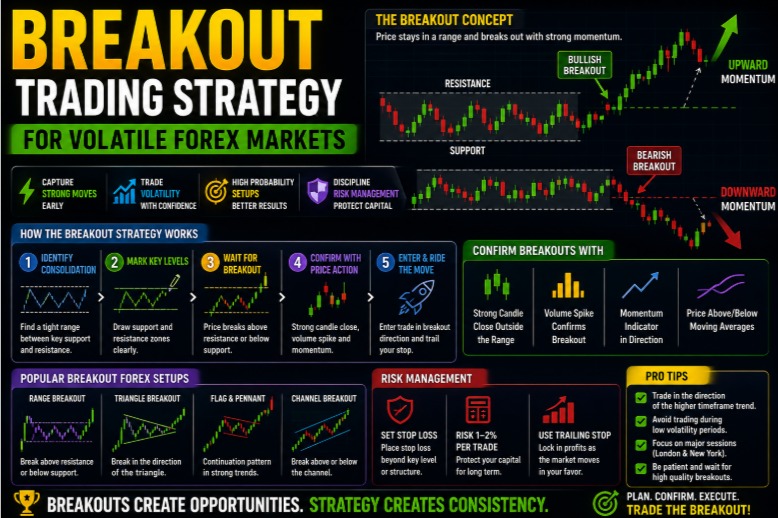
A breakout trading strategy focuses on identifying key price levels and entering trades when the market moves beyond those levels with strong momentum. Breakouts often occur after periods of consolidation when price has been trapped within a specific range. Once price escapes this range, substantial directional movement can follow.
Volatile market conditions provide ideal environments for breakout traders because large price movements can occur in a relatively short period. However, successful breakout trading requires more than simply entering trades when price crosses support or resistance. Traders must understand market structure, volatility, and confirmation techniques to identify high-quality opportunities.
By combining a robust breakout trading strategy with sound price action analysis and proper risk management, traders can significantly improve their ability to profit from dynamic forex markets.
Understanding Breakout Trading in Forex Markets
Before applying a breakout trading strategy, traders must understand what constitutes a breakout.
A breakout occurs when price moves beyond an established support or resistance level with sufficient strength and momentum. These levels often represent areas where buyers and sellers have previously reached equilibrium.
When price breaks above resistance, it may signal the beginning of a bullish trend. Conversely, when price breaks below support, bearish momentum may emerge.
The objective of a breakout trading strategy is to identify these opportunities early and participate in the resulting price expansion. Since volatile forex markets frequently experience sharp movements, breakout setups can provide attractive profit potential.
Effective price action analysis allows traders to determine whether a breakout is genuine or likely to fail. Understanding market context is essential because not all breakouts lead to sustained trends.
Why Volatility Matters in Breakout Trading
Volatility plays a critical role in the success of any breakout trading strategy.
Periods of low volatility often precede major market moves. As volatility contracts, price becomes compressed within narrower ranges. Eventually, this compression ends, and price frequently explodes in one direction.
High volatility creates ideal conditions for volatility breakout setups because stronger price movements often follow periods of consolidation.
Many professional traders actively seek volatility breakout opportunities around major economic announcements, central bank decisions, and significant geopolitical events.
Increased volatility can generate powerful forex setups capable of producing substantial gains. However, higher volatility also increases risk, making disciplined execution and proper risk management essential.
Combining volatility analysis with momentum trading principles enables traders to identify breakout opportunities with greater confidence.
Identifying Key Breakout Levels
A successful breakout trading strategy begins with identifying significant market levels.
Support and resistance zones are among the most important areas to monitor. These levels represent historical price areas where buying or selling pressure has repeatedly influenced market behavior.
Trendlines, chart patterns, and consolidation ranges can also act as potential breakout zones.
Common chart formations used in breakout trading include triangles, rectangles, flags, and channels. These patterns often precede significant directional moves.
Analyzing price action around these levels helps traders determine whether market participants are preparing for a potential breakout.
Strong forex setups frequently develop when price repeatedly tests support or resistance before eventually breaking through.
Accurate identification of these levels forms the foundation of every profitable breakout trading strategy.
Using Price Action for Breakout Confirmation
Relying solely on price crossing a support or resistance level can lead to false signals. Therefore, traders often incorporate price action analysis to confirm breakout strength.
Candlestick formations provide valuable insight into market sentiment. Large bullish or bearish candles closing beyond key levels often indicate genuine breakout momentum.
Similarly, multiple strong candles moving in the breakout direction may suggest increasing participation from institutional traders.
Volume analysis can also strengthen breakout confirmation when available. Higher trading activity frequently accompanies legitimate breakouts.
Many experienced traders wait for candle closes rather than entering immediately when price briefly exceeds a level. This approach reduces exposure to false breakouts and improves the quality of generated forex setups.
Integrating price action confirmation into a breakout trading strategy can substantially improve trading performance.
Volatility Breakout Strategy Explained
The volatility breakout approach is specifically designed to capture powerful market movements following periods of consolidation.
This strategy involves identifying narrow trading ranges where volatility has significantly decreased. Traders then prepare for potential breakouts once price escapes the consolidation zone.
Indicators such as Bollinger Bands or Average True Range can help identify contracting volatility conditions.
As volatility begins expanding, traders monitor breakout levels and wait for confirmation through price action signals.
A properly executed volatility breakout strategy enables traders to participate in emerging trends during their early stages.
Because market momentum often accelerates rapidly following periods of consolidation, volatility breakout systems remain popular among professional forex traders.
Many successful forex setups originate from these compressed market environments.
Momentum Trading and Breakout Strategies
Momentum trading and breakout trading naturally complement one another.
Breakouts accompanied by strong momentum often have a higher probability of success because increased buying or selling pressure supports continued price movement.
In momentum trading, traders seek assets demonstrating strong directional movement. Breakouts frequently represent the beginning of such moves.
Indicators like the Relative Strength Index, MACD, or moving averages can help confirm momentum strength.
For example, if a bullish breakout occurs while momentum indicators show increasing strength, traders may view the setup more favorably.
Combining momentum trading with a comprehensive breakout trading strategy allows traders to filter weak breakouts and focus on higher-probability opportunities.
Strong momentum frequently transforms ordinary breakouts into highly profitable forex setups.
Popular Forex Setups for Breakout Traders
Several well-known forex setups are commonly used by breakout traders.
Triangle breakouts occur when price consolidates within converging trendlines before eventually breaking in one direction.
Rectangle breakouts develop when price remains confined within horizontal support and resistance levels for an extended period.
Flag and pennant formations often emerge during strong trends and typically signal trend continuation following brief consolidations.
These forex setups become particularly effective when combined with momentum trading principles and favorable market conditions.
Successful traders rarely trade every breakout they encounter. Instead, they focus on high-quality forex setups supported by strong price action and favorable volatility conditions.
Selecting quality opportunities remains an essential component of a successful breakout trading strategy.
Managing Risk in Breakout Trading

Even the most effective breakout trading strategy cannot eliminate risk entirely.
False breakouts occur regularly in forex markets, making disciplined risk management essential.
Stop-loss orders should generally be placed beyond the breakout level or recent swing points to limit potential losses.
Position sizing is equally important. Many professional traders risk only a small percentage of their account balance on any individual trade.
Because volatility breakout trades can experience rapid price fluctuations, maintaining appropriate position sizes helps protect trading capital.
Risk management is especially important in momentum trading environments where market conditions can change quickly.
Successful traders understand that preserving capital is just as important as generating profits.
Common Mistakes Traders Make in Breakout Trading
One common mistake traders make is entering positions prematurely before a breakout is confirmed.
Many traders react to temporary price spikes that quickly reverse, resulting in unnecessary losses.
Another frequent error involves ignoring broader market context. Effective price action analysis requires understanding trend direction, market sentiment, and significant economic events.
Overtrading is another major issue. Not every market movement qualifies as a valid volatility breakout opportunity.
Poor risk management also undermines many traders. Even high-quality forex setups can fail unexpectedly.
Finally, traders often ignore momentum confirmation. Incorporating momentum trading principles into a breakout trading strategy can significantly improve consistency.
Avoiding these mistakes helps traders develop a more disciplined and sustainable approach.
Building a Complete Breakout Trading Strategy
Developing a comprehensive breakout trading strategy begins with identifying important support and resistance levels.
Next, traders analyze market conditions and look for consolidation patterns likely to produce volatility breakout opportunities.
Once potential breakout zones are identified, traders monitor price action for confirmation signals such as strong candle closes or increasing momentum.
Additional confirmation can be obtained through momentum trading indicators and broader market analysis.
Only the highest-quality forex setups should be selected for execution.
Finally, disciplined risk management and consistent execution complete the trading process.
Combining these elements creates a robust and repeatable framework capable of performing effectively in volatile forex markets.
Conclusion
A well-designed breakout trading strategy offers traders an effective way to capitalize on explosive market movements in volatile forex conditions.
By understanding volatility breakout principles, incorporating momentum trading concepts, and analyzing price action, traders can identify high-probability opportunities with greater confidence.
Successful breakout traders focus on quality forex setups, maintain disciplined risk management, and avoid emotional decision-making.
Although no strategy guarantees profits, combining patience, preparation, and consistency can significantly improve long-term trading results.
Mastering the breakout trading strategy can provide traders with a powerful framework for navigating volatile forex markets and capturing substantial market moves.