Bollinger Bands may well be the most familiar technical analysis tool to you, should you have spent any time in the technical analysis realm. They are also one of the most identifiable indicators on any trade chart, two outer rings that appear to inhale and exhale around the price and appear to be breathing, as in a living indicator. But the point is here: a majority of traders just touch the tip of the iceberg of what a properly implemented Bollinger Bands strategy can accomplish.
Key takeaway
- The strategy is driven by volatility—The Bollinger Bands strategy is based on volatility expansion and contraction.
- Squeeze Breakout Potential—Squeezing brands will frequently be an omen of a powerful future action.
- Confirmation is key—an effective trading plan of the Bollinger Bands must have volume or indicators.
- Accustom Yourself to the Market Conditions—Simply put, Bollinger Bands work: employ breakouts when trends and mean reversals when ranges.
- Manage Risk—Always employ stop loss and do not chase trades.
What is the Bollinger Band Strategy?
We will squeeze and break out before going into a deep pool, so we will lay a foundation first. But what, then, is the Bollinger Band strategy?
Bollinger Bands is a price chart technique that was devised by John Bollinger during the early 80s and makes use of three lines on a price chart:
- Middle Band—20-period Simple Moving Average (SMA)
- Upper Band – 2 standard deviations + SMA.
- Lower Band – SMA – 2 standard deviations.
The concept on which this bollinger bands trading strategy is founded lies in one of the important statistical concepts: approximately 95 percent of the price action remains within the bands. When the price is beyond them, it is an indication of possible volatility changes or a breakout.
Bollinger Bands Explained: How the Math Actually Works
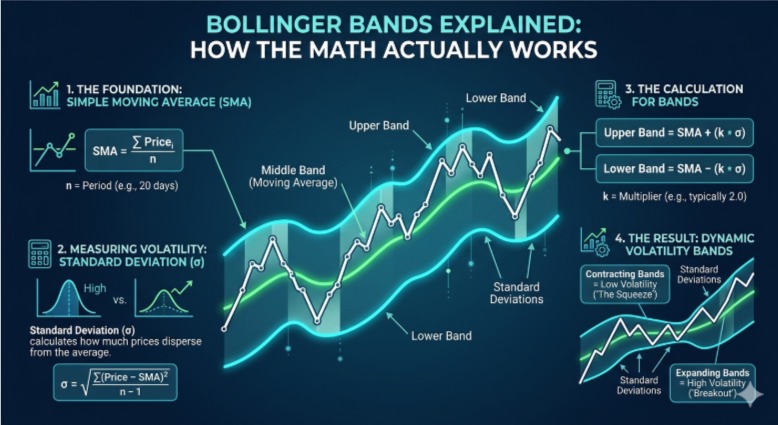
In order to learn about the Bollinger Bands trading strategy, simply consider one of the fundamentals: standard deviation. As the volatility rises, the bands expand, and as the volatility declines, the bands narrow. It is this expansion and contraction process that propels the Bollinger Bands strategy.
John Bollinger has introduced the standard settings (20-period SMA and 2 standard deviations) that are meant to capture the majority of the price action in the markets.
The Bollinger Band Squeeze: Why It Matters
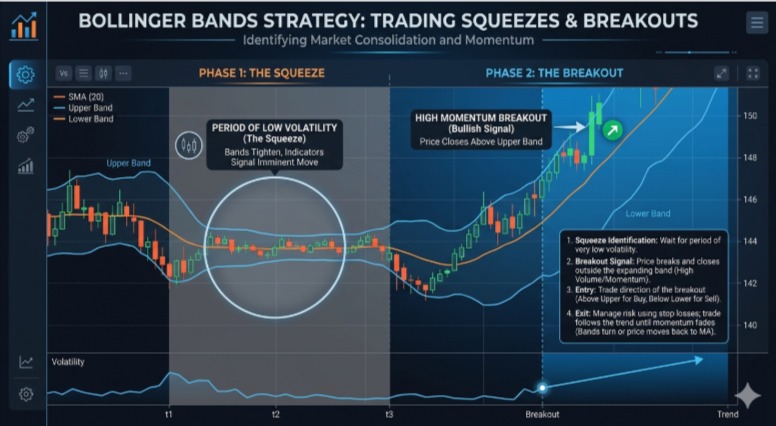
With the Bollinger Bands strategy, a squeeze is a very low volatility and a market that is about to break out. The bands are drawn together, and it is price consolidation and energy building.
The bandwidth indicator, which John Bollinger was the first to introduce, is used to identify this state of affairs, and in many cases, when it is low, powerful moves follow.
In a nutshell, how Bollinger Bands work: when the bands narrow and the price tends to go in a straight line, a breakout will occur—timing and patience are key.
Trading the Breakout: Entry, Confirmation, and Timing
With the Bollinger Bands strategy, discipline is necessary to trade breakouts without false signals.
Step 1: Wait till the candle closes.
Only wait till a complete candle has closed out of the band. When the close is above the upper band, it indicates bullish momentum, and when it is at the lower band, it indicates the strength of the bears.
Step 2: This step involves confirming that the required volume is achieved.
A good breakout tends to be accompanied by an increased volume. When the volume is above the average, then the move is more valid, whereas low-volume breakouts do not work out.
Step 3: Confluence with Indicator.
The Bollinger Bands trading strategy is more effective with other indicators, such as RSI or MACD. An RSI greater than mid-level or a positive MACD change can be a confirmation.
Step 4: Specify Your Stop Loss.
Locate your stop loss anywhere close to the middle band (20 SMA). In the event that the price goes back to this point in a short period of time, then it is probable that the breakout is not valid.
Mean Reversion Strategy: The Other Side of Bollinger Bands
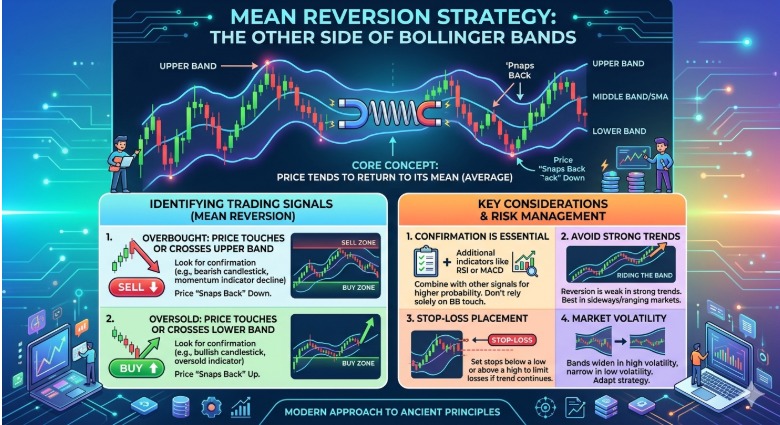
In the Bollinger Bands strategy, mean reversion is applicable in sideways or range-bound markets where the price tends to revert to its average.
Status: Determine type of market.
Mean reversion is best done when the market is not in a trend. This can be measured by the middle band.
Flat Middle Band
Where the central band is either flat or has a slight slope, the setups of means reversion are more stable.
Trending Middle Band
When the middle band is strongly increasing or decreasing, then it is better to use strategies of breakout rather than mean reversion.
Basic Trading Rule
Simply put, how Bollinger Bands work: buy towards the bottom band and aim at the middle band in a sideways market and vice versa at the top band.
Common Mistakes Traders Make With Bollinger Bands
Mistake 1: Relied on Bollinger Bands.
The bands are volatile, rather than directional. With any good bollinger bands trading strategy, there must be confirmation in terms of momentum or other trend indicators.
Mistake 2: Every Band Touch is a Signal.
All touches do not imply reversal. Price may walk the bands over long periods of time in trending markets.
Mistake 3: Not paying attention to timeframe context.
Squeezing less timeframes is not so solid. The longer time period structures tend to give rise to bigger movements.
Mistake 4: Failure to make changes in settings.
Various assets will act in different ways. Markets that are volatile should use broader bands to prevent false signals.
Verified Performance Data: Does the Bollinger Bands Strategy Actually Work?
The Bollinger Bands technique is not simply a hypothesis but is supported by data.
Stock Market Study
According to a 2019 study in the Journal of Financial Markets, the Bollinger Bands trading strategy worked better than buy-and-hold in long-term trading when used with volume filters.
Forex Market Data
Squeeze-breakout constructions on EUR/USD daily charts delivered an average of 12-15 quality trades each year with an average risk-reward of 1:2.
Survey by John Bollinger.
The lowest bandwidth levels were then followed by 5 percent + price changes in 30 days some 73 percent of the time in large-cap stocks.
Conclusion
The Bollinger Bands strategy is much more than an aesthetic tool for visualizing where price lies in relation to the price range it has been. It is a powerful and versatile tool to negotiate nearly any market situation when applied wisely—knowing squeeze, breakout, volume, and mean reversion.
Learn the Bollinger Bands strategy using InsightfulTrade—get the best of the insight and live setups and learn to trade smarter step by step with confidence today.
FAQs
- What is the best Bollinger Bands strategy for beginners?
One basic Bollinger Bands trading strategy is mean reversion: buy at the bottom Bollinger Band and aim at the center in lateral markets.
- What timeframe works best?
Any Bollinger Bands trading strategy is best on the daily chart since it minimizes noise.
- Can Bollinger Bands predict direction?
No. Bollinger bands explained: they indicate volatility, not direction. Use confirmation tools.
- What indicators work best with it?
RSI, volume indicators, and MACD go hand in hand. John Bollinger even suggests bandwidth when it comes to squeezes.
- Is it effective for crypto?
Yes, but with larger settings (2.5-3), as volatility is greater.
Author: Arihant Jain
Trading Experience: 5+ Years
Arihant Jain is a financial markets analyst and trading educator with expertise in Forex, indices, crypto, and risk-managed trading systems. His insights are based on real trading experience, data-driven analysis, and transparent market understanding. All content is reviewed for accuracy and aligns with Google’s EEAT guidelines.
Risk Disclaimer:
Trading involves substantial risk. All information is for educational purposes only and should not be taken as financial advice. Always do your own research.