

Introduction
The confluence trading strategy is one of the most reliable methods used by professional Forex traders to improve the quality of their trade entries. Instead of relying on a single indicator or signal, this strategy combines multiple technical factors that support the same trading decision. When several independent tools point toward the same market direction, traders gain greater confidence in the setup and reduce the chances of taking low-quality trades.
In the Forex market, price movements are influenced by numerous factors, making it risky to depend on one indicator alone. A confluence trading strategy solves this problem by bringing together price action, trend analysis, support and resistance levels, moving averages, Fibonacci retracements, candlestick patterns, momentum indicators, and volume confirmation. When these elements align, traders can identify high-probability opportunities with better risk-to-reward ratios.
The primary goal of this strategy is not to predict every market movement but to trade only when the odds are clearly in your favor. Whether you are a beginner or an experienced trader, understanding how to build a strong confluence trading setup can significantly improve consistency and discipline. This guide explains everything you need to know about using confluence in Forex trading while naturally incorporating concepts like multiple confirmation trading, price action confluence, and high probability trading.
Why Confluence is Important in Forex Trading
Forex markets are highly dynamic and influenced by global economic events, institutional activity, and market sentiment. No single technical indicator can consistently predict price movements. Indicators often generate false signals, especially during periods of high volatility or low liquidity.
Confluence minimizes these false signals by requiring agreement between different trading tools. Instead of reacting to every market fluctuation, traders wait until multiple conditions align before entering a position.
Using confluence also improves trade management. Traders can identify stronger entry points, place stop-loss orders more effectively, and choose realistic profit targets. Since every confirmation strengthens the trading idea, confidence increases while emotional trading decreases.
Professional traders rarely depend on one indicator. They combine market structure, trend direction, price action, and momentum analysis to identify trades with greater accuracy. This is exactly what makes the confluence trading strategy so powerful.
Confluence Trading Setup: Building Strong Trading Opportunities
A successful confluence trading setup involves combining several technical elements that independently support the same trade idea. The more high-quality confirmations present, the stronger the trading opportunity becomes.
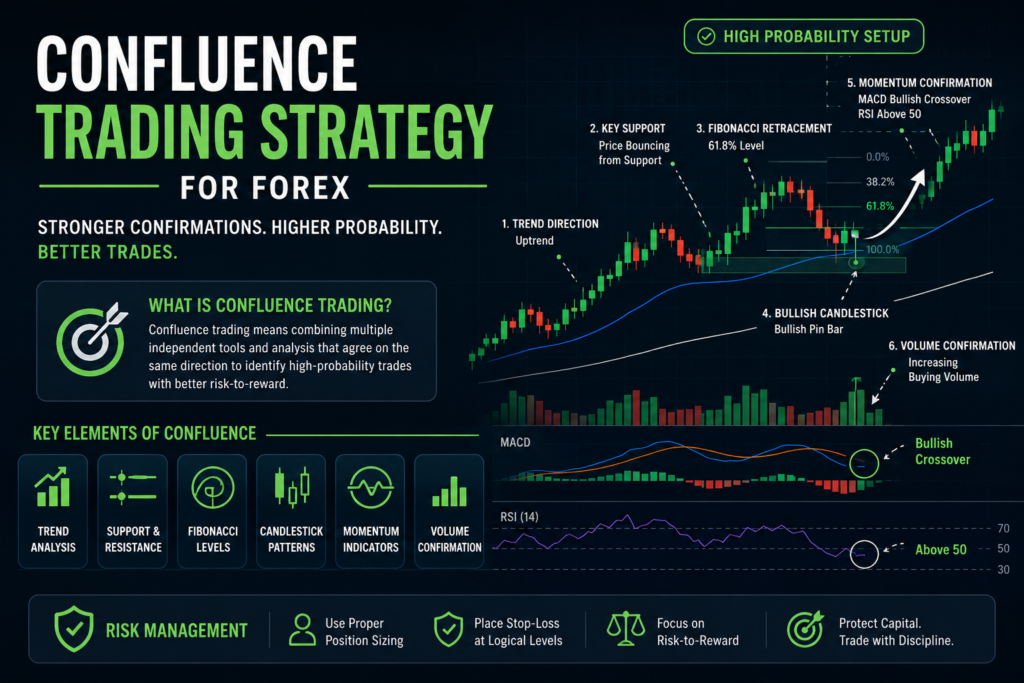
For example, a bullish setup might include price bouncing from a major support level, the overall trend remaining upward, a Fibonacci retracement reaching the 61.8% level, a bullish candlestick formation, and increasing momentum shown by the MACD. These confirmations work together rather than individually.
Similarly, a bearish confluence setup could involve resistance rejection, a downward trend, bearish engulfing candles, declining momentum, and RSI divergence. When these signals appear simultaneously, traders have stronger evidence supporting the trade.
The key is selecting confirmations that complement one another instead of using several indicators that measure the same thing. This creates a balanced trading system capable of adapting to different market conditions.
Multiple Confirmation Trading: Increasing Trading Confidence
Multiple confirmation trading is the foundation of every successful confluence strategy. It requires traders to seek confirmation from various market perspectives before opening a position. Instead of relying solely on moving averages or oscillators, traders combine trend analysis, price action, support and resistance, momentum indicators, and candlestick patterns.
Each confirmation serves as additional evidence supporting the trade. For instance, a trader may first identify an overall bullish trend using moving averages. Next, price retraces toward a key support level. A bullish pin bar then forms, while RSI shows oversold conditions. Finally, increasing volume confirms buying pressure. Together, these factors create a much stronger trading opportunity than any single indicator could provide.
Multiple confirmation trading also improves emotional discipline. Traders become more selective, avoiding impulsive trades based on incomplete information. Over time, this leads to greater consistency and reduced losses caused by false breakouts or market noise.
Price Action Confluence: Reading the Market Naturally
Price action confluence focuses on combining raw price movements with important technical levels instead of relying entirely on indicators. Many professional traders prefer price action because it reflects actual buying and selling behavior without lag.
For example, suppose price reaches a long-term support zone. If a bullish engulfing candle forms while rejecting that level and the overall trend remains bullish, traders have multiple layers of confirmation through price action alone.
Pin bars, inside bars, engulfing candles, and rejection wicks become much more meaningful when they appear at key support or resistance levels. These patterns reveal shifts in market sentiment and often indicate institutional buying or selling activity.
Price action confluence encourages traders to understand the market rather than simply following indicator signals. This deeper understanding often leads to better timing and more confident trade execution.
Risk Management in Confluence Trading
Even the strongest confluence setup can fail due to unexpected market events. Therefore, proper risk management remains essential.
Risk only a small percentage of your account on each trade, typically between one and two percent. Never increase position size simply because multiple confirmations exist. Strong setups improve probability but never eliminate risk.
Use logical stop-loss placement, avoid emotional trading, and maintain consistency across all trades. A trading journal can help identify which combinations of confirmations perform best over time.
Effective risk management allows traders to survive losing streaks while maximizing gains during favorable market conditions.
Common Mistakes to Avoid
Many traders overcrowd their charts with indicators that provide similar information. This creates confusion rather than stronger confirmation.
Another common mistake is forcing trades by convincing yourself that weak signals represent confluence. Genuine confluence occurs naturally when independent tools align without manipulation.
Ignoring higher timeframe trends is another error. Lower timeframe signals become more reliable when they agree with the broader market direction.
Finally, avoid entering trades before all confirmations appear. Patience remains one of the most valuable skills in successful confluence trading.
High Probability Trading Through Confluence
The main objective of high probability trading is to identify setups where multiple independent factors increase the likelihood of success. No strategy guarantees winning trades, but confluence significantly improves the statistical odds.
High-probability trades usually occur when market structure, trend direction, support or resistance, price action, and momentum all align. Traders focus on these premium opportunities instead of attempting to trade every market movement.
For example, entering a buy trade after a bullish trend resumes at a Fibonacci retracement level, supported by bullish candlesticks and increasing momentum, offers much higher probability than buying randomly during market consolidation.
Patience is essential. Waiting for strong confluence reduces unnecessary trades and helps maintain consistent long-term performance.
Limitations of the Confluence Trading Strategy
Despite its advantages, confluence trading has limitations. Strong setups occur less frequently, requiring patience. Waiting for several confirmations may sometimes result in slightly later entries compared to aggressive strategies.
Additionally, interpreting confluence involves experience and practice. Beginners may initially struggle to determine which confirmations carry the greatest importance. However, with consistent chart analysis and journaling, these skills improve significantly.
Best Tips for Mastering Confluence Trading
Successful traders always begin with the higher timeframe trend before analyzing lower timeframes. Focus on combining complementary tools rather than using many similar indicators.
Maintain a trading journal to evaluate which confluence combinations consistently produce positive results. Practice identifying price action at major support and resistance zones, and always prioritize risk management over profit potential.
Most importantly, remain patient. High-quality confluence setups are worth waiting for because they typically offer better probabilities than frequent low-quality trades.
Conclusion
The confluence trading strategy is one of the most effective approaches for improving consistency and confidence in Forex trading. By combining multiple technical factors instead of relying on a single indicator, traders can identify stronger market opportunities with greater accuracy. Whether you use confluence trading setup techniques, apply multiple confirmation trading, focus on price action confluence, or aim for high probability trading, the underlying principle remains the same: wait for independent signals to align before entering a trade.
Although no strategy can eliminate losses, combining trend analysis, support and resistance, candlestick patterns, Fibonacci levels, moving averages, and momentum indicators helps filter out weaker setups and improve long-term performance. With patience, disciplined execution, and sound risk management, a confluence trading strategy can become a valuable part of a professional Forex trading plan.