Introduction
Global trade tensions have become one of the most influential factors affecting the foreign exchange market in recent years. Whenever major economies introduce tariffs, impose sanctions, or engage in trade disputes, investors quickly adjust their positions, leading to significant movements in currency prices. For forex traders, understanding trade tensions forex dynamics is essential because these events often create both risks and profitable trading opportunities. Countries involved in trade conflicts experience changes in exports, imports, inflation, and economic growth, all of which influence their currencies. Whether it is the ongoing competition between major global economies or unexpected tariff announcements, trade tensions can trigger sudden volatility that reshapes market sentiment.
Traders who understand the relationship between political decisions and currency movements are better equipped to manage risk and identify trading opportunities. By combining economic fundamentals, technical analysis, and disciplined risk management, forex traders can navigate uncertain market conditions more effectively. This guide explains how trade tensions affect the forex market, explores the role of tariffs, examines currency volatility, discusses geopolitical developments, and provides practical market analysis techniques to help traders succeed during periods of global economic uncertainty.
Tariffs Impact on Trade Tensions Forex
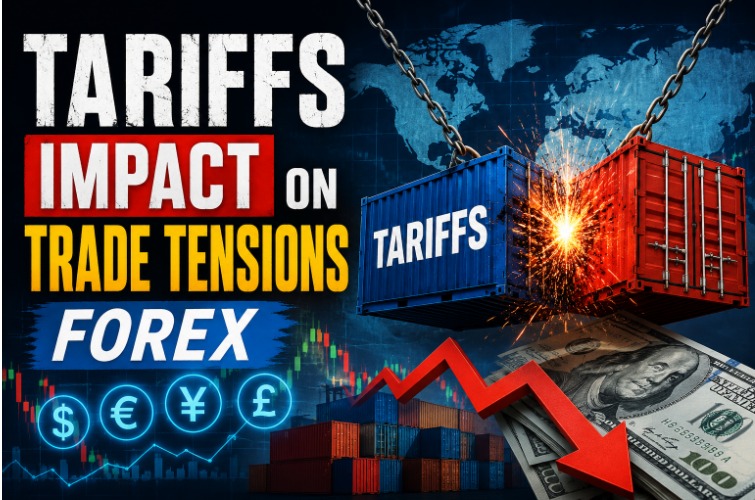
One of the strongest drivers of trade tensions forex movements is the tariffs impact on national economies. Tariffs increase the cost of imported goods, making foreign products more expensive for consumers and businesses. Governments usually introduce tariffs to protect domestic industries or reduce trade deficits, but these policies often produce wider economic consequences.
When tariffs are imposed, businesses that depend on imported materials experience rising production costs. These higher costs frequently lead to inflation, reduced corporate profits, slower investment, and weaker economic growth. Currency markets quickly adjust expectations based on these changing economic conditions.
Tariffs also affect central bank policy. If economic growth slows due to trade restrictions, central banks may lower interest rates to stimulate economic activity. Lower interest rates generally reduce foreign investment flows, placing additional downward pressure on the domestic currency.However, tariff announcements do not always weaken currencies. In some situations, investors believe tariffs will improve domestic manufacturing and reduce trade deficits over the long term. Market expectations therefore play a greater role than the tariffs themselves
Forex traders closely monitor scheduled trade negotiations, tariff implementation dates, political speeches, and international economic agreements because markets often experience sharp movements before and after these events. Understanding how tariffs influence inflation, employment, exports, and monetary policy provides valuable insight into future currency trends.
Currency Volatility During Trade Disputes

One of the defining characteristics of trade tensions in forex environments is increased currency volatility. Financial markets dislike uncertainty, and trade conflicts create uncertainty across nearly every sector of the global economy. As expectations constantly change, exchange rates experience larger daily price swings than during normal market conditions.
Volatility increases because traders rapidly adjust positions following each new headline. A single announcement regarding trade negotiations can completely reverse market sentiment within minutes. Positive developments may trigger strong rallies in risk-sensitive currencies, while disappointing news often causes sharp declines.Currencies closely linked to global trade generally experience the highest volatility. Commodity-exporting countries may see significant exchange rate fluctuations if tariffs reduce global demand for raw materials. Manufacturing economies dependent on exports also become vulnerable when trade restrictions limit international commerce.
Many traders use volatility indicators such as the Average True Range (ATR) or Bollinger Bands to adjust trading strategies during periods of elevated market uncertainty. Wider stop-loss levels, smaller position sizes, and reduced leverage often help protect trading capital when volatility increases.Instead of fearing volatility, successful forex traders adapt their strategies to changing market conditions while maintaining disciplined risk management practices.
Geopolitical Events and Their Influence on Trade Tensions Forex
Trade disputes rarely exist in isolation. Most trade tensions and forex movements are closely connected with broader geopolitical events including diplomatic conflicts, military tensions, international sanctions, political elections, and global economic alliances.
Political uncertainty influences investor confidence because international relations directly affect future trade agreements and economic cooperation. When diplomatic relations deteriorate between major economies, investors often expect reduced international trade, slower economic growth, and weaker business investment.
Monitoring geopolitical developments has become just as important as analyzing economic indicators. Successful forex traders combine political awareness with technical analysis to anticipate how international developments may influence currency trends over both the short and long term.
Market Analysis for Trading During Global Trade Tensions
Effective market analysis is essential for navigating periods of heightened trade uncertainty. Forex traders cannot rely solely on technical charts because political announcements frequently override traditional price patterns. Combining multiple forms of analysis produces more reliable trading decisions.
Fundamental analysis begins with evaluating the economic consequences of trade policies. Traders monitor GDP growth forecasts, manufacturing activity, inflation rates, unemployment figures, trade balances, and central bank statements. These indicators help determine whether trade tensions are strengthening or weakening an economy
Technical analysis remains valuable for identifying entry and exit points even when markets are driven by news. Support and resistance levels, moving averages, trendlines, Fibonacci retracements, RSI, MACD, and price action patterns help traders identify high-probability setups after major announcements.
Sentiment analysis has become increasingly important during global trade disputes. Financial markets often react more strongly to expectations than actual policy changes. Monitoring investor positioning, market forecasts, volatility indexes, and institutional sentiment provides valuable insight into potential future price direction.
Intermarket analysis also improves forecasting accuracy. Stock indices, government bond yields, commodity prices, and precious metals often provide early warning signals before significant currency movements occur. For example, declining equity markets combined with rising gold prices frequently indicate increasing investor caution.
Successful traders continuously compare multiple sources of information instead of relying on individual indicators. A balanced combination of technical, fundamental, and sentiment analysis creates a more comprehensive understanding of market conditions during trade conflicts.
Risk Management During Trade Tensions
Trading during periods of international uncertainty requires stronger risk management than normal market environments. Large price swings can generate significant profits but also increase the possibility of rapid losses. Reducing position size is often the first adjustment professional traders make when volatility rises. Smaller positions help limit financial exposure while allowing traders to participate in major market opportunities.
Stop-loss orders should reflect current market volatility rather than fixed distances. Wider stops combined with smaller position sizes often provide greater protection against temporary price fluctuations. Avoiding excessive leverage is equally important. High leverage magnifies both gains and losses, making accounts vulnerable during sudden news-driven market movements. Conservative leverage allows traders to survive unpredictable price swings.
Diversification across multiple currency pairs can also reduce overall portfolio risk. Instead of concentrating capital in one trade, experienced traders spread exposure across different currencies while avoiding highly correlated positions. Maintaining emotional discipline is another essential component of risk management. Unexpected headlines often create fear and greed, encouraging impulsive trading decisions. Following a predefined trading plan helps eliminate emotional reactions during volatile conditions.
Trading Strategies for Global Trade Tensions
Different trading strategies perform well depending on market conditions created by trade disputes. Trend-following strategies work effectively when tariffs or political developments establish long-term economic expectations. Strong trends often develop as investors gradually adjust portfolios based on changing economic forecasts.
Breakout strategies are popular immediately following major trade announcements. Important news frequently pushes prices beyond established support or resistance levels, creating momentum trading opportunities.
Swing trading allows traders to capture medium-term movements resulting from ongoing negotiations or evolving political developments. Since trade disputes often unfold over weeks or months, swing traders benefit from sustained market trends.
News trading focuses directly on scheduled announcements involving tariffs, trade negotiations, economic reports, or government statements. While potentially profitable, this approach requires fast execution, disciplined risk management, and awareness of widening spreads during volatile periods.
Position traders may hold trades for several months if trade tensions significantly alter long-term economic fundamentals. This strategy relies heavily on macroeconomic analysis rather than short-term price fluctuations.
Choosing the appropriate strategy depends on individual experience, risk tolerance, available trading time, and prevailing market conditions.
Conclusion
Global trade disputes continue to shape financial markets, making trade tensions forex knowledge increasingly valuable for modern currency traders. Tariff announcements, changing international relationships, economic sanctions, and political negotiations all influence exchange rates by affecting investor confidence and economic expectations. Understanding the tariffs impact, monitoring currency volatility, evaluating geopolitical events, and performing detailed market analysis allow traders to make more informed decisions during uncertain periods. While global trade tensions create substantial market volatility, they also present profitable opportunities for disciplined traders who combine sound analysis with effective risk management. Success depends on staying informed, adapting strategies to changing market conditions, controlling emotional decision-making, and maintaining consistent trading discipline. As international trade policies continue evolving, traders who understand the complex relationship between politics, economics, and currency markets will be better prepared to identify opportunities while protecting their trading capital in an increasingly interconnected global financial system.