Introduction
Success in the foreign exchange market is often portrayed as the result of finding the perfect trading strategy, indicator, or algorithm. While technical analysis, fundamental analysis, and market knowledge certainly matter, experienced traders understand that long-term profitability depends far more on the way they think and react than on the tools they use. This is where winning forex psychology becomes the defining factor between consistent traders and those who repeatedly struggle. Every trade involves uncertainty, and no strategy can eliminate losses entirely.
However, traders who master their emotions, maintain discipline, and follow a structured risk management plan are far more likely to achieve sustainable success. The psychology behind successful forex trading is built on patience, confidence, emotional stability, and the ability to make rational decisions regardless of market conditions. Instead of chasing profits or fearing losses, winning traders focus on executing their trading plans with consistency. Understanding how emotions influence decisions allows traders to avoid common mistakes like revenge trading, overtrading, and abandoning proven strategies after a few losses. Developing the right psychological habits takes time, but once mastered, they become a competitive advantage that separates professionals from beginners.
Understanding Winning Forex Psychology
The foundation of winning forex psychology lies in understanding that trading is a probability-based business rather than a prediction game. Every trade has an uncertain outcome, regardless of how strong the setup appears. Winning traders accept this uncertainty instead of trying to control every market movement. They understand that losses are simply part of the business and not a reflection of their intelligence or trading ability
Many beginners believe successful traders rarely lose, but the reality is quite different. Professional traders often experience multiple losing trades in a row while remaining profitable because they consistently follow their trading plans. Their confidence comes from trusting their edge over hundreds of trades rather than expecting each individual trade to be successful.
Winning psychology also requires traders to detach emotionally from money. Instead of focusing on the profit or loss of a single trade, experienced traders concentrate on executing high-quality setups according to predefined rules. This mindset reduces emotional pressure and allows objective decision-making even during periods of high market volatility.
Emotional Control: The Core of Trading Success
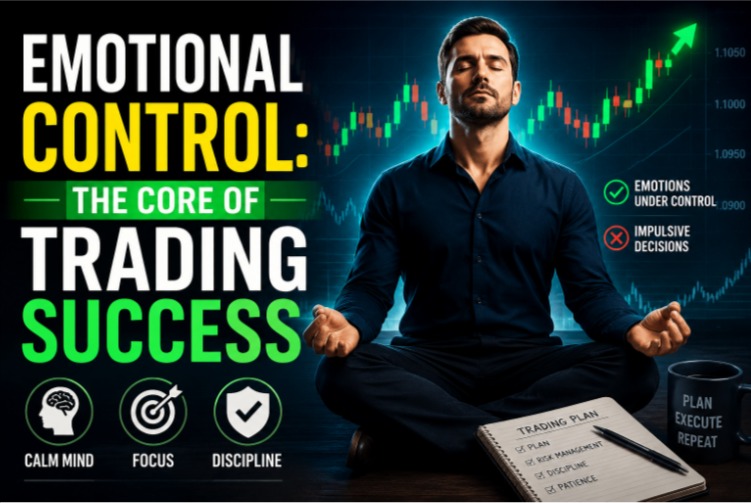
One of the most critical elements of successful trading is emotional control. Financial markets constantly trigger emotions because every price movement directly affects a trader’s account balance. Fear, greed, excitement, frustration, hope, and regret all influence trading decisions if they are not properly managed.
Fear often prevents traders from entering valid setups because they worry about losing money. They hesitate until the opportunity disappears or enter late after the majority of the move has already occurred. On the other hand, greed encourages traders to ignore profit targets, increase position sizes excessively, or enter low-quality trades simply because they want to make more money quickly.
Emotional control also means remaining calm during winning streaks. Confidence is healthy, but overconfidence often leads traders to increase risk unnecessarily, believing they cannot lose. Professionals avoid this trap by maintaining the same disciplined approach regardless of recent performance.
Developing emotional stability requires self-awareness. Many traders maintain journals that record not only market analysis but also their emotional state before, during, and after each trade. Over time, patterns emerge that reveal emotional weaknesses requiring improvement.
Trading Discipline Builds Long-Term Consistency
Among all psychological characteristics, trading discipline is perhaps the strongest predictor of consistent profitability. Discipline means following your trading plan regardless of emotions, opinions, or recent market outcomes. It requires executing trades exactly as planned without making impulsive adjustments based on temporary market noise.
Many traders spend months developing profitable strategies but abandon them after experiencing only a few losses. This lack of discipline prevents them from allowing their statistical edge to work over a large sample of trades. Winning traders understand that consistency in execution is more important than constantly changing strategies.
Trading discipline also includes following a structured daily routine. Professional traders prepare before market sessions by reviewing economic calendars, identifying important support and resistance levels, and planning potential trading opportunities. During trading hours, they patiently wait for high-probability setups instead of forcing trades out of boredom.
Risk Management Protects Both Capital and Confidence
No discussion of risk management would be complete without recognizing its psychological importance. While risk management is commonly viewed as a mathematical concept involving position sizing and stop-loss placement, it also plays a vital role in maintaining emotional stability.
Traders who risk excessive amounts on each trade experience heightened emotional reactions because every market fluctuation significantly affects their account balance. Large position sizes increase fear, encourage impulsive decisions, and often cause traders to abandon their trading plans.
Winning traders typically risk only a small percentage of their trading capital on each position. By keeping individual losses manageable, they reduce emotional pressure and allow themselves to think objectively. Small losses become routine business expenses rather than emotionally devastating events.
Proper risk management also protects confidence during inevitable losing streaks. Since no strategy wins all the time, every trader experiences periods of consecutive losses. Those who manage risk effectively survive these periods with their accounts and confidence largely intact, enabling them to continue executing their strategies consistently.
Diversification of opportunities, maintaining favorable risk-to-reward ratios, and limiting daily or weekly losses further strengthen psychological stability. These practices help traders remain calm because they know no single trade can significantly damage their trading career.
Overcoming Fear and Greed
Fear and greed remain the two most destructive emotions in forex trading. Fear often appears after several consecutive losses, causing traders to hesitate or avoid valid trading opportunities. Greed emerges after profitable trades, encouraging excessive risk-taking and unrealistic expectations.
Winning traders overcome fear by trusting their tested strategies. They understand that individual outcomes are unpredictable but that consistent execution produces positive long-term results. Confidence grows through repetition, preparation, and experience rather than wishful thinking.
Greed is controlled through predefined trading rules. Profit targets, position sizes, and maximum daily risk limits prevent emotions from influencing decisions. Successful traders recognize that protecting existing profits is often more valuable than pursuing unrealistic gains.
Accepting that no one captures every market move also helps reduce greed. Markets offer endless opportunities, making it unnecessary to chase every price movement. Missing one trade simply creates space for the next high-quality opportunity .
Developing the Right Trader Mindset

The trader mindset determines how individuals interpret both success and failure. Winning traders view every trade as one event within a much larger statistical process rather than as a personal achievement or failure.
Patience is another defining characteristic of a strong trader mindset. Markets provide opportunities every day, yet profitable setups remain relatively rare. Winning traders understand that waiting for ideal conditions is often the most profitable decision. They avoid overtrading because they recognize that activity does not necessarily generate profits.
Adaptability also plays a significant role. Financial markets constantly evolve due to changing economic conditions, geopolitical developments, and shifts in market sentiment. Successful traders remain flexible while maintaining the core principles of their trading strategies. They adjust to changing volatility without abandoning disciplined decision-making.
Self-confidence within a healthy trader mindset comes from preparation rather than hope. Traders who thoroughly test their strategies, maintain detailed journals, and review their performance develop confidence based on evidence rather than emotion
Accepting Losses as Part of the Process
One of the defining characteristics of winning forex psychology is accepting losses without emotional attachment. Many beginners interpret losing trades as personal failures, leading to frustration, revenge trading, or abandoning profitable strategies.
Professional traders understand that losses are inevitable regardless of experience or strategy quality. Their focus remains on whether they executed the trade according to plan rather than whether the trade generated profit.
This distinction transforms the learning process. A losing trade executed perfectly is considered successful because it demonstrates disciplined execution. Conversely, a profitable trade resulting from poor decision-making is viewed as dangerous because it reinforces bad habits.
Acceptance reduces emotional exhaustion. Instead of fighting market uncertainty, winning traders embrace it and concentrate on maintaining consistency across hundreds of trades.
Conclusion
Mastering winning forex psychology is one of the most valuable investments any trader can make. While technical indicators, economic analysis, and trading strategies provide essential market knowledge, psychological strength determines whether those tools are used effectively. Developing strong emotional control, maintaining unwavering trading discipline, practicing consistent risk management, and cultivating a resilient trader mindset allow traders to navigate uncertainty with confidence and professionalism. Successful forex trading is not about eliminating losses or predicting every market movement. Instead, it is about making rational decisions repeatedly while managing emotions under pressure. Every profitable trader has experienced setbacks, losing streaks, and moments of doubt, but their psychological resilience enabled them to continue improving. By focusing on disciplined execution, realistic expectations, continuous learning, and emotional balance, traders can build the mental foundation necessary for lasting success. In the long run, psychology is not just another part of forex trading, it is the factor that determines whether knowledge becomes consistent profitability.