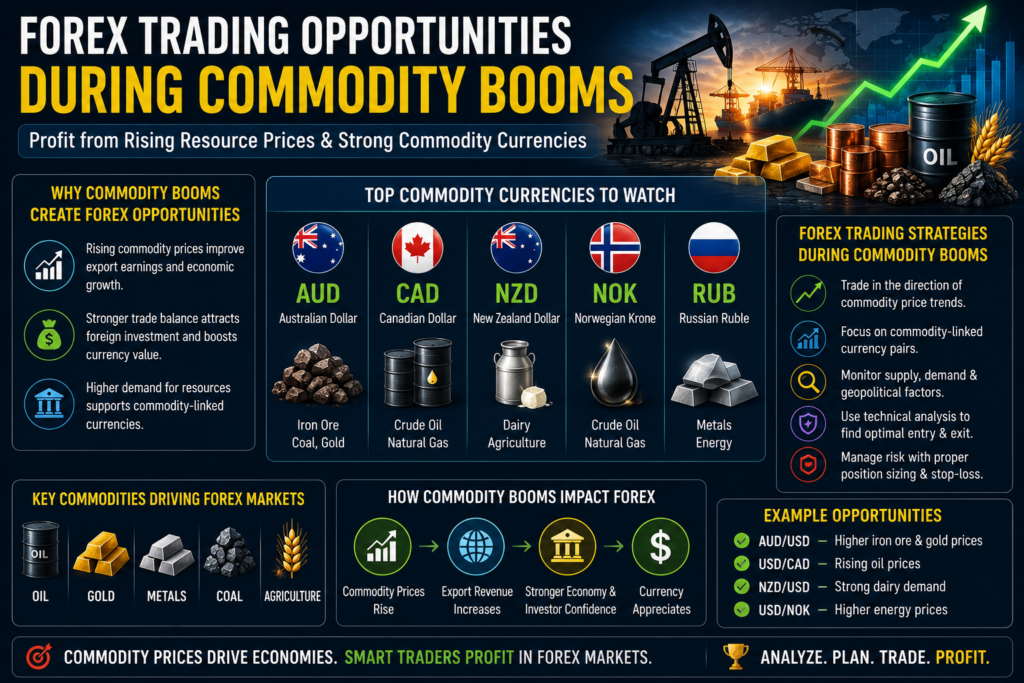
 Commodity booms have historically created some of the most profitable opportunities in global financial markets. When demand for natural resources such as oil, gold, copper, natural gas, and agricultural products increases, commodity-exporting economies often experience stronger economic growth, improved trade balances, and appreciating currencies. For forex traders, understanding these relationships can provide valuable insights into market trends and potential trading opportunities.
A successful commodity boom forex strategy requires understanding the behavior of commodity currencies, implementing an effective AUD trading strategy, conducting detailed CAD forex analysis, recognizing opportunities in global demand trading, and adapting to changing macroeconomic conditions.
This comprehensive guide explains how commodity booms influence forex markets, why certain currencies outperform during resource-driven growth periods, and how traders can position themselves to benefit from these market cycles.
Understanding Commodity Booms and Forex Markets
A commodity boom occurs when prices of key natural resources rise significantly due to increased global demand, limited supply, or a combination of both factors.
These periods often coincide with strong economic growth, infrastructure development, industrial expansion, and increased consumer demand worldwide.
The connection between commodity markets and currencies forms the foundation of successful commodity boom forex trading.
When resource prices increase, commodity-exporting countries often receive higher export revenues. These inflows can strengthen national currencies and improve economic performance.
Understanding the relationship between commodities and exchange rates is essential for traders seeking opportunities during commodity booms.
The influence of commodity boom forex trends can extend across global currency markets for months or even years.
Why Commodity Currencies Matter
Some currencies are particularly sensitive to changes in commodity prices.
These currencies are commonly referred to as commodity currencies because their economies depend heavily on resource exports.
Examples include:
Australian Dollar (AUD)
Canadian Dollar (CAD)
New Zealand Dollar (NZD)
Norwegian Krone (NOK)
During commodity booms, commodity currencies often outperform other currencies due to increased export earnings and stronger economic growth.
Forex traders frequently monitor commodity currencies because they provide direct exposure to global commodity market trends.
Understanding the behavior of commodity currencies can significantly improve trading decisions during periods of rising resource prices.
Commodity Boom Forex and Economic Growth
One of the most important aspects of commodity boom forex trading is understanding how rising commodity prices affect economic growth.
Higher export revenues often support employment, government spending, and business investment.
These developments can strengthen economic fundamentals and attract foreign capital.
As a result, commodity currencies frequently appreciate during sustained commodity booms.
The relationship between resource prices and currency values makes commodity boom forex analysis particularly valuable for macroeconomic traders.
Monitoring economic indicators alongside commodity markets can provide a clearer understanding of potential currency movements.
AUD Trading Strategy During Commodity Booms
The Australian Dollar is one of the most widely traded commodity currencies.
Australia is a major exporter of iron ore, coal, gold, and other natural resources.
As global demand for commodities increases, the Australian economy often benefits significantly.
A successful AUD trading strategy involves monitoring:
Iron ore prices
Chinese economic growth
Global industrial demand
Australian employment data
Reserve Bank of Australia policy
These factors play a critical role in shaping the performance of the Australian Dollar.
Many professional traders use an AUD trading strategy to capitalize on commodity-driven market trends.
Understanding global demand conditions improves the effectiveness of any AUD trading strategy.
Why China Matters for AUD Trading Strategy
China is Australia’s largest trading partner and one of the world’s largest consumers of raw materials.
As a result, Chinese economic growth has a significant influence on the Australian Dollar.
An effective AUD trading strategy often includes monitoring Chinese manufacturing activity, infrastructure investment, and economic policy decisions.
Strong Chinese demand typically supports Australian exports and strengthens the currency.
This relationship makes the Australian Dollar one of the most responsive commodity currencies in the forex market.
Traders who incorporate Chinese economic data into their AUD trading strategy often gain a valuable competitive advantage.
CAD Forex Analysis During Resource Booms
The Canadian Dollar is another major beneficiary of rising commodity prices.
Canada is one of the world’s largest exporters of crude oil, natural gas, and other natural resources.
Effective CAD forex analysis requires understanding the relationship between energy markets and the Canadian economy.
Oil prices are particularly important because energy exports represent a substantial portion of Canada’s export revenue.
When oil prices rise, the Canadian Dollar often strengthens.
Professional traders frequently conduct detailed CAD forex analysis to identify opportunities linked to commodity market trends.
Key Factors in CAD Forex Analysis
A successful CAD forex analysis framework includes evaluating several critical variables.
These include:
Crude oil prices
Bank of Canada policy
Employment reports
Inflation data
U.S. economic performance
Trade balances
Because Canada maintains close economic ties with the United States, CAD forex analysis often incorporates both domestic and international economic developments.
Understanding these factors can improve forecasting accuracy and trade selection.
Many traders use CAD forex analysis to identify long-term opportunities during commodity booms.
Global Demand Trading and Commodity Markets
The concept of global demand trading is central to understanding commodity booms.
Commodity prices often rise when global economic growth accelerates.
Increased industrial activity, infrastructure spending, and consumer demand create higher demand for raw materials.
Successful global demand trading involves identifying regions and sectors driving commodity consumption.
China, India, Southeast Asia, and emerging markets frequently play important roles in shaping commodity demand.
Understanding these trends can improve commodity boom forex strategies and help traders anticipate future currency movements.
Commodity Currencies and Trade Balances
Trade balances play a major role in determining currency strength.
During commodity booms, higher export revenues often improve trade balances in resource-producing countries.
This development can strengthen commodity currencies and attract foreign investment.
Countries with large commodity exports frequently experience increased demand for their currencies when resource prices rise.
Understanding these relationships is essential for successful global demand trading and long-term forex analysis.
Trade balance data often provides valuable clues regarding future currency performance.
Risk Management During Commodity Boom Forex Trading
Although commodity booms create opportunities, they also introduce risks.
Commodity prices can be highly volatile and sensitive to economic conditions, geopolitical developments, and supply disruptions.
Effective commodity boom forex trading requires disciplined risk management.
Traders should monitor:
Position size
Leverage levels
Commodity price trends
Economic releases
Central bank policies
Strong risk management helps traders navigate uncertainty while preserving capital.
Even the best AUD trading strategy or CAD forex analysis can produce losses if risk controls are neglected.
Global Demand Trading and Emerging Markets

Emerging markets often play a significant role in commodity cycles.
Rapid industrialization and urbanization increase demand for energy, metals, and agricultural products.
This creates opportunities for global demand trading and influences the performance of commodity currencies.
Traders who monitor emerging market growth trends can gain valuable insights into future commodity demand.
Understanding these long-term developments enhances both AUD trading strategy and CAD forex analysis approaches.
Additional High-Volume Related Keywords
In addition to the primary keywords, traders frequently search for:
Commodity currency trading
Oil price forex strategy
Australian dollar forecast
Canadian dollar analysis
Resource market trading
Commodity cycle investing
Forex macro trading
Energy market forex
Mining sector currencies
Global growth trading
These related keywords complement commodity boom forex, AUD trading strategy, CAD forex analysis, commodity currencies, and global demand trading while helping traders build a broader understanding of commodity-driven market opportunities.
Common Mistakes Traders Make During Commodity Booms
Many traders focus exclusively on commodity prices without considering broader economic conditions.
Ignoring trade balances can reduce the effectiveness of CAD forex analysis.
Some traders implement an AUD trading strategy without monitoring Chinese economic data.
Others underestimate the importance of global demand trading and fail to recognize shifts in economic growth trends.
Successful traders combine commodity analysis, macroeconomic research, and disciplined risk management.
A comprehensive approach often produces more consistent results.
Conclusion
Commodity booms create powerful opportunities in the forex market by influencing economic growth, trade balances, and investor sentiment. Understanding commodity boom forex dynamics, developing an effective AUD trading strategy, conducting detailed CAD forex analysis, monitoring commodity currencies, and recognizing opportunities in global demand trading can help traders capitalize on these market cycles.
As global demand for resources continues to evolve, commodity-driven currencies will remain an important part of the forex landscape. Traders who understand these relationships can position themselves more effectively and take advantage of opportunities created by rising commodity prices.
Frequently Asked Questions
What is commodity boom forex trading?
Commodity boom forex trading involves analyzing and trading currencies that benefit from rising commodity prices and increased resource demand.
What are commodity currencies?
Commodity currencies are currencies whose economies rely heavily on natural resource exports, such as the Australian Dollar and Canadian Dollar.
What is an AUD trading strategy?
An AUD trading strategy focuses on trading the Australian Dollar by analyzing commodity prices, Chinese economic growth, and Australian economic indicators.
Why is CAD forex analysis important?
CAD forex analysis helps traders understand how oil prices, economic conditions, and Bank of Canada policies influence the Canadian Dollar.
What is global demand trading?
Global demand trading involves analyzing worldwide economic growth and resource consumption trends to identify trading opportunities.
Which commodities most influence forex markets?
Oil, gold, iron ore, copper, natural gas, and agricultural products often have the greatest influence on commodity currencies.
How can traders manage risk during commodity booms?
Traders can improve risk management by monitoring commodity price trends, controlling leverage, conducting thorough CAD forex analysis, and following a structured AUD trading strategy.